



Overview
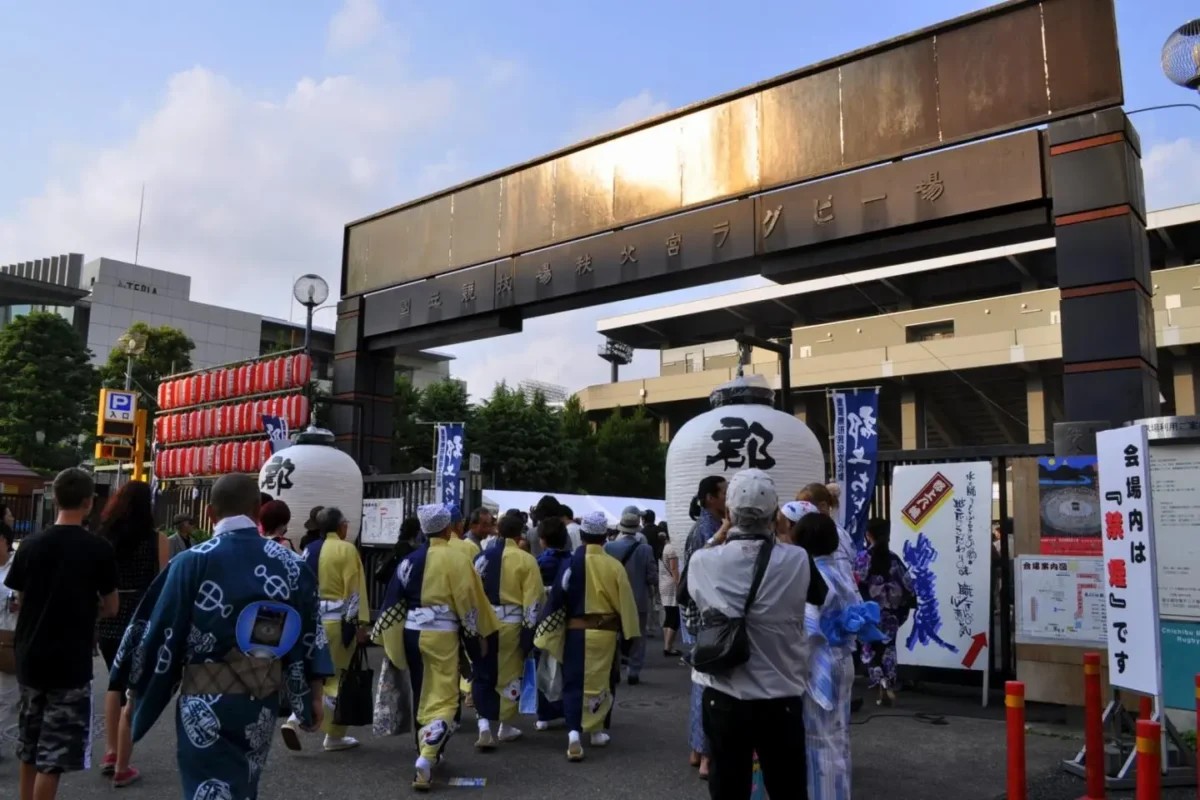
What it is: A steady, pounding drum keeps time as a traditional singer croons into the microphone. Every other beat or so, a collective clap sounds out or the clacks of wooden geta sandals against the concrete. There are audience members sitting, listening and enjoying the sights and sounds, but the main event is the group dancing. This is Gujo Odori in Aoyama, a Tokyo outpost of Japan’s longest bon odori festival.
Origin: The festival originated in Gujo-Hachiman, Gifu prefecture, and the musicians at this event were invited from there. Gujo Odori has a history of over 400 years and is designated a National Important Intangible Folk Cultural Property. It is counted as one of Japan’s three great bon odori dances alongside Awa Odori and Nishimonai Bon Odori.
Tokyo version: Held in the parking lot of the Chichibunomiya Rugby Stadium in Kita-Aoyama, Minato-ku. The event brings the castle town dance tradition to central Tokyo, allowing anyone to participate without traveling to Gifu.
Enjoy Your Event Stress-Free with Japan Travelo
Do you know? Planning events, festivals, concerts, and cultural experiences in Japan can be overwhelming. Japan Travelo brings everything together in one place, helping you manage your itinerary, transport, and accommodation with ease—so you can enjoy Japan without the stress of planning.
Participation ethos: Some odori festivals occur in a parade-type fashion, with dancers proceeding down the street for onlookers to delight in. A great thing about this event is that anyone can participate. Gujo Odori is not a dance that you enjoy watching, but you also enjoy dancing.
Cultural Significance & Origins
Feudal lord story: Gujo Odori dates from the Edo Period when feudal lord Endo Yoshitaka supposedly encouraged dances to bring his subjects together across different classes. The oldest known historical account dates origin to late 16th century around 1590, when inhabitants of Hachiman performed dances to honour deities to thank them for victory in war or good harvest. In 1991 the festival celebrated its 400th anniversary.
Aoyama connection: Experience the charm of Gujo Hachiman’s iconic summer dance right in middle of Tokyo at the Gujo Odori in Aoyama — a special event with deep historical ties to the neighborhood. Aoyama owes its name to Tadanari Aoyama, a retainer of Tokugawa Ieyasu. The Aoyama clan later governed the Gujo domain in Gifu, and their family temple, Baiso-in, remains in Aoyama to this day — hence the cultural connection that inspired this unique festival. From the edge of the family temple of the Gujo Hachiman Lord and Aoyama house, it started from inviting the Gujo Odori Preservation Association to Tokyo Aoyama.
Ten dances: Gujo Odori consists of 10 different dances and corresponding songs, preserved by the Gujo Odori Preservation Association. Various floats transport live singers, accompanied by musicians playing traditional instruments like shamisen and taiko drum. Ten dances are featured, Kawasaki being the most popular along with its older version.
Community dance: Historically castle town dances where all classes danced together in a large circle around a small float with singers. This welcoming attitude continues today, even first-timers are encouraged to join by following simple repetitive movements.
Traditions, Rituals & Customs
Circle dance: Dancers form a large circle around a yagura tower or central stage where singers and musicians sit. They dance collectively yet individually, moving counterclockwise. Hundreds of people dancing in a large circle can be quite a sight, but you are all the more encouraged to join in.
Clap and geta: Tradition includes collective clap sounds and clacks of wooden geta sandals against concrete keeping rhythm with drum. Singers croon into microphone with powerful folk voices, accompanied by shamisen and taiko.
Repeated sequences: Each dance lasts anywhere from five to ten minutes. Most people seem to know moves, but for beginners each dance is a repeated sequence of only a few moves so it’s easy to learn right away. Because choreography is easy, you can participate in dance ring even if you just watch.
Workshop: Before you start dancing, scheduled from around 4:00 pm in previous editions, organizers provide simple workshop where instructors teach basic steps of Kawasaki and other dances.
Yukata tradition: It was wonderful to see so many people dress in seemingly endless designs of yukata — light summer kimonos — and geta, both sold at this particular event, but there was no dress code to participate. Go out in yukata and get ahead of summer.
What to Expect at the Festival
Dancing not watching: The main event is group dancing in parking lot of Chichibunomiya Rugby Stadium. Audience members sitting around perimeter listen and enjoy sights and sounds, but center is filled with dancers during period.
Sound: Steady pounding drum, shamisen, traditional singer, collective claps, geta clacks create hypnotic rhythm. Songs tell stories of history, agriculture, seasons, and local legends.
Market: Alongside dancing, don’t miss local product market offering specialties from Gujo, including Meiho ham, regional sake, and fresh vegetables. Both days from afternoon until end of dancing, stalls sell Gujo specialties.
Welcoming crowd: Gujo Odori lovers gather from various places, venue filled with dancers. Women and men, young and old, all come together. No experience necessary, no dress code.
Date & Schedule
Event timing: Early Jul – Early September 2027 (Dates TBD)
Clarification on range: The user phrase Early Jul – Early September 2027 (Dates TBD) refers to the broader Gujo Odori season in Gujo-Hachiman itself, which runs over 30 nights from mid-July to early September, with the height Obon period in mid-August including all-night dances from 8 p.m. until wee hours of morning. The Tokyo Aoyama outpost is a concentrated two-day weekend event within that season.
Tokyo Aoyama pattern based on previous editions:
2025 edition: June 20 to 21, 2025, at Chichibunomiya Rugby Stadium Parking Lot, 5:00 PM to 8:00 PM each day, local product market from 3:00 PM until end of dancing. 26th edition.
2026 edition: June 20 to 21, 2026, Friday 5:00 PM to 8:00 PM, Saturday 5:00 PM to 8:00 PM, plus local market.
Typical Aoyama schedule:
3:00 PM: Local product market opens, selling Meiho ham, sake, vegetables, yukata and geta.
4:00 PM: Simple dance workshop for beginners, teaching Kawasaki steps.
5:00 PM to 8:00 PM: Main Gujo Odori dancing with live singers and musicians from Gujo, 10 dances in rotation, each 5 to 10 minutes.
8:00 PM: End of dancing, market closes.
Note: No coin lockers or baggage services at venue, manage personal belongings. Shelves available. Light rain does not cancel, severe weather may.
Visiting this event? Don’t miss out on these amazing activities and local experiences while you’re here.
Main Events & Programme
Live music on float: Singers and musicians from Gujo Odori Preservation Association sit on small float or yagura tower, singing traditional songs and playing shamisen, taiko, shakuhachi. Ten dances performed in rotation.
Ten representative dances: Include Kawasaki, Harukoma, Mikoshi, and others, each with different rhythm and story. Kawasaki is most famous, lively and easy to learn. Others include agricultural themes and historical narratives.
Dance circle: Hundreds of dancers form large circle around musicians, moving counterclockwise. Anyone can join circle at any time. Children, elderly, tourists all dance together.
Local product market: Specialties from Gujo including Meiho ham famous cured ham, regional sake from Gujo breweries, fresh mountain vegetables, ayu sweetfish products, and crafts. Sales from 3:00 PM until end.
Workshop: Before dancing starts, simple workshop teaching basic moves, allowing first-timers to learn quickly.
Traditional Dress, Arts & Crafts
Yukata and geta: Light summer kimonos in endless designs and wooden geta sandals are traditional attire. Both sold at event, with prices from 25 USD to 60 USD for yukata, 15 USD to 30 USD for geta based on previous editions. No dress code required, but wearing yukata enhances experience and keeps you cool.
Gujo crafts: Market offers Gujo local crafts including indigo dyed textiles, woodwork from surrounding mountains, and washi paper products.
Dance as intangible art: Gujo Odori itself is a National Important Intangible Folk Cultural Property. The songs and dances are preserved by association, with lyrics in old Japanese dialects and movements passed down generations.
Food crafts: Meiho ham is specialty of Meiho area of Gujo, made with traditional curing methods. Gujo sake uses mountain water and rice.
Traditional Food & Local Specialties
Gujo specialties at market:
Meiho ham: Cured ham from Gujo highlands, sold as sliced packs and ham sandwiches, 5 USD to 10 USD.
Regional sake: Gujo has several sake breweries using pure mountain water, tasting cups 3 USD to 6 USD, bottles 15 USD to 30 USD.
Fresh vegetables: Mountain vegetables, tomatoes, and Hida region produce sold fresh, 3 USD to 7 USD per bag.
Ayusweets: Ayu sweetfish grilled with salt, local river fish specialty, 5 USD to 8 USD.
Festival foods: Standard Japanese matsuri foods like yakisoba, takoyaki, kakigori available from nearby stalls, 3 USD to 6 USD each.
No large food court: Focus is on Gujo product market rather than extensive food stalls, so eat before or after at Aoyama restaurants.
Location & Festival Areas
Venue: Chichibunomiya Rugby Stadium Parking Lot, address 2-8-35 Kita-Aoyama, Minato-ku, Tokyo. Parking lot is transformed into dance circle with yagura tower in center and market stalls on edges.
Area layout:
Dance circle: Central large circle area on asphalt parking lot, about 50 meters diameter, where dancers gather.
Yagura stage: Small raised stage for singers and musicians in center or side.
Market zone: Edge of parking lot with tents selling Meiho ham, sake, vegetables, yukata, geta.
Audience seating: Perimeter area with benches and standing space for watchers.
Historical neighborhood: Kita-Aoyama is fashionable area near Gaienmae, with Baiso-in temple, family temple of Aoyama clan, nearby.
Getting to the Festival
By train: 5 minute walk from Gaiemmae Station Tokyo Metro Ginza Line. Also 10 minute walk from Aoyama-itchome Station Ginza Line, Hanzomon Line, Oedo Line. 15 minute walk from Omotesando Station.
From central Tokyo: From Shibuya, take Ginza Line to Gaiemmae, 5 minutes. From Shinjuku, take Ginza Line direct or Oedo Line to Aoyama-itchome.
On foot: From Harajuku and Jingumae, walk east through Aoyama-dori boulevard about 15 minutes to stadium.
Access note: Chichibunomiya Rugby Stadium is in Meiji Jingu Gaien area, near Jingu Stadium and National Stadium.
Where to Stay Nearby
Aoyama and Omotesando: Boutique hotels and luxury hotels in Aoyama, Omotesando, and Harajuku range from 120 USD to 300 USD per night based on previous pricing.
Shibuya and Shinjuku: Business hotels from 70 USD to 150 USD per night, 10 to 15 minutes by train to Gaiemmae.
Gaienmae and Akasaka: Hotels near Gaienmae Station and Akasaka, rates 80 USD to 180 USD per night, walking distance to venue.
Budget: Hostels in Shibuya and Shinjuku dorm beds 25 USD to 45 USD per night.
Booking tip: Gujo Odori in Aoyama is free and does not cause hotel shortage, but summer is peak travel. Book at least few weeks in advance.
What Visitors Can Participate In
Join dance circle: The great thing about this event is anyone can participate. No registration needed, just step into outer circle and follow others. Each dance repeated sequence of only few moves, easy to learn right away.
Workshop: Join simple workshop before dancing starts around 4:00 PM where instructors teach basic steps slowly.
Wear yukata: Buy or rent yukata and geta at market and wear during dancing, experiencing traditional summer attire.
Buy local products: Purchase Meiho ham, sake, vegetables as souvenirs directly from Gujo producers.
Photography: Photos allowed, but avoid blocking dance circle. Video of dancing encouraged.
Things to Do Before or After the Festival
Meiji Jingu Gaien: Large park area with ginkgo tree avenue, Jingu Stadium, and art museums, adjacent to rugby stadium. Famous for autumn ginkgo illumination and summer beer gardens.
Baiso-in Temple: Family temple of Aoyama clan in Minato-ku, origin of Aoyama place name, small historic temple near venue.
Aoyama shopping: High-end fashion boutiques, cafes, and galleries along Aoyama-dori, perfect for afternoon before dancing starts.
Harajuku and Omotesando: Fashion and street culture 10 minutes walk west.
National Stadium and Olympic Museum: New National Stadium and Japan Olympic Museum nearby in Shinjuku area.
Local Food & Restaurants
Around Gaiemmae: Aoyama area offers many cafes, Italian, French, and Japanese restaurants, lunch sets 12 USD to 25 USD, dinner 20 USD to 40 USD.
Gaien area: Beer gardens in summer at Meiji Kinenkan and other buildings, with views of stadium.
Market foods: At venue, Meiho ham sandwiches and sake tasting serve as light snacks, but not full meal.
After dancing: Many dancers go to nearby izakaya in Aoyama and Gaienmae for post-dance drinks, with Gujo sake sometimes available.
Ticket Information & Access
Admission: Free, 0 JPY, approximately 0 USD, based on previous editions. No ticket required for dancing or market. Open to all ages.
Seating: Free standing and sitting around dance circle. No reserved seats. Bring towel or small sheet if you want to sit on asphalt.
Baggage: While shelves available at venue, there are no coin lockers or baggage services. Manage personal belongings carefully, especially when dancing.
Weather: Light rain will not cancel event, but severe weather may cause rescheduling. Check organizer’s calendar gujohachiman.com for updates.
Cost reference: Yukata sold at event 25 USD to 60 USD, geta 15 USD to 30 USD, Meiho ham 5 USD to 10 USD, sake bottles 15 USD to 30 USD, food stalls 3 USD to 6 USD.
Official Event Information
Event name: Gujo Odori in Aoyama 2027 – Tokyo, Japan, also called Aoyama Gujo Odori, Gujo Odori Festival in Aoyama, 26th edition previously
Venue: Chichibunomiya Rugby Stadium Parking Lot, 2-8-35 Kita-Aoyama, Minato-ku, Tokyo
Organizer: Gujo Odori Preservation Association, Gujo-Hachiman Tourism Association, Minato City Tourism Association, Aoyama area community, with support from Baiso-in temple connection
Access: 5-minute walk from Gaiemmae Station Tokyo Metro Ginza Line, 10-minute walk from Aoyama-itchome Station
Official website text: en.japantravel.com/tokyo/gujo-odori-festival-aoyama-tokyo/5389 and gujohachiman.com and visit-minato-city.tokyo event page for Gujo Odori in Aoyama
Admission: Free
Historical note: Aoyama owes its name to Tadanari Aoyama, retainer of Tokugawa Ieyasu, clan later governed Gujo domain, family temple Baiso-in remains in Aoyama
Video
Location
FAQ
What is Gujo Odori and how is Aoyama version different from Gujo-Hachiman main festival?
Gujo Odori is one of Japan's three major bon odori dances with over 400 years history, consisting of 10 different dances and songs preserved by Gujo Odori Preservation Association. The main festival in Gujo-Hachiman town runs over 30 nights from mid-July to early September, with all-night dances in mid-August. The Aoyama version is a special two-day outpost held in parking lot of Chichibunomiya Rugby Stadium, bringing live singers and musicians from Gifu to Tokyo so anyone can participate without traveling to Gifu.
Do I need to know the dances or wear yukata to join Gujo Odori in Aoyama?
No, you do not need to know dances or wear special clothes, as anyone can participate and there is no dress code. Each dance lasts five to ten minutes and is a repeated sequence of only a few moves, so it's easy to learn right away by following others in large circle. A simple workshop is also provided before dancing starts around 4:00 PM, teaching basic steps of popular dance Kawasaki.
How many dances are there in Gujo Odori and which is most popular?
There are 10 representative types of dance, each with corresponding traditional song played by shamisen and taiko drum. The most popular is Kawasaki, a lively dance that most people know, along with its older version. Other dances include Harukoma, Mikoshi, and dances themed around history and agriculture, all performed in rotation during evening.
What is the historical connection between Aoyama and Gujo?
Aoyama owes its name to Tadanari Aoyama, a retainer of Tokugawa Ieyasu who lived in this area of Tokyo, and the Aoyama clan later governed the Gujo domain in Gifu prefecture. Their family temple Baiso-in remains in Aoyama to this day, creating cultural connection that inspired inviting Gujo Odori Preservation Association to perform in Tokyo Aoyama. The festival started from this historical link between family temple and Gujo domain.
Is Gujo Odori in Aoyama free and what should I bring?
Yes, admission is free based on previous editions, with no ticket required for dancing or local product market. You should bring comfortable shoes or geta if you plan to dance on concrete, as clacks of geta are part of rhythm, and manage personal belongings carefully as there are no coin lockers. Shelves are available at venue, but large bags should be left at hotel, and you may want to buy yukata at event for full experience.

Leave a Reply