
Overview
Mibu no Hana Taue is a traditional rice-planting ritual performed in Northern Hiroshima. It was awarded UNESCO Intangible Cultural Heritage status in 2011. This unique celebration blesses the year ahead for a bountiful harvest; this further pertains to relationships and other avenues of life. It’s a truly historical Japanese experience where one can feel the age of tradition surrounding them.
Held across many rice fields in Mibu, Hiroshima, at the dedicated Mibu flower rice planting venue, Mibu no Hana Taue is regarded as the largest and most spectacular surviving hanadaue ritual in western Japan. Every year, the rolling green hills north of Hiroshima city host this visually striking festival that is simultaneously a religious ceremony, a community gathering, an agricultural event, and a work of performance art.
The ritual is so beautiful, alive with music, color, and tradition, that UNESCO added it to its Representative List of the Intangible Cultural Heritage of Humanity. It has also been designated as an Important Intangible Folk Cultural Property of Japan since 1976. The festival draws thousands of visitors who come to witness close to 100 participants, including more than 10 decorated cows and 80 saotome rice planting girls, accompanied by music and chanting.
Enjoy Your Event Stress-Free with Japan Travelo
Do you know? Planning events, festivals, concerts, and cultural experiences in Japan can be overwhelming. Japan Travelo brings everything together in one place, helping you manage your itinerary, transport, and accommodation with ease—so you can enjoy Japan without the stress of planning.
The ceremony is preserved by the Mibu community of Kitahiroshima Town, with dedicated groups including the Mibu no Hana Taue Hozonkai preservation society, two dengaku music troupes, and the Kazari-ushi Decorated Cattle Preservation Society maintaining the herd year-round specifically to keep this important aspect of the ritual alive.
Cultural Significance & Origins
Mibu no Hana Taue traces its origins to around 1400, with roots in the broader hayashida or tabayashi tradition of musically-accompanied communal rice planting that dates to at least the Heian period. By the Kamakura period, it had become customary in western Japan for a Saotome to sing a rice planting song while accompanied by large drum, small drum, flute, and hand-made kane, in accordance with the time signature of Sasara.
The ritual is a farming ceremony to worship Sanbai, also known as Ta-no-Kami, the rice paddy deity. Japanese belief holds that Tanokami arrives at rice-planting season and resides in the grain itself. Rites connected with rice cultivation are intended to please the deity and imbue the rice with life force. Hana Taue originated as both a prayer for a good harvest and work safety, and as a practical device to make the hard labor of rice planting more bearable through song and communal rhythm.
Historically, the festival served as far more than agriculture. It was held to offer prayers for a good harvest and work safety, creating a meeting place between men and women, and even to introduce new family members such as brides and bridegrooms. Large local landowners would summon many participants to mark the end of planting on their fields, making it a community celebration as much as a spiritual one. The gorgeous appearance of cows fitted with flower saddles and Saotome dressed with red sashes and waistbands created a day of hare, or sacred festivity, which gave the event the name Hanada Ue, meaning flower rice planting.
Kitahiroshima is also one of Japan’s leading rice-growing regions, cultivating some twenty varieties and earning top national rankings for rice quality, making it a fitting home for the country’s most celebrated rice-planting ceremony.
Traditions, Rituals & Customs
The Mibu no Hana Taue is defined by a clear ritual structure where each stage is connected to the next by music that never entirely stops.
Worship of Sanbai: At the center of the planting is the Sanbai, the conductor of the ceremony, named for the rice deity itself. Sanbai is the local Geihoku term for Ta-no-Kami. Standing in front of singers and planters, Sanbai embodies the deity and takes charge of the ceremony. He holds sasara, a percussion instrument made from soot-blackened split bamboo carved with yin-yang markings, rubbing the pieces together to mark rhythm.
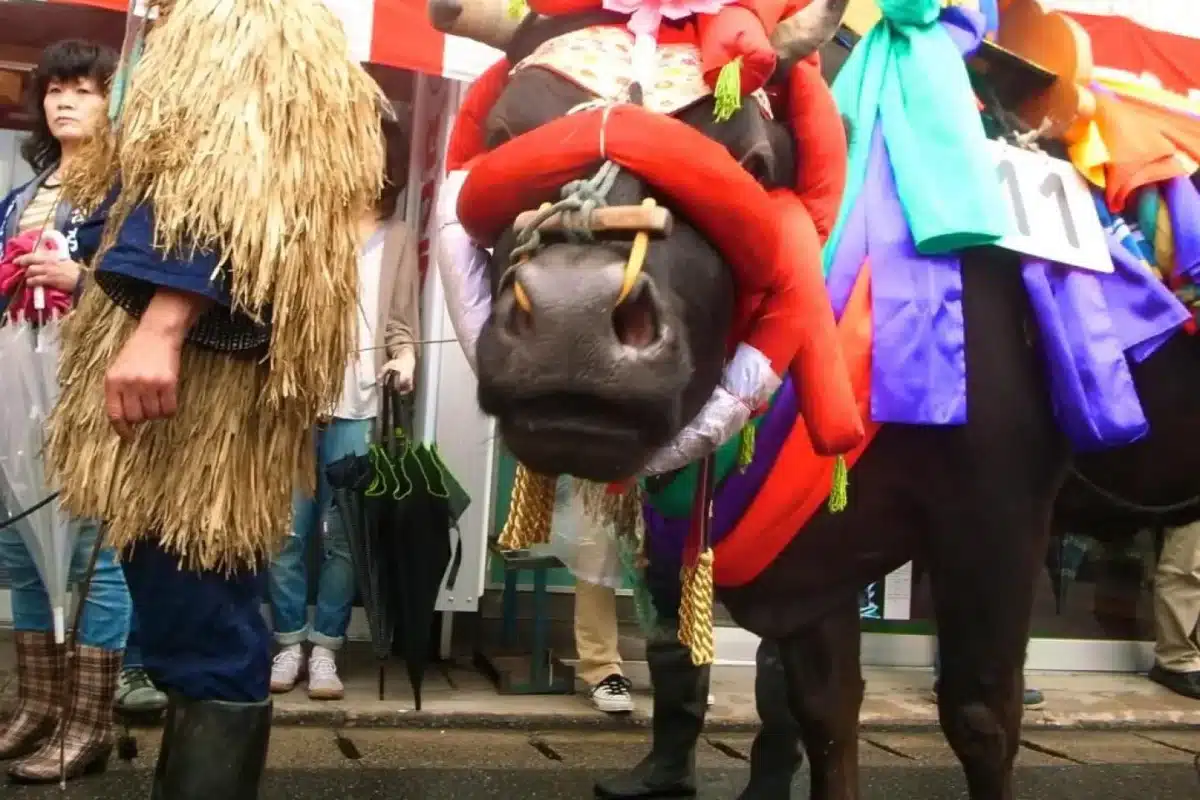
Kazari-ushi Decoration: The stars of the show are the decorated cattle. Only black-coated cattle specifically trained to tolerate music, crowds, and mud are chosen. Each animal is fitted with a magnificent hanagura, a flower saddle wrought in gold brocade and adorned with elaborate artificial flowers, with shapes of helmets and dragons worked into the design. Around their necks they wear kubidama, soft red fabric bags stuffed with cotton that swing and jingle. The lead animal, called omouji or chief bull, carries special honor.
Shirokaki Plowing: Fitted with a mangwa harrow, the cattle enter the flooded field in single file and till the paddy mud, scraping and leveling it to prepare for planting. This ceremonial reenactment using oxen is called Shirokaki.
Eburizuki Leveling: After the oxen, the Eburi implement is used to level the field. The rice deity is said to descend into the eburi at this moment, making this a deeply sacred act.
Taue Planting: Clad in traditional costumes, young unmarried women called saotome line up in a row and rhythmically plant rice seedlings one by one, in time with the song they sing to welcome Tanokami. Planting in time with the song’s rhythm supposedly makes the back-breaking work less burdensome. The song’s verses run into the hundreds, and no two verses are repeated during long days of planting.
Eburi Closing Rite: At the field’s water inlet, the eburi is stood upside down and stuck into the paddy, and three bundles of seedlings are placed on it. The rice deity is said to remain or to return to the heavens by climbing it, an act of gratitude for successful completion.
What to Expect at the Festival
Expect an immersive, day-long performance that unfolds across shrine grounds, shopping street, and sacred paddy.
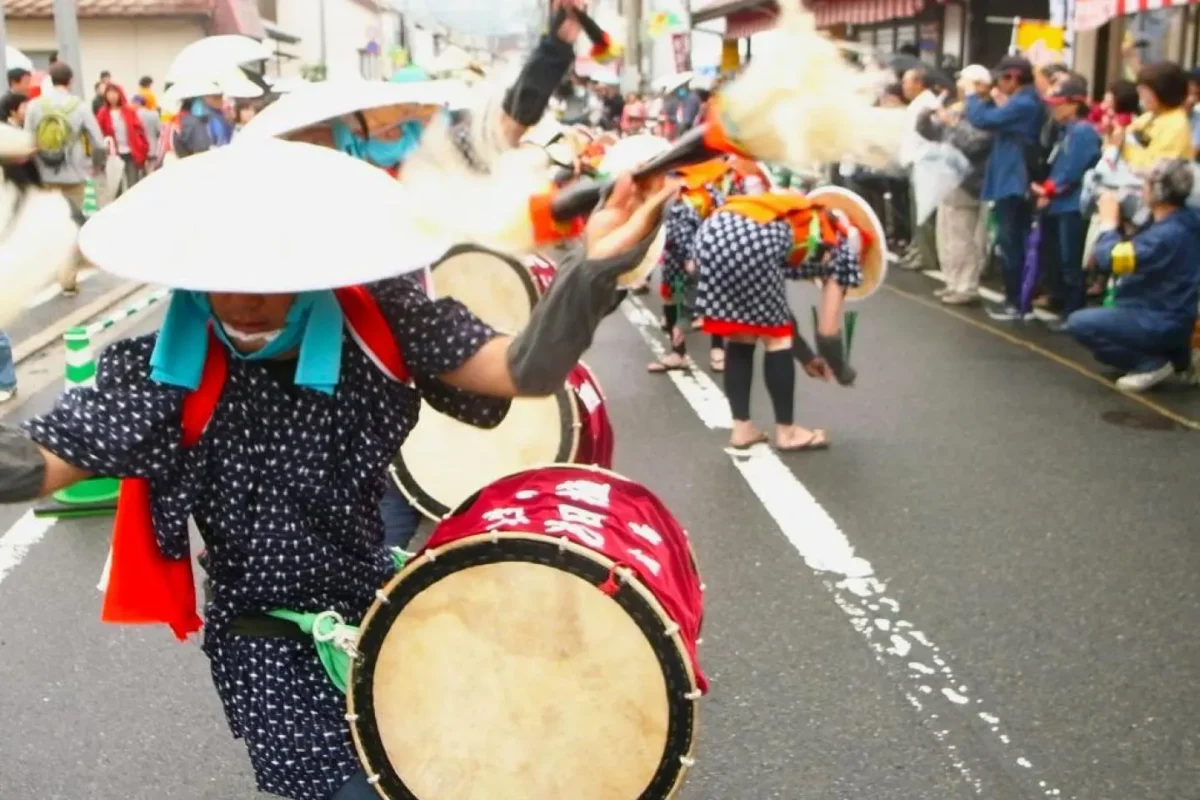
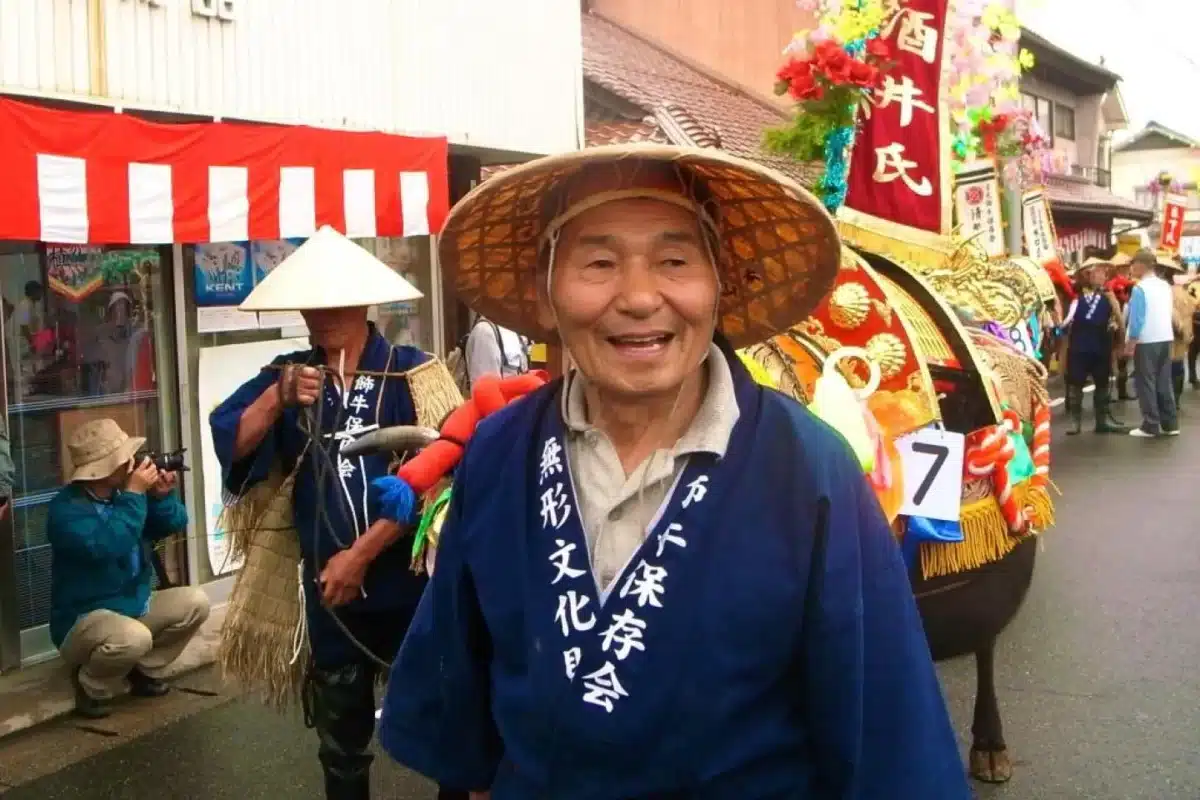
You will first see the Kazari-ushi being transformed at Mibu Hachiman Shrine, where horns are polished and gold saddles fitted. Then the Michiyuki grand procession of ten or more flower-crowned cattle winding through the local shopping street begins, drawing crowds to the roadside before planting commences. Decorated cattle, saotome maidens, the Sanbai conductor, and musicians from both dengaku orchestras parade together.
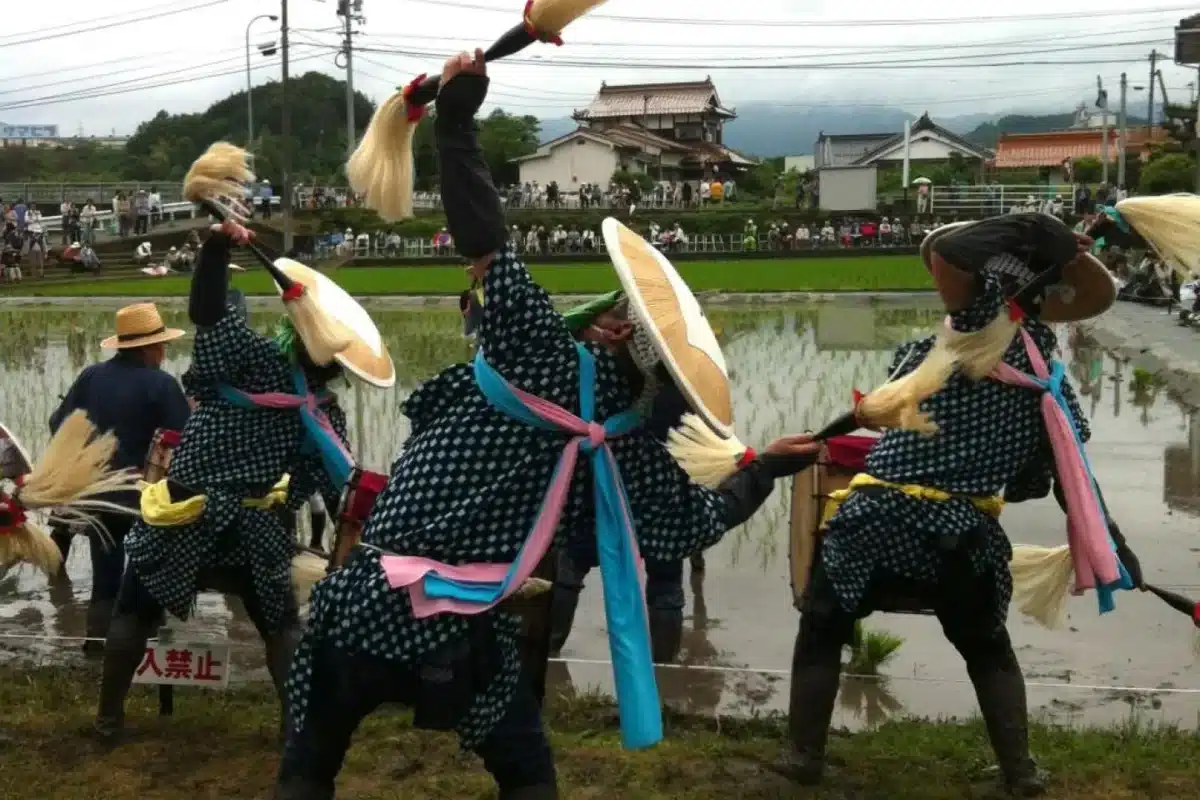
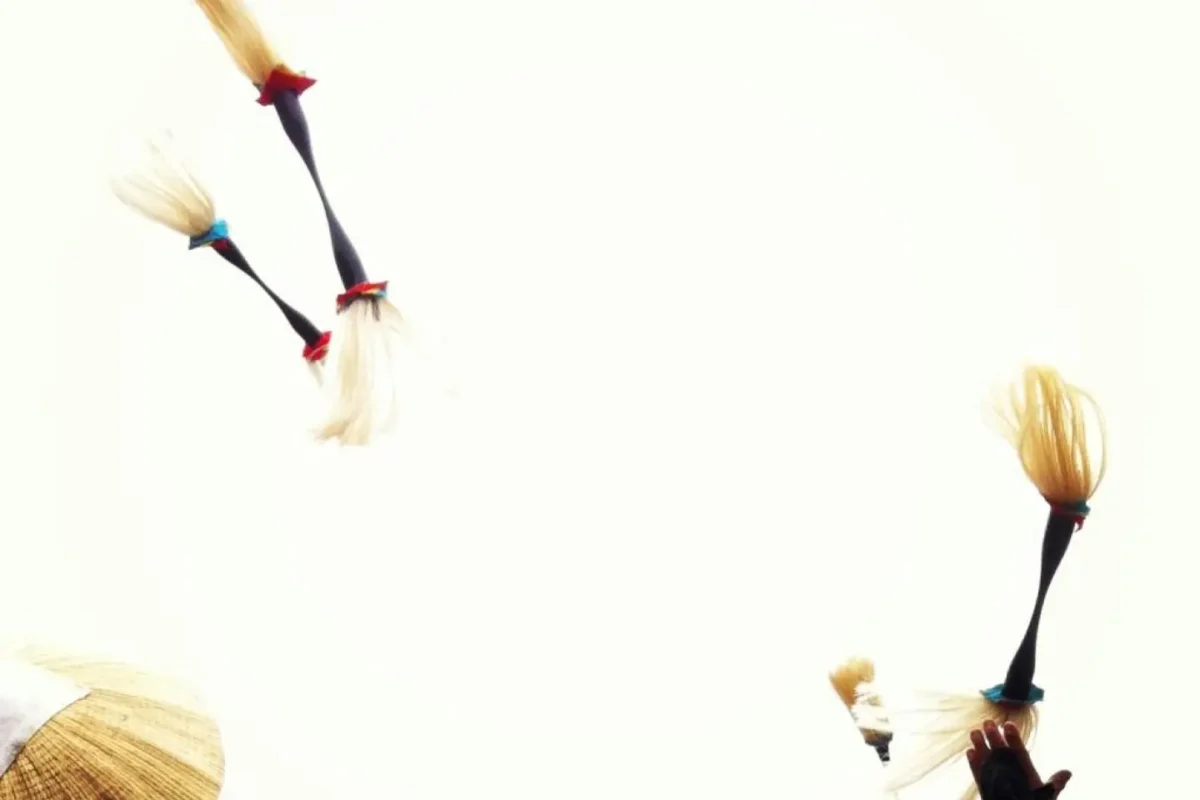
At the ritual field, you will witness the full musical ensemble with large drum odaiko, small drum kodaiko, flute fue, and hand-struck bell teuchigane playing throughout. The tradition is carried by two community traditional music groups, the Kawatoda Dengaku-dan and the Mibu Dengaku-dan. The sound is accompanied by the visual impression of rhythmic movements of musicians and tossing of carefully choreographed drumsticks while saotome bob up and down.
The festival atmosphere enlivens a usually quiet farming area. An announcer explains the meaning of each part in Japanese as it unfolds. Local stalls offer food and crafts, and the closing eburi rite provides a quiet, moving finale that many visitors miss if they leave early. You will be filled with deep gratitude, reflecting on how Japan’s rice culture has been preserved thanks to generations who encouraged one another through demanding labor.
Date & Schedule
Event Dates: Early June 2027 (Dates TBD)
Official Schedule Note: This festival is held across many rice fields in Mibu, Hiroshima. Traditionally, Mibu no Hana Taue is held every year on the first Sunday of June in Kitahiroshima, Hiroshima, in hopes of a good harvest. For 2027, the official dates are listed as Early June 2027 and are not yet confirmed. Please check the official event site for the latest info.
Historical Frequency: The festival is held annually on the first Sunday of June every year, starting from Shinto Rituals at Mibu-jinja. In recent editions, the event attracted 6,000 people, according to a nonprofit group to preserve the ritual.
Typical Daily Flow:
- Morning: Kazari-ushi cattle decoration at Mibu Shrine
- Mid-morning: Michiyuki grand procession from shrine through shopping street to ritual field
- Late morning: Shirokaki cattle plow the ritual field
- Midday: Naetori seedling collection and Eburizuki field leveling
- Midday onward: Taue ritual planting with Sanbai leading oya-uta main songs and saotome responding with ko-uta sub songs
- Closing: Final rite with eburi display at water inlet
Kagura Performance: Additional Kagura performances are staged from 09:00 to 11:00 at Koryu Center Murasaki no Sato during festival morning.
Visiting this event? Don’t miss out on these amazing activities and local experiences while you’re here.
Main Events & Programme
The program is preserved by local community groups and follows a sequence that has been performed by the Mibu and Kawahigashi communities as it has been with some gaps since medieval times.
Morning Decoration Ritual: At Mibu Hachiman Shrine grounds, black cattle are brought by truck and transformed for their big day. Horns and coats are polished, gold brocade hanagura saddles are fitted, and kubidama necklaces adjusted.
Michiyuki Procession: The grand parade through town. Thirteen cows adorned with golden saddles, colorful clothes and banners plowed an about 800-square-meter rice paddy in recent editions. A local music troupe of about 70 members participates, creating a moving spectacle.
Shirokaki Plowing: Cattle fitted with mangwa harrow enter the flooded field in single file and till the paddy mud. Once done, the field is handed over to humans. This is the ceremonial reenactment of preparation.
Naetori and Eburizuki: Saotome collect seedlings while specialists level the field with eburi. This marks the moment the rice deity is believed to descend.
Taue Main Planting: Saotome line up facing Sanbai conductor and plant seedlings walking backward along a guide rope. Sanbai leads oya-uta on sasara rattles; maidens respond with ko-uta. Male musicians play hayashi accompaniment behind them. In service to the tanokami, young women plant rice seedlings to a music rhythm at the ritual.
International Exchange Performance: In recent years, groups from abroad, such as a group from Jeonbuk State in southwestern South Korea, have joined to perform traditional songs and dances before the ritual.
Closing Eburi Rite: The eburi is turned upside down at the inlet with three bundles of seedlings, symbolizing gratitude and prayer for a bountiful harvest in the fall.
Traditional Dress, Arts & Crafts
The festival is renowned for its gorgeous appearance, which gave it the name Hanada Ue.
Kazari-ushi Attire: Magnificent hanagura flower saddles wrought in gold brocade with elaborate artificial flowers, helmets and dragons worked into design, and kubidama red fabric bags stuffed with cotton that swing and jingle. Only specially trained black-coated cattle are selected.
Saotome Costume: Female rice planters wear sedge hats and kasuri ikat, a form of tie-dye kimono. They wear red sashes and waistbands, straw hats, and traditional work aprons. Clad in traditional costumes, young unmarried women called saotome line up in a row, complete with straw hat.
Sanbai-san Attire: Sanbai embodies the rice deity and wears distinctive ceremonial garb suitable for conducting, holding sasara made from susutake soot-blackened split bamboo.
Dengaku Musicians: Musicians wear matching happi coats and headbands representing their troupe, Kawatoda Dengaku-dan and Mibu Dengaku-dan, with large drums carried on shoulder straps.
Sasara Instrument: The sasara itself is a folk craft, made from bamboo blackened by hearth soot, carved with yin-yang markings, and played by rubbing pieces together.
Textile Arts of Geihoku Region: The broader area is known for traditional weaving and embroidery used in hanagura, with gold and silver threads embroidered in elaborate patterns preserved by the Decorated Cattle Preservation Society.
Traditional Food & Local Specialties
While the festival focuses on rice planting, the food culture of Kitahiroshima reflects its status as a top rice-producing area.
Sacred Rice and Offerings: The rice planted in the reserve field is kept specially in reserve to honor the rice deity. After harvest, it is offered to the deity and sometimes shared as blessed grain. This reflects the belief that rice embodies life force.
Festival Stalls: At the venue, local merchants set up stalls along the shopping street and near the field offering yakitori, oden, and rice-based snacks. You will be able to eat and shop at local stalls, feeling vibrant energy at the venue.
Kitahiroshima Rice Cuisine: The town cultivates some twenty varieties of rice, including premium sake rice. Local restaurants serve kamameshi pot rice, onigiri made with newly harvested rice, and sake brewed from local water.
Geihoku Region Specialties: The mountainous Geihoku area is known for wild vegetable tempura, soba noodles made with local buckwheat, and freshwater fish dishes, often priced from 8 USD to 15 USD for a set meal.
Sake and Amazake: Sake breweries in the area use top-ranked rice, with tasting sets around 6 USD to 12 USD. Amazake sweet fermented rice drink is commonly offered during the ritual as a nod to the rice deity.
Location & Festival Areas
Venue: Mibu flower rice planting venue, 157 Mibu, Kitahiroshima, Yamagata District, Hiroshima 731-1515
This festival is held across many rice fields in Mibu, Hiroshima. The ritual reenactment is performed in a field kept specially in reserve, with activities spread across several connected sites.
Mibu Hachiman Shrine: The starting point where Kazari-ushi decoration occurs. This very old Shinto shrine is described as a Real My Neighbor Totoro world, unknown to many foreign tourists. Hana-Taue starts from Shinto Rituals at Mibu-jinja.
Shopping Street Procession Route: The local shopping street through Mibu district where Michiyuki parade draws crowds to roadside. This is one of the great sights of rural Hiroshima’s festival calendar.
Ritual Paddy Field: The main 800-square-meter flooded paddy where Shirokaki, Eburizuki, and Taue planting occur. A stage and viewing areas are set around it.
Koryu Center Murasaki no Sato: Nearby cultural center where Kagura performances are staged from 09:00 to 11:00.
Chiyoda Michi-no-Eki and Kitahiroshima Town Hall: Designated parking and shuttle hubs for visitors, as there is no parking directly at the shrine or field.
Getting to the Festival
Access requires a combination of highway bus and free shuttle, as there is no parking at the venue itself.
Free Shuttle Bus: Free shuttle bus is available from Kitahiroshima Town Hall and Michi no Eki Mairoado parking area. Festival shuttles run to the venue, generally from 09:00 to 16:00. Park at Chiyoda Michi-no-Eki or Kitahiroshima Town Hall, then take the shuttle to the ritual field.
By Bus from Central Hiroshima: Take the Miyoshi-Shobara-Matsue bound bus from Hiroshima Bus Center platform 9 and alight at Chiyoda IC. Fare approximately 9 USD one way. Festival shuttles then run to venue. By bus from Hiroshima Shinkansen Station, take the Hamada-bound bus and alight at Chiyoda IC, then festival shuttle buses connect.
By Car: Approximately 40 km north of Hiroshima city; exit at Chiyoda IC on the Chugoku Expressway. Park at Chiyoda Michi-no-Eki or Kitahiroshima Town Hall, then take shuttle. The transportation here is convenient, and it is immediately accessible from Kitahiroshima Interchange area.
Visitor Tips: Head to Mibu Shrine early to watch cattle being decorated. Claim a roadside spot for michiyuki procession before crowds build. Wear light, breathable clothing and sun protection as field ceremony takes place under open sky. Rubber-soled shoes you do not mind getting muddy are sensible near paddy edges. There is no parking directly at Mibu Shrine.
Where to Stay Nearby
Kitahiroshima is a rural town, so many visitors stay in Hiroshima city and travel by bus, while others opt for onsen resorts nearby.
Onsen Resort Near Mibu: 550 Mibu, Kitahiroshima-cho, Yamagata-gun is listed as a resort location only 1.0 km from Mibu Shrine, offering onsen baths and traditional rooms. Previous rates range from 90 USD to 180 USD per night for two persons including breakfast.
Minamigata Onsen Hotel: 3659 Minamigata, Kitahiroshima-cho, Yamagata-gun, located 3.0 km from Mibu Shrine, offering mountain views and local cuisine dinners. Rates from 80 USD to 150 USD per night.
Hiroshima City Hotels: For convenience, Hiroshima city center hotels near Hiroshima Bus Center provide easy access to festival buses. Business hotels range from 65 USD to 120 USD, mid-range from 110 USD to 200 USD, and luxury from 200 USD to 350 USD per night.
Michi-no-Eki Lodging: Some visitors use farm stay and guesthouse options around Michi-no-Eki Raimu to Gochi area, with prices from 55 USD to 110 USD per night.
Booking Advice: Since the event attracted 6,000 people recently and up to 15,000 after UNESCO registration, accommodation fills quickly. Book early and consider staying the night before to catch morning decoration at the shrine.
What Visitors Can Participate In
Although the core planting is performed by designated preservation members, visitors have active participatory roles.
Roadside Cheering for Procession: Line the shopping street for Michiyuki parade and cheer the Kazari-ushi and Saotome as they pass. This is considered a vital community support.
Audience for Hayashi Music: Clap and sing along to the call-and-response of oya-uta and ko-uta led by Sanbai. The rhythm is infectious and audience participation is welcomed.
Reserved Front Row Experience: Some local tour operators provide bus ride trips enjoying countryside sceneries and history up through Kitahiroshima’s Mibu neighborhood, where you can eat and shop at local stalls, feel vibrant energy and experience Mibu no Hana Taue performance with reserved seats at front row. These guided experiences include English explanation.
Ema and Omamori: Purchase ema prayer tablets and omamori charms at Mibu Hachiman Shrine and write wishes for harvest and work safety.
Stall Shopping: Buy local crafts, kasuri textiles, and agricultural products at venue stalls, directly supporting preservation groups.
Things to Do Before or After the Festival
Kitahiroshima offers nature, history, and hot springs beyond the ritual.
Sandankyo Gorge: One of Japan’s most beautiful gorges, located in Akiota area nearby, with boat rides and hiking trails through dramatic cliffs and waterfalls.
Kagura Performances: Kitahiroshima is known as a center for Hiroshima Kagura, with regular performances at Koryu Center Murasaki no Sato. Kagura performances are staged from 09:00 to 11:00 at the center for 10 USD.
Michi-no-Eki Mairoado Chiyoda: Roadside station offering local produce market, restaurant serving Geihoku soba, and information center about Mibu no Hana Taue preservation.
Geihoku Ski Area and Highlands: In warmer months, the highlands offer hiking, cycling, and panoramic views of the Chugoku Mountains.
Hiroshima City Extension: Return to Hiroshima city for Peace Memorial Park, Miyajima Island with Itsukushima Shrine, and Hiroshima Castle, all within 1 hour from Chiyoda IC by bus.
Sake Brewery Tours: Visit Kamotsuru and other sake breweries in nearby Saijo area, famous for brewing with top-ranked Hiroshima rice.
Local Food & Restaurants
Dining around Mibu reflects mountain village cuisine and rice culture.
At the Venue: Festival day stalls offer yakitori, oden, yakisoba, and onigiri made with local rice, priced from 3 USD to 7 USD per item. Bring cash as stalls at venue do not always accept cards.
Mibu Area Restaurants: Small family-run eateries serve Geihoku soba, wild vegetable tempura, and kamameshi rice pots. Lunch sets around 8 USD to 14 USD.
Michi-no-Eki Restaurant: Restaurant at Michi-no-Eki Mairoado offers set meals featuring local rice varieties, miso soup with mountain vegetables, and grilled river fish, around 9 USD to 13 USD.
Kitahiroshima Town Hall Area: Casual restaurants and cafes near shuttle hubs offer udon, ramen, and curry rice, with meals from 6 USD to 11 USD.
Hiroshima City Specialties: If returning to city, try Hiroshima-style okonomiyaki layered with noodles, oysters, and Hiroshima sake, with dinner from 10 USD to 20 USD.
Ticket Information & Access
Price of Admission: FREE
Tickets are listed as 0 JPY, which converts to 0 USD. The festival is free to watch. Access to the ritual field is free, with no ticket required. Previous editions have maintained free admission to encourage community participation.
Reserved Seating Tours: While general viewing is free, some guided tours with reserved front-row seats and bus transport from Hiroshima city charge approximately 45 USD to 90 USD per person, including lunch and English guide.
Kagura Performance Ticket: Separate Kagura performances at Koryu Center Murasaki no Sato are ticketed at 10 USD per person based on previous pricing of 1,500 yen.
Shuttle Cost: The shuttle bus from Kitahiroshima Town Hall and Michi no Eki Mairoado parking area is free. Highway bus from Hiroshima Bus Center to Chiyoda IC is approximately 9 USD one way based on previous fare of 1,310 yen.
Access Notes: There is no parking at Mibu Shrine or the ritual field. All visitors must use designated parking at Chiyoda Michi-no-Eki or Kitahiroshima Town Hall and transfer to shuttle. Wear light clothing and rubber-soled shoes.
Official Event Information
Event Name: Mibu no Hana Taue Festival 2027 – Kitahiroshima, Japan
Venue: Mibu flower rice planting venue, 157 Mibu, Kitahiroshima, Yamagata District, Hiroshima 731-1515
Organizer: Mibu no Hana Taue Hozonkai Preservation Society, Kitahiroshima Town, Kawatoda Dengaku-dan and Mibu Dengaku-dan
Official Website for Information: https://en.japantravel.com/hiroshima/mibu-no-hana-taue/5026
Additional Official Site: https://kitahiro.jp/about/mibu_hanadaue.html
Cultural Designation: Designated as an Important Intangible Folk Cultural Property of Japan in 1976, and inscribed in 2011 on the UNESCO Representative List of the Intangible Cultural Heritage of Humanity, Reference 00411, Region Asia and the Pacific.
Contact: Kitahiroshima Town Tourism Association, Chiyoda area. For latest updates, please check official event sites as dates are not yet confirmed.
Video
Location
FAQ
What makes Mibu no Hana Taue different from other rice planting festivals in Japan?
Mibu no Hana Taue is the largest surviving hanadaue ritual in western Japan and the most elaborate, featuring more than 10 decorated cows and 80 saotome planting maidens with full dengaku musical accompaniment. It was designated as an Important Intangible Folk Cultural Property in 1976 and inscribed by UNESCO in 2011 as Intangible Cultural Heritage, recognizing its historical depth and faithful preservation. Unlike smaller shrine-based ceremonies, it includes the full sequence of cattle decoration, grand procession, plowing, leveling, and planting with two distinct music preservation societies performing continuously.
Do I need a ticket or reservation to attend the festival?
General viewing of the Mibu no Hana Taue ritual is completely free and open to the public, with no ticket or reservation required to watch the procession or planting from the roadside and field edges. However, you must use designated parking areas and free shuttle buses, as there is no parking at the shrine or field itself. Some guided experiences offering reserved front-row seats and English interpretation are available through local tour operators for a fee and should be booked in advance due to high demand.
How do I get to the venue from Hiroshima city without a car?
The most reliable method is to take the highway bus from Hiroshima Bus Center platform 9 bound for Miyoshi-Shobara-Matsue or Hamada and alight at Chiyoda IC, then transfer to the free festival shuttle bus to the ritual field. The highway bus fare is modest and shuttle buses run from mid-morning to late afternoon, covering the main ceremony. From Hiroshima Shinkansen Station, similar Hamada-bound buses also stop at Chiyoda IC with shuttle connections, making it accessible even for visitors arriving by bullet train.
Is the festival suitable for families and international visitors?
The festival is very family-friendly, with children often participating in the rice planting dance and local school performances, and the decorated cattle procession is particularly popular with young visitors. International visitors are welcome, though announcements are primarily in Japanese; some guided tours provide English explanation and reserved seating for better viewing. The atmosphere is that of a rural community celebration rather than a formal ceremony, so respectful photography and cheering along the procession route are encouraged.
What happens if it rains and what should I bring?
The ritual is held outdoors in a flooded paddy and generally proceeds even in light rain, as rain is considered auspicious for rice planting, though heavy storms may shorten some segments. You should bring light breathable clothing, sun protection, a hat, water, and rubber-soled shoes that can get muddy near the paddy edges. Cash is essential as food and craft stalls at the venue do not always accept cards, and arriving early to Mibu Shrine to watch cattle decoration and securing a roadside spot for the Michiyuki parade will greatly enhance your experience.

Leave a Reply