
Overview
Kashima, a city in southwest Saga, was known for very little when the prefecture was founded. With no highway or shinkansen line connecting it to the rest of Japan, Kashima had to make itself known if it wanted to attract visitors. In order to do this, the mayor decided that they would hold a sporting event in Kashima that would attract tourists from all around the area, but it would not be on the dry land, but on the mudflats at the edge of the city, and so the Gatalympics was born.
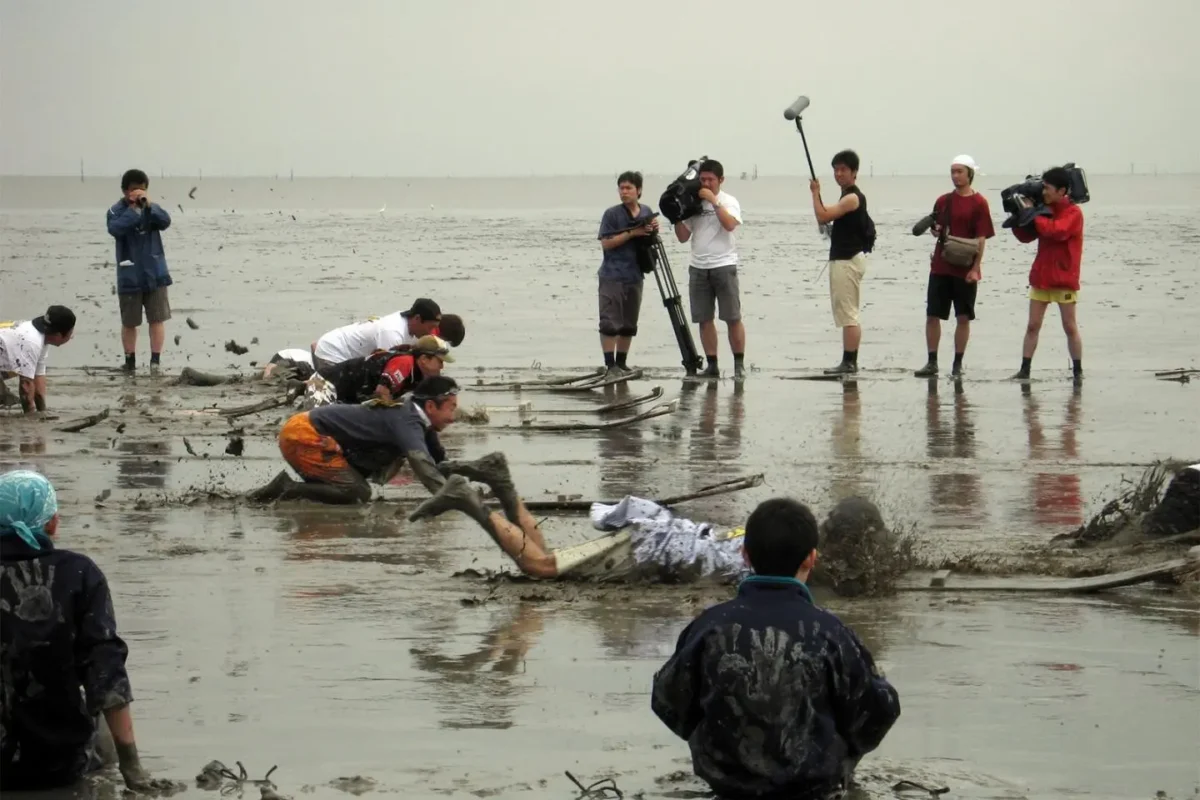
Often called the craziest sporting event in all of Japan, at around the end of May every year tens of thousands of tourists and locals alike make their way down to Kashima in order to compete. Normal sporting events such as the 25m dash or a cycling race are made all the crazier by mountains of mud. Twenty-five meters may seem like a short distance but it’s difficult to manage when you are waist-deep in mud. The cycling race is also complicated by lack of brakes and the ever-looming possibility of being thrown off into the mud.
The Kashima Gatalympics is an event held in the mudflats of the Ariake Sea off Kashima city in Saga Prefecture, Japan. The Ariake Sea has a tidal range of six metres, which on a low tide, exposes the vast mudflats on which the games take place. It has become a well known event throughout Saga Prefecture with around 300 athletes participating each year in its early editions, now growing to as many as 2,000 athletes and twelve events, attracting around 35,000 spectators, more than the whole population of Kashima, plus television audiences nationwide.
Enjoy Your Event Stress-Free with Japan Travelo
Do you know? Planning events, festivals, concerts, and cultural experiences in Japan can be overwhelming. Japan Travelo brings everything together in one place, helping you manage your itinerary, transport, and accommodation with ease—so you can enjoy Japan without the stress of planning.
The spirit of the Gatalympics is all about throwing away inhibitions, having fun, and not worrying about making a fool of yourself. Virtually every contestant ends up plastered in mud from head to toe. Even if they manage to keep faces clean, someone is usually kind enough to smear a bit of mud afterwards. The event is also featured in popular culture, including the anime Zombie Land Saga, bringing wide popularity.
Cultural Significance & Origins
The origins of Kashima Gatalympics lie not in ancient agriculture but in modern civic survival. When the prefecture plan for Saga was published in 1984, it was decided that Kashima City would not have a highway or a Shinkansen connection. Mr. Masahiko Kuwahara, the mayor of Kashima, was also the president of the junior chamber. He created a committee called Forum Kashima to improve the city’s cultural calendar.
As a result, the first Kashima Gatalympic event was held on 3 May 1985. Initially, the name proposed was The big athletic meet on the mudflats. Later, a second name The Gata-olympic big athletic meet on the mudflats was suggested. This was eventually shortened to just Gatalympics. The term Gatalympics comes from the name of mudflats in Japanese, Kashima Higata and the Olympics.
As the Gatalympics became well known, the mudflats that had been previously neglected were improved. As a result, the mudflats became an important and valued symbol for the growth of the city as a whole. What was once seen as wasteland became a stage for community pride. The mudflats themselves are ecologically significant, supporting mudskipper fish known locally as mutsugoro, and the event has helped raise awareness of tidal flat conservation.
The event reflects a distinctly Japanese approach to regional revitalization known as machi okoshi, where humor and self-deprecation are used to draw attention to rural areas. Kashima turned its perceived disadvantage, isolation and vast sticky mud, into its greatest asset.
Traditions, Rituals & Customs
Although not a centuries-old religious festival, the Gatalympics has developed its own beloved customs over four decades.
Opening Ceremony on the Mud: The opening ceremony commences at 10am, with events from 11am to 3pm in traditional scheduling. Participants line up in team uniforms, already aware they will not stay clean. A declaration of fun is made, and safety instructions are given for playing in tidal mud.
Human Mudskipper – Ningen Mutsugoro: One of the signature events is ningen mutsugoro, human mudskipper, a type of fish. Contestants compete on mud sledges, lying flat on boards and paddling through mud with hands, mimicking the local mudskipper fish that hops across the Ariake mudflats.
Mud Sumo – Gata Sumo: Ten women stand on a Styrofoam float, and the last one to remain on the float is the winner. After a few seconds of merciless pushing and shoving, nine women end up in the mud and one emerges victorious. There is also men’s mud sumo, where competitors wrestle while sinking.
Gatachari – Tidal Flat Bike: Contestants ride bicycles on boards laid over mud. To make things more fun, the bikes have no brakes, and plenty of contestants end up coming off the boards and landing in the mud. The cycling race is complicated by lack of brakes and the ever-looming possibility of being thrown off.
Tug of War and Ball Hunt: Other events include tugs of war where teams inevitably collapse into mud, and for kids, a find the balls hidden in the mud game which is absolutely guaranteed to result in an all-over mud bath.
Closing Mud Bath: After events, everyone is invited into the mud for a relaxing dip and to feel the cleansing benefits of the mud. Floating in mud is something everyone should experience at least once. Fire hoses are on hand to help everyone get cleaned up at the end.
What to Expect at the Festival
Expect joyful chaos, full-body mud coverage, and non-stop laughter. The mudflats stretch for hundreds of meters, grey-brown, sticky, and glistening under sun. Races just starting show clean participants, but there is no way they will be this clean by the time they reach the finish line.
Events include the 25 metre dash, not as easy as it sounds as you sink waist-deep into the mud with every stride, and a bicycle race along wooden planks placed on the mud. Other events include tugs of war and races in which surfboards are paddled through the mud. The obstacle course is a highlight; not many contestants make it through without falling in the mud at some point.
You will see girls covered in mud who do not seem to mind being caked, men and women covered in mud making faces, and swimmers who go for a swim afterwards if they did not get muddy enough during competitions. Spectators line the edge of the mudflats, cheering, photographing, and occasionally getting splashed.
For those who do not wish to get dirty, you can go as a spectator and watch all the shenanigans unfold. Even as a spectator, wear clothes you do not mind getting dirty and rubber boots. Food stalls are set up at Roadside Station Kashima offering local delicacies.
Date & Schedule
Event Dates: Late May 2027 (Dates TBD)
Official Scheduling: The Kashima Gatalympics is an event held in the mudflats of the Ariake Sea off Kashima city in Saga Prefecture, Japan. The event takes place every year at the end of May. In previous editions, the event was held on 27 May 2007, 7 June 2009, and 25 May 2014. The 2027 edition is currently listed as Late May 2027 and dates are to be confirmed.
Typical Daily Schedule Based on Previous Editions:
- 10:00 – Opening ceremony at Roadside Station Kashima
- 11:00 – 15:00 – Main competitions on the mudflats including 25m dash, Gatachari bike race, surfboard race, human mudskipper, mud sumo, obstacle course, relay races, tug of war, and children’s ball hunt
- 15:00 – 16:00 – Free mud bath experience for all participants and spectators who wish to join, followed by cleanup with fire hoses
Weather Note: The Gatalympics are not held if the weather is raining heavily due to safety and tidal conditions, and low tide timing determines exact start. Organizers announce final timing a few days in advance.
Participation Deadline: Teams must sign up a few months in advance. It is hard to make substitutions, a boy is only allowed to be substituted with a boy, a girl with a girl. Failure to find a replacement may result in your team being cancelled.
Visiting this event? Don’t miss out on these amazing activities and local experiences while you’re here.
Main Events & Programme
The Gatalympics are a series of fun-filled competitions that take place on the mudflats. Participants compete in unique games where they become covered with mud.
25m Mud Dash: The iconic sprint where waist-deep mud turns 25 meters into an epic struggle. Events include the 25 metre dash not as easy as it sounds as you sink waist-deep into the mud with every stride.
Gatachari Bicycle Race: Bicycle race along wooden planks placed on the mud. Bikes have no brakes, adding to inevitable tumbles.
Surfboard Race – Gata Surfing: Surfboards are paddled through the mud, requiring balance and arm strength. Contestants lie prone and pull themselves forward.
Ningen Mutsugoro – Human Mudskipper Race: Lying on wooden sledges, competitors propel themselves across the flats mimicking the mudskipper fish.
Gata Sumo – Mud Sumo Tournament: Sumo wrestling on unstable foam floats over mud. The last woman remaining on float wins; men’s division similarly ends with all but one in mud.
Obstacle Course: Wooden barriers, nets, and mud pits where falling is expected. Photo courtesy of past events shows few make it through clean.
Relay Races and Tug of War: Team events where coordination fails hilariously in mud.
Children’s Events: Find the balls hidden in the mud game, ensuring all-over mud bath for young competitors.
Free Mud Bath: After competitive events, everyone is invited for a communal mud dip believed to have skin benefits due to mineral-rich Ariake mud.
Traditional Dress, Arts & Crafts
This festival does not feature Heian kimono but has developed its own uniform of mud.
Team Uniforms: Teams wear matching T-shirts, headbands, and shorts, often with humorous slogans. Many design costumes referencing Saga Prefecture, mudskipper fish, or anime characters from Zombie Land Saga which featured the Gatalympics.
Mud as Costume: The true dress code is full mud coverage. By the end, virtually every contestant ends up plastered in mud from head to toe. The Ariake mud is fine-grained, grey, and sticks like clay, creating a natural body paint.
Decorated Sledges and Bikes: For Ningen Mutsugoro and Gatachari, participants decorate sledges and bicycles with colors and banners. The decorated bikes and boards become folk art objects.
Local Craft – Roadside Station: Roadside Station Kashima sells local crafts including ceramics from nearby Arita and Imari, as well as products featuring mutsugoro motifs.
Mud Art: Local children create mud sculptures on the flats during downtime, a spontaneous art form that disappears with the tide, reflecting the impermanent nature of the Ariake Sea’s six metre tidal range.
Traditional Food & Local Specialties
Being a sporting event on mudflats, food is provided at the Roadside Station rather than inside the mud arena.
Saga and Kashima Specialties: Kashima is famous for its sake, thanks to pure water and rice. Yutoku Inari Shrine area sake is renowned. Local specialties include Kashima sencha tea and Ariake Sea delicacies.
Ariake Sea Delicacies: The mudflats produce nori seaweed, mudskippers, and clams. At stalls, you can find nori tempura, grilled mutsugoro fish, and asari clam miso soup, typically priced from 4 USD to 8 USD per serving.
Roadside Station Kashima Food Court: Offers set meals featuring Saga beef, with meals from 9 USD to 15 USD. Local oysters from the Ariake Sea are available for 6 USD to 12 USD per plate.
Festival Street Food: Standard Japanese festival foods like yakitori, yakisoba, and kakigori shaved ice are available for 3 USD to 6 USD each.
Mud-Themed Sweets: Some vendors sell chocolate snacks shaped like mud clumps as novelty souvenirs for 3 USD to 5 USD.
Location & Festival Areas
Venue: Roadside Station Kashima, 4427 Otonari, Kashima, Saga 849-1323, Japan
Geography: The event takes place in a small town called Hama, near Kashima City, on the mudflats of the Ariake Sea off Kashima City in Saga Prefecture. The Ariake Sea has a tidal range of six metres which on low tide exposes the mudflats.
Festival Zones:
- Roadside Station Kashima: Main hub with parking, food court, souvenir shop, toilets, and information center. The opening ceremony is held here.
- Mudflats Arena: The tidal flat itself, about 800 square meters of competition area marked with flags and boards. Spectators view from raised banks and wooden walkways.
- Cleaning Zone: Area with fire hoses and showers where participants wash off after events. Fire hoses are on hand to help everyone get cleaned up at the end.
- Hama District: The small fishing town adjacent to flats, with traditional wooden houses and views of the sea.
Nearby Landmarks: Historic Hizen Hamashuku sake brewing district, Yutoku Inari Shrine one of Japan’s three major Inari shrines, and Oouo Shrine floating torii gate that appears to float at high tide.
Getting to the Festival
Kashima City has no highway or Shinkansen connection, which originally inspired the festival, so planning transport is essential.
By Train: Take JR Nagasaki Main Line to Hizen-Kashima Station or Hizen-Hama Station. From Hizen-Kashima, take local bus or taxi to Roadside Station Kashima, approximately 10 minutes. From Saga Station, driving distance is 29 km, about 30 minutes by car.
By Bus: Highway buses from Saga Station Bus Terminal and Fukuoka to Kashima are available. Local buses connect Hizen-Kashima Station to Roadside Station.
By Car: From Saga city, take Route 207 south. Parking is available at Roadside Station Kashima but fills early; arrive before 9am. Additional parking at Kashima City Hall with shuttle on festival day.
From Saga Airport: Saga Airport has flights from Tokyo Haneda. From airport, take taxi or bus to Saga Station then train to Kashima.
Accessibility Tip: The mudflats themselves are not wheelchair accessible, but viewing banks are accessible and Roadside Station has accessible facilities.
Where to Stay Nearby
Kashima City is small, so many visitors stay in Saga city, Ureshino Onsen, or nearby historic districts.
In Kashima City:
- Guest House Maru Hostel: Located in Kashima, 5-minute drive from Hizenhamashuku and 6 minutes from Yutoku Inari Shrine, 2.8 miles from Kashima Road Station. Hostel with garden and wireless internet. Dorm beds from 25 USD to 40 USD, private rooms from 55 USD to 85 USD per night.
Ryokan Near Shrine:
- Masuya Ryokan: 1688 Koba, Furueda, Kashima, near Oouo Shrine, offering traditional tatami rooms and views of Ariake Sea. Rates from 90 USD to 150 USD per night including breakfast.
Ureshino Onsen Area: 6.7 miles from Hizennkashima Station, famous hot spring town. Bansyoukaku Shikisima and Ureshino Onsen Yuyado Sarayama offer onsen baths. Rates from 120 USD to 250 USD per night for onsen ryokan with dinner.
Saga City Hotels: Saga City Hotel, Comfort Hotel Saga near Saga Station, with rooms from 60 USD to 110 USD per night. Recent reviews highlight great location near Saga Station with bikes for rent.
Fairfield by Marriott Saga Ureshino Onsen: Convenient location next to JR station and bus line, rated 10/10 excellent, rooms from 130 USD to 200 USD per night.
Booking Tip: Festival attracts around 35,000 spectators, more than whole population of Kashima, so book accommodation several months in advance.
What Visitors Can Participate In
Unlike traditional shrine festivals, Kashima Gatalympics is participatory by design.
Compete as Athlete: Sign up as team a few months in advance for events like mud sumo, 25m dash, Gatachari, surfboard race, obstacle course, and ningen mutsugoro. Around 300 to 2,000 athletes participate each year depending on edition. Teams must ensure correct gender substitution rules.
Children’s Mud Ball Hunt: Kids can join find the balls hidden in the mud game, guaranteed all-over mud bath and prize.
Free Mud Bath: After competitive events, everyone is invited into the mud for a relaxing dip. Even if you do not win anything there is a consolation prize, a free mud bath. Floating in mud feels weird, not at all like bathing in water, but for most people it is a really pleasant sensation.
Spectator Cheering: For those who do not wish to get dirty, you can go as a spectator and watch all the shenanigans unfold. Cheer, photograph, and enjoy commentary.
Local Interaction: Talk to local preservation society members about mudflat ecology and mudskipper fish.
Things to Do Before or After the Festival
Kashima area offers rich cultural and natural attractions beyond mud.
Yutoku Inari Shrine: One of Japan’s three most important Inari shrines, with bright red gates cascading down hillside, similar to Kyoto’s Fushimi Inari but less crowded.
Hizen Hamashuku: Historic sake brewing town with preserved Edo-period merchant houses. Tour sake breweries and taste local sake. Guest House Maru is 5-minute drive from here.
Oouo Shrine Floating Torii: A captivating sight at high tide where torii gates appear to float on Ariake Sea, similar to Miyajima but unique to Kashima.
Roadside Station Kashima: Enjoy panoramic views of Ariake Sea, purchase local products, and learn about tidal flat ecosystem at information corner.
Ureshino Onsen: Famous for silky hot spring water good for skin, just north of Kashima. Perfect for washing away any lingering mud and relaxing muscles after competition.
Saga International Balloon Fiesta Area: If extending trip to November, visit Kase River area where famous balloon fiesta attracts 500,000 visitors.
Local Sake and Pottery: Visit Arita and Imari nearby for porcelain, and Takeo for additional onsen.
Local Food & Restaurants
Kashima’s food scene is tied to Ariake Sea and Saga Prefecture’s agricultural bounty.
Near Roadside Station Kashima:
- Small eateries serve Ariake delicacies like grilled mutsugoro, nori tempura, and clam soup. Meals from 8 USD to 14 USD.
- Roadside Station food court offers Saga beef bowls for 10 USD to 16 USD.
Hizen Hamashuku Sake District: Restaurants offer sake tasting sets from 5 USD to 12 USD paired with local tofu and seafood.
Yutoku Inari Shrine Area: Shops sell Inari sushi and kitsune udon, with meals from 6 USD to 10 USD.
Saga City Options: Saga International Guesthouse Hagakure hostel area has dining area and friendly staff. Restaurants near Saga Station offer ramen, Saga beef, and fresh seafood.
Ureshino Specialty: Ureshino is famous for onsen tofu and green tea. Onsen tofu set for 12 USD to 18 USD.
Souvenir Food: Kashima sencha tea boxes from 8 USD to 20 USD, nori seaweed packs from 4 USD to 10 USD, and local sake bottles from 12 USD to 30 USD.
Ticket Information & Access
Price of Admission: FREE for spectators
Tickets are listed as 0 JPY, which converts to 0 USD. Spectator entry to view the Gatalympics from the banks is free. This has been consistent across previous editions.
Participant Entry Fees: Athletes pay team registration fees. Based on previous editions, team registration ranges from 15 USD to 40 USD per team depending on event, covering insurance and cleaning costs. Individual events like mud sumo may charge 5 USD to 10 USD per person.
Shuttle and Parking: Parking at Roadside Station Kashima is free but limited. City Hall parking with shuttle is free. Highway bus from Saga to Kashima costs approximately 12 USD to 20 USD one way.
Equipment: Organizers provide surfboards, sledges, and bicycles for events. Participants should bring change of clothes, towels, and plastic bags for muddy items. No need to take mud home as fire hoses are available for cleanup.
TV Broadcast: For those who do not wish to get dirty, event is usually broadcast on TV every year locally in Saga.
Contact for Exact Date: To find out exact date of next Gatalympics, contact organizers on phone 0954-63-3312 or at gatalym@vip.saganet.ne.jp, or check official website.
Official Event Information
Event Name: Kashima Gatalympics 2027 – Japan
Venue: Roadside Station Kashima, 4427 Otonari, Kashima, Saga 849-1323, Japan – mudflats of Ariake Sea off Kashima city, Hama district
Organizer: Kashima City and Forum Kashima Committee, Kashima Gatalympics Executive Committee
Official Website: https://www.kashimagatalympic.com/
Additional Information Site: https://en.japantravel.com/saga/katashima-gatalympics/5021
History: First held on 3 May 1985 after prefecture plan in 1984 decided Kashima would not have highway or Shinkansen. Created by mayor Masahiko Kuwahara to improve cultural calendar. Term Gatalympics comes from Kashima Higata and Olympics.
Description: Japan’s craziest sporting event held on the mudflats of Kashima. Often called the craziest sporting event in all of Japan, tens of thousands of tourists and locals alike make their way down to Kashima in order to compete.
Video
Location
FAQ
Is the Kashima Gatalympics safe for participants despite all the mud?
Yes, safety is a priority and organizers have decades of experience managing events on the tidal flats, with medical staff and volunteers stationed around the arena. The Ariake mud is soft and fine-grained without sharp rocks, and the tidal range is monitored to ensure competitions occur at low tide when water depth is minimal. While falling is inevitable, injuries are rare beyond minor scrapes, and fire hoses and showers are available immediately after for thorough cleaning.
Can international tourists participate or is it only for locals?
International tourists are warmly welcomed to participate as athletes, with many teams including visitors from abroad and some English guidance available at Roadside Station. Teams must sign up a few months in advance and adhere to substitution rules where a boy can only be substituted with a boy and a girl with a girl to maintain event categories. Even if you miss team registration, you can join the free mud bath after official events or participate in children's activities and spectator games along the banks.
What should I wear and bring if I want to compete?
You should wear clothes you are prepared to throw away or that can withstand heavy mud, such as old T-shirts, shorts, and tight-fitting clothes that will not get pulled off in deep mud. Bring a complete change of clothes, towels, plastic bags for muddy items, sunscreen, and waterproof camera protection, as spectators near the edge also get splashed. Organizers provide all specialized equipment like surfboards, mud sledges, and brakeless bicycles, so you do not need to bring sporting gear.
How muddy do spectators get and is there a clean viewing area?
Spectators on the raised banks generally stay relatively clean, though front-row viewers may receive minor splashes during close races like tug of war and sumo. Roadside Station Kashima has elevated viewing decks and indoor areas where you can watch comfortably without any mud contact, and the event is also broadcast on local television. If you want to stay completely clean, bring a rain poncho and rubber boots and position yourself slightly back from the immediate edge of the competition zone.
What else is there to do in Kashima besides the Gatalympics?
Kashima offers cultural sites that complement the muddy fun, including Yutoku Inari Shrine with its stunning hillside torii gates and Hizen Hamashuku sake brewing district with Edo-period architecture. You can visit Oouo Shrine's floating torii that appears at high tide, enjoy Ariake Sea seafood like nori and mudskipper dishes, and relax in nearby Ureshino Onsen hot springs famous for skin-beautifying waters. Roadside Station Kashima itself is a destination for local crafts and panoramic views of the six-metre tidal range that makes the Gatalympics possible.

Leave a Reply