
-
April 28, 2027
Event date:
-
April 30, 2027
Event end:
What to expect
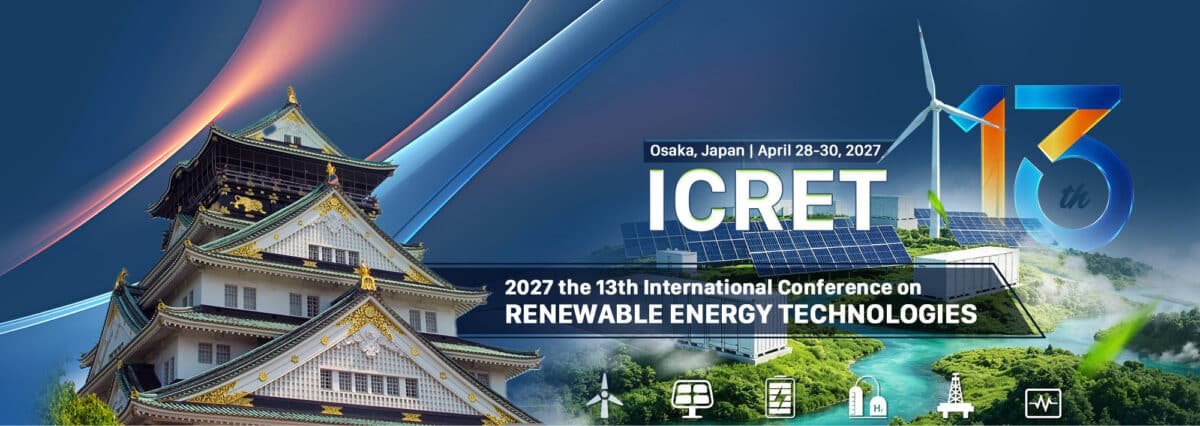
ICRET 2027 – Osaka, Japan, the 13th International Conference on Renewable Energy Technologies, is a premier global forum dedicated to advancing research, innovation, and collaboration in the renewable energy sector. Hosted in the vibrant city of Osaka, this conference brings together leading researchers, engineers, scientists, industry professionals, and policymakers from around the world to exchange ideas in an informal yet highly technical environment.
What to expect is a focused, high-level academic and industrial gathering that emphasizes both fundamental research and applied technologies. The conference is designed to encourage discussion of the latest developments, early-stage work, and even controversial results through workshops, keynote lectures, and parallel technical sessions. Unlike large-scale trade fairs, ICRET is selective and technically deep, ensuring quality interactions and meaningful networking.
Participants will benefit from direct access to cutting-edge research in clean and renewable energy systems, power and energy engineering, smart grids, and energy storage. The event provides an excellent opportunity for publication, as all accepted and presented papers are collected in conference proceedings indexed by Scopus and Ei Compendex. Expect an international atmosphere, rigorous peer review, and opportunities for collaboration that extend beyond the conference halls into Osaka’s dynamic innovation ecosystem.
Enjoy Your Event Stress-Free with Japan Travelo
Do you know? Planning events, festivals, concerts, and cultural experiences in Japan can be overwhelming. Japan Travelo brings everything together in one place, helping you manage your itinerary, transport, and accommodation with ease—so you can enjoy Japan without the stress of planning.
Event dates
Conference Name: 13th International Conference on Renewable Energy Technologies (ICRET 2027)
Official Conference Period: April 28–30, 2027
Conference Venue Location: Osaka Institute of Technology – Umeda Campus, Osaka, Japan
Detailed Schedule:
April 28, 2027 (Wednesday): 10:00 am – 5:00 pm – Test for virtual conference and onsite registration
April 29, 2027 (Thursday): 9:00 am – 6:00 pm – Opening ceremony plus keynote speeches and parallel author sessions
April 30, 2027 (Friday): 9:00 am – 6:00 pm – Parallel author sessions and closing
Important Deadlines:
Submission Deadline: November 1, 2026
Notification Deadline: December 1, 2026
Registration Deadline: December 20, 2026
Camera Ready Submission: March 30, 2027
Listener Registration Deadline: April 23, 2027
All deadlines are based on the official conference timeline published on https://www.icret.org/. Service hours for inquiries are from 10:00 to 18:30 (UTC+08:00) Monday through Friday via icret@young.ac.cn.
Visiting this event? Don’t miss out on these amazing activities and local experiences while you’re here.
Venue & exhibition site
Venue Name: Osaka Institute of Technology — Umeda Campus, OIT Umeda Tower
Official Address: OIT Umeda Tower, 1-45 Chayamachi, Kita-ku, Osaka 530-8568, Japan
Campus Profile: OIT Umeda Campus is located in the heart of Osaka’s commercial and educational district. The tower offers modern conference facilities, high-speed connectivity, lecture halls equipped for hybrid presentations, and panoramic views of the city. The venue is specifically chosen for its accessibility and its integration with Osaka’s innovation corridor.
Exhibition and Presentation Site: While ICRET is primarily an academic conference, the exhibition site includes poster presentation areas, demo corners for prototype systems, and publisher booths in the tower’s conference floors. Presentation rooms are equipped for both onsite and virtual participation, with test sessions provided to ensure smooth delivery for remote attendees.
On-Site Facilities: The tower includes cafeterias, co-working lounges, printing services, and multi-language support desks. The building is fully accessible and located within a short walk of major transport hubs.
Full industry programme
The full industry programme is structured to maximize technical exchange and dissemination of research.
Opening Ceremony and Keynotes: The programme begins with an opening address by conference chairs followed by four distinguished keynote speeches from global leaders in renewable energy technologies. These talks cover strategic trends in clean energy transition and future electricity networks.
Parallel Technical Sessions: Four parallel tracks run throughout the main conference period, each dedicated to specific themes under Clean and Renewable Energy and Power and Energy Engineering. Each session includes oral presentations of full papers, with Q&A and discussion moderated by session chairs.
Workshops and Focused Tracks: Special workshops are organized to discuss early-stage work, controversial results, and emerging topics such as new energy materials, fault monitoring, and predictive maintenance for power systems.
Poster Sessions: Dedicated poster areas allow researchers to present visual summaries of their work and engage in one-to-one discussions.
Closing and Awards: The programme concludes with best presentation awards, closing remarks, and networking reception.
Featured companies & exhibitors
While ICRET is an academic conference rather than a commercial expo, it features participation from a wide range of academic institutions, research laboratories, and technology-focused organizations.
Academic and Research Institutions: Leading universities from Asia, Europe, and North America present their latest research groups in photovoltaics, wind energy, and energy storage. Past editions included representatives from Chongqing Jiaotong University, Osaka Institute of Technology, and other technical universities.
Industry R&D Divisions: R&D teams from energy companies, power system equipment manufacturers, and renewable technology developers participate to share industrial applications and collaborate with academia.
Publishers and Indexing Services: Representatives from proceedings publishers and indexing services provide guidance on publication standards and research visibility.
Technology Demonstrators: Selected exhibitors showcase prototype devices such as photovoltaic test systems, energy storage modules, smart grid simulation platforms, and energy-saving devices.
This mix ensures that participants gain exposure to both theoretical advances and practical industrial challenges.
Industry sectors & technologies
ICRET covers two major topical domains that span the entire renewable energy value chain.
Topic A: Clean and Renewable Energy: This sector includes photovoltaic systems and solar energy engineering, wind energy systems, renewable energy utilizations, new energy applications, energy-saving technology, and new energy materials and devices. It addresses generation, material innovation, and efficient utilization of clean energy.
Topic B: Power and Energy Engineering: This sector focuses on the infrastructure that enables renewable integration. It includes electricity networks of the future, energy storage technologies and devices, power and energy generation, energy transmission and distribution, power systems and automation, and fault monitoring and predictive maintenance.
Together these sectors provide a holistic view of how renewable technologies are developed, integrated, managed, and maintained in modern energy systems.
Products, machinery & innovations
The innovations presented at ICRET are research-driven and future-oriented.
Photovoltaic and Solar Innovations: High-efficiency solar cells, solar tracking systems, BIPV solutions, and solar forecasting tools.
Wind Energy Systems: Advances in turbine design, offshore wind integration, wind resource assessment, and control systems for variable wind conditions.
Energy Storage: Lithium-ion and beyond-lithium battery technologies, hydrogen storage, thermal storage, and hybrid storage systems for grid stabilization.
Power Systems and Automation: Smart inverters, microgrid controllers, energy management systems, fault detection algorithms, and predictive maintenance platforms using AI.
Energy-Saving Technologies: Energy-efficient power conversion, low-loss transmission technologies, and demand-side management solutions.
New Materials and Devices: Perovskite materials, advanced semiconductor devices for power electronics, and nanomaterials for energy applications.
These innovations are presented through peer-reviewed papers, live demos, and technical discussions rather than large machinery displays.
Demonstrations & technical presentations
Demonstrations and technical presentations are at the core of ICRET’s knowledge exchange model.
Oral Presentations: Each accepted full paper is allocated a presentation slot in parallel sessions. Presenters share methodology, results, and implications, followed by moderated Q&A. Presentation formats support both onsite and virtual delivery.
Poster Demonstrations: Poster presenters engage in direct dialogue with attendees, allowing deeper technical discussion and feedback collection.
Virtual Conference Tests: A dedicated test session is provided to ensure all virtual presenters and attendees can connect smoothly, test screen sharing, and verify audio-visual setup.
Technical Panels: Selected sessions include panel discussions where multiple authors address a common challenge such as grid integration of renewables or lifecycle assessment of storage systems.
Best Presentation Awards: Outstanding presentations are recognized based on technical quality, clarity, and audience engagement, encouraging high presentation standards.
All demonstrations emphasize scientific rigor, reproducibility, and potential for real-world impact.
Ticket types & registration
Registration categories are clearly defined to accommodate different participant types.
Author Registration – Student: 500 USD – For students presenting a full paper that will be included in proceedings. This includes presentation slot and publication.
Author Registration – Professional: 550 USD – For non-student authors presenting a full paper with publication.
Presentation Only – Student: 350 USD – For students presenting an abstract without publication in proceedings.
Presentation Only – Professional: 400 USD – For professionals presenting an abstract without publication.
Listener – Student: 200 USD – For students attending without presentation.
Listener – Professional: 250 USD – For professionals attending without presentation.
Additional Paper: 350 USD per extra paper from same author.
Additional Pages: 60 USD per extra page beyond standard length.
Extra Proceedings: 60 USD per additional copy.
All fees are listed in USD as per official policy. Registration includes access to all technical sessions, conference materials, e-proceedings, e-program, and certificate.
Trade visitor & professional access
ICRET is open to both academic and professional participants with a focus on quality engagement.
Professional Access: Open to researchers, engineers, R&D managers, energy consultants, utility professionals, and policymakers. A professional background in renewable energy, power systems, or related fields is expected.
Student Access: Graduate and doctoral students are strongly encouraged to participate as authors or listeners to gain exposure to global research trends and publication opportunities.
Listener Category: Professionals who wish to learn without presenting can register as listeners, gaining full access to all sessions and networking events.
Virtual Access: The conference supports hybrid participation, allowing international attendees to join virtually if travel is not possible. Virtual attendees receive e-materials and certificates via email.
Verification: Registration requires submission of affiliation and research interest to ensure relevance and maintain the technical level of discussions.
Exhibition halls & floor plan
The conference layout within OIT Umeda Tower is designed for efficient navigation.
Main Conference Hall: Located on upper floors of OIT Umeda Tower, hosting opening ceremony and keynote speeches with capacity for several hundred attendees.
Parallel Session Rooms: Multiple lecture rooms equipped with projectors, microphones, and hybrid conferencing systems for simultaneous tracks.
Poster and Demo Area: Located in the foyer area outside main halls, providing high visibility and easy access during breaks.
Registration Desk: Situated at the entrance of the conference floor for badge collection, material pickup, and on-site assistance.
Networking Lounges: Adjacent areas with seating for informal meetings, business discussions, and refreshment breaks.
Publisher and Information Booths: Small booths for proceedings information, future conference announcements, and technical service providers.
A detailed floor plan is shared with registered participants via email along with the e-program before the conference.
Business meetings & networking
Business meetings and networking are integral to ICRET’s value proposition.
Networking Breaks: Scheduled coffee breaks and lunch periods provide informal networking opportunities among authors, session chairs, and keynote speakers.
Technical Discussion Corners: Designated spaces where presenters can continue discussions after their sessions with interested attendees.
Collaboration Matching: The conference secretariat facilitates introductions between researchers with complementary interests, particularly for international collaboration.
Industry-Academia Interaction: Dedicated time for industry participants to discuss practical challenges with academic researchers and explore joint project opportunities.
Social Events: An informal networking reception is typically organized in the Umeda area, leveraging Osaka’s vibrant hospitality scene to foster relationships in a relaxed setting.
Virtual Networking: For remote participants, chat rooms and virtual Q&A tools enable engagement with onsite sessions.
Event rules & visitor information
Code of Conduct: All participants are expected to maintain professional and respectful communication during presentations and discussions. Harassment or disruptive behavior is not tolerated.
Presentation Rules: Authors must present their work as scheduled and adhere to allocated time limits. Full papers must meet the minimum length requirement of 4 to 5 pages.
Publication Policy: Submitted papers are reviewed by the Technical Program Committee and sub-reviewers. Only registered and presented papers are included in proceedings indexed by Scopus and Ei Compendex.
Intellectual Property: Participants must ensure their presentations do not contain confidential information without permission. Recording of presentations without consent is prohibited.
Badge Policy: Participants must wear conference badges at all times within the venue for security and identification.
Contact Policy: The official conference email is icret@young.ac.cn. The secretariat will never request credit card information for hotel bookings via unsolicited emails. Participants should be cautious of phishing attempts.
How to get there
Getting to OIT Umeda Tower is straightforward due to its central location.
By Air – Kansai International Airport: KIX is the main international gateway located approximately 50 km from the venue. Options include the Nankai Airport Express Rapi:t to Namba followed by Midosuji Subway to Umeda, or Airport Limousine Bus directly to Osaka Station.
By Train – Major Hub: Osaka Station and Umeda Station form a major railway hub just a five-minute walk from the venue. JR lines, Hankyu, Hanshin, and subway lines converge here.
By Shinkansen: Travelers from Tokyo, Nagoya, and other cities can arrive at Shin-Osaka Station and then take one stop to Osaka Station, followed by a short walk or taxi.
By Taxi: Taxi from Shin-Osaka to the venue takes approximately 15 minutes. Taxis are readily available and start at around 660 JPY.
Local Navigation: The venue address is easily searchable in map apps as OIT Umeda Tower, 1-45 Chayamachi.
Public transport & parking
Subway System: Osaka Metro is efficient and affordable, with fares ranging from 180 to 370 JPY per ride. The Midosuji Line serves Umeda Station.
IC Cards: Rechargeable smart cards such as ICOCA and Suica are accepted on all trains and buses and are highly convenient for visitors.
Bus Services: Airport limousine buses and city buses connect major stations and provide direct service to Osaka Station, which is close to the venue.
Parking: Due to the central Umeda location, on-site parking is limited and expensive. Public transport is strongly recommended. Nearby commercial parking lots are available but charge hourly rates.
Walking: The Umeda district is highly walkable, with underground shopping streets connecting stations to the venue, protecting visitors from weather.
Accommodation areas
Accommodation near the venue is convenient and varied.
Immediate Proximity: Hotel Hankyu International is located approximately three minutes walk from OIT Umeda Tower, making it the most convenient option for participants.
Umeda Station Area: Osaka Dai-ichi Hotel is approximately eight minutes walk from Osaka and Umeda Stations, offering easy access to both venue and transport.
Broader Umeda District: The area around Osaka Station hosts numerous business hotels ranging from 80 USD to 200 USD per night, including international chains and Japanese business hotel brands.
Booking Advice: Participants are advised to book early due to high demand in the Umeda area. The conference secretariat does not handle hotel reservations and will not contact participants for booking. Use official hotel websites or reputable booking platforms.
Local Attractions: Staying in Umeda provides access to dining, shopping, and attractions such as Umeda Sky Building and easy connections to Dotonbori and Osaka Castle.
Accessibility
Building Accessibility: OIT Umeda Tower is a modern high-rise with elevators, escalators, and barrier-free access to all conference floors.
Station Accessibility: Osaka and Umeda stations are fully accessible with elevators, tactile paving, and accessible restrooms.
Transport Accessibility: Subway and JR lines offer priority seating and wheelchair spaces. Taxi services include accessible vehicle options.
Conference Support: The registration desk can provide assistance for participants with mobility needs. Presentation rooms are wheelchair accessible.
Language Support: Conference materials and presentations are in English, the official language of the event. Staff at the venue can provide basic English assistance.
Health and Safety: Emergency exits are clearly marked, and first aid is available within the tower complex.
Previous year’s highlights
The previous editions of ICRET have built a strong reputation for technical quality and global participation.
The most recent conference held in Shanghai brought together participants from over twenty countries, with keynote speeches on next-generation photovoltaic materials, grid-scale storage challenges, and AI applications in power system monitoring. Proceedings from that edition were successfully indexed by Scopus and Ei Compendex, maintaining the conference’s strong publication record.
Highlights included robust parallel sessions on wind energy conversion systems, energy-saving technologies for industrial applications, and electricity networks of the future. Poster sessions featured innovative student research, and best presentation awards recognized outstanding contributions from both established researchers and early-career scholars.
Networking events facilitated new collaborations that resulted in joint publications and research projects. Feedback from participants emphasized the conference’s selective review process, efficient organization, and the opportunity for in-depth technical exchange in a supportive environment.
Official tickets & registration
Official registration and information are handled through the conference’s official channels.
Official Website: https://www.icret.org/
Contact Email: icret@young.ac.cn
Conference Secretary: Amber Tseng
Service Hours: 10:00 to 18:30 (UTC+08:00) Monday through Friday
Electronic Submission System: Papers and abstracts should be uploaded via the Electronic Submission System accessible from the official website.
Fee Policy: All fees are listed in USD. Student and professional categories are available for authors, presentation-only participants, and listeners.
Receipt and Materials: All receipts, e-conference proceedings, e-programs, and certificates are sent to every author by email after registration and presentation.
Security Notice: The conference hotel or secretary will never contact participants for reservations or request credit card details unsolicited. All communication should be verified via the official email and website.
Location
FAQ
What is ICRET 2027 – Osaka, Japan and who should attend?
ICRET 2027 is the 13th International Conference on Renewable Energy Technologies, focusing on clean and renewable energy and power and energy engineering. It is designed for researchers, engineers, scientists, industry professionals, and students working in renewable energy, power systems, energy storage, and related fields. The conference provides a platform for presenting peer-reviewed research, publication in Scopus and Ei Compendex indexed proceedings, and networking with global experts.
How do I submit a paper and what are the publication benefits?
Papers must be submitted through the Electronic Submission System linked on the official website, with full papers requiring at least four to five pages and abstracts between three hundred and five hundred words. All submissions are reviewed by the Technical Program Committee and sub-reviewers for technical quality and originality. Accepted, registered, and presented papers are collected in conference proceedings indexed by Scopus and Ei Compendex, providing high visibility and academic recognition for authors.
What registration options are available and what do they include?
Registration categories include full paper author for students and professionals, presentation-only for abstract presenters, and listener categories for attendees without presentation. Full paper registration includes oral presentation slot, publication in proceedings, access to all sessions, e-materials, and certificate. Listener registration provides access to all technical sessions and networking events without presentation or publication. Additional paper, extra page, and extra proceedings options are also available at defined fees.
Where is the venue and how can I reach it easily?
The venue is Osaka Institute of Technology Umeda Campus, OIT Umeda Tower, located at 1-45 Chayamachi, Kita-ku, Osaka. It is a five-minute walk from Osaka and Umeda stations, which are major railway hubs served by JR, Hankyu, Hanshin, and subway lines. From Kansai International Airport, participants can take Nankai Rapi:t express to Namba and then subway to Umeda, or limousine bus directly to Osaka Station. The location is highly accessible via public transport.
What should I know about accommodation and local support during the conference?
Recommended hotels include Hotel Hankyu International just three minutes walk from the venue and Osaka Dai-ichi Hotel about eight minutes from Osaka Station. The Umeda district offers many business hotels in various price ranges, but early booking is advised due to high demand. The conference secretariat does not handle hotel bookings and participants should avoid unsolicited emails requesting credit card details. Service hours for official inquiries are from 10:00 to 18:30 UTC+08:00 Monday through Friday via the official email.

Leave a Reply