
-
October 3, 2026
Event date:
-
December 6, 2026
Event end:
What to expect in 2026
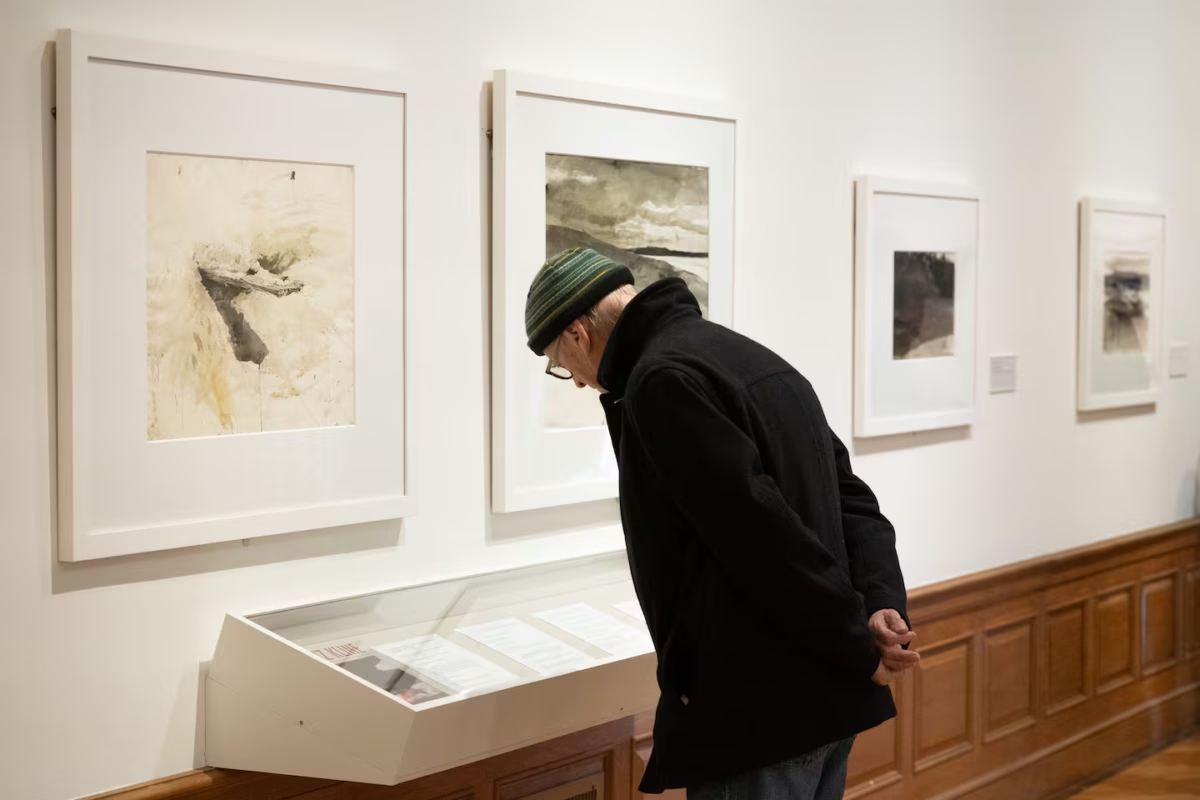
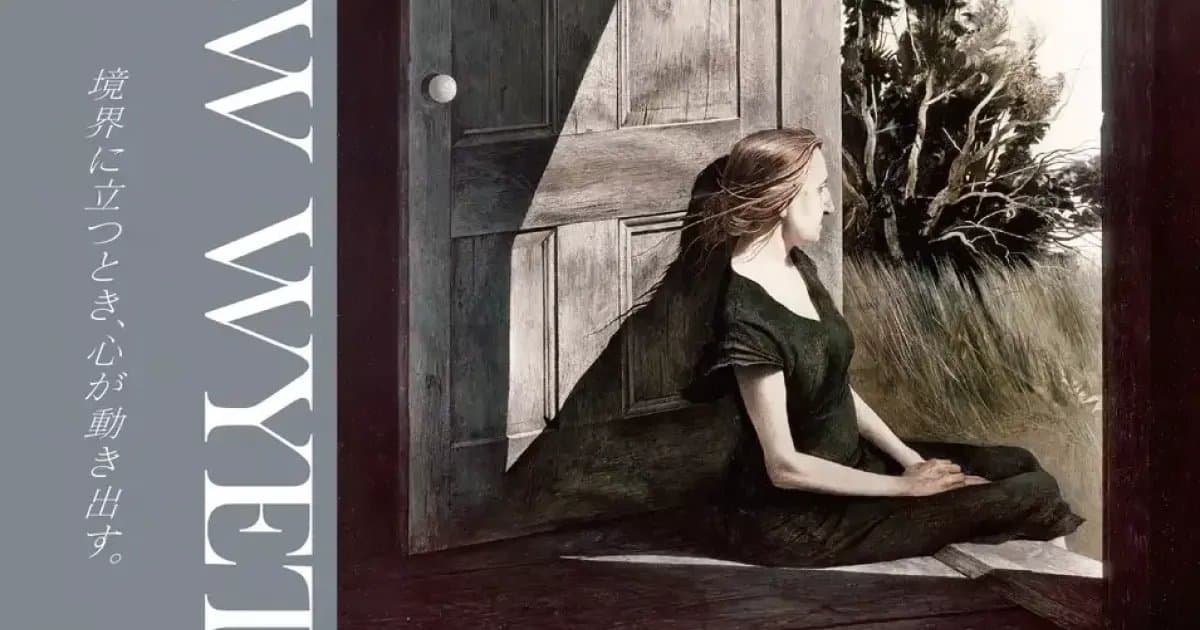
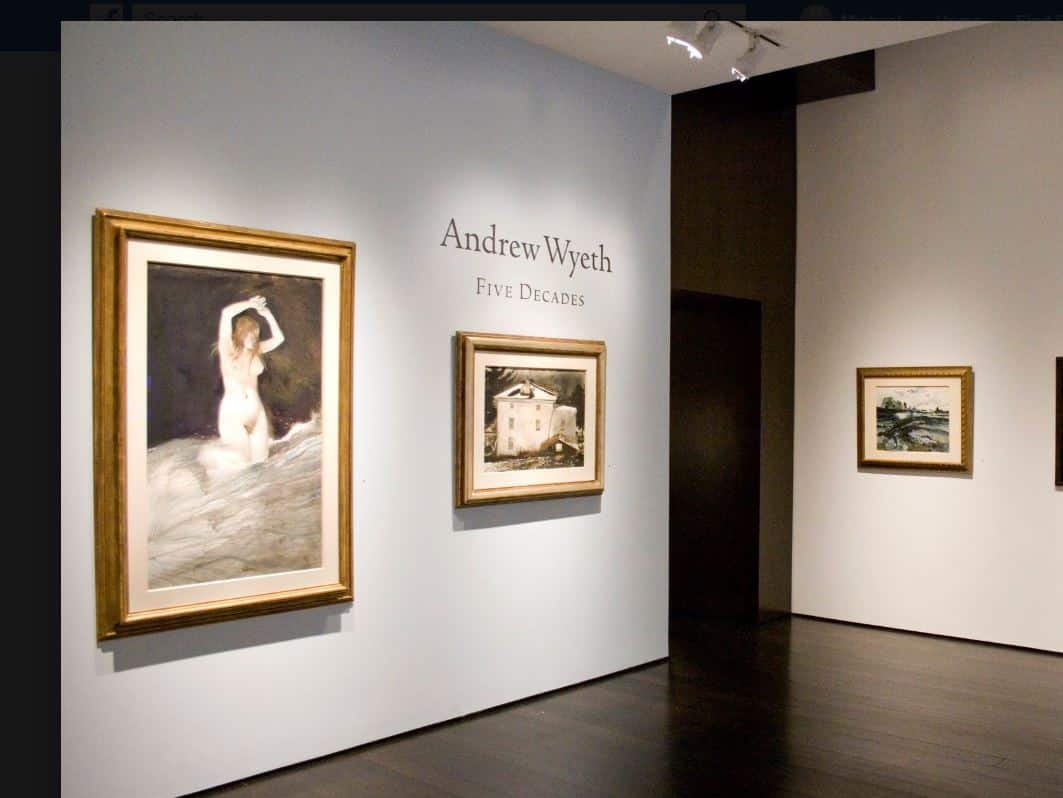
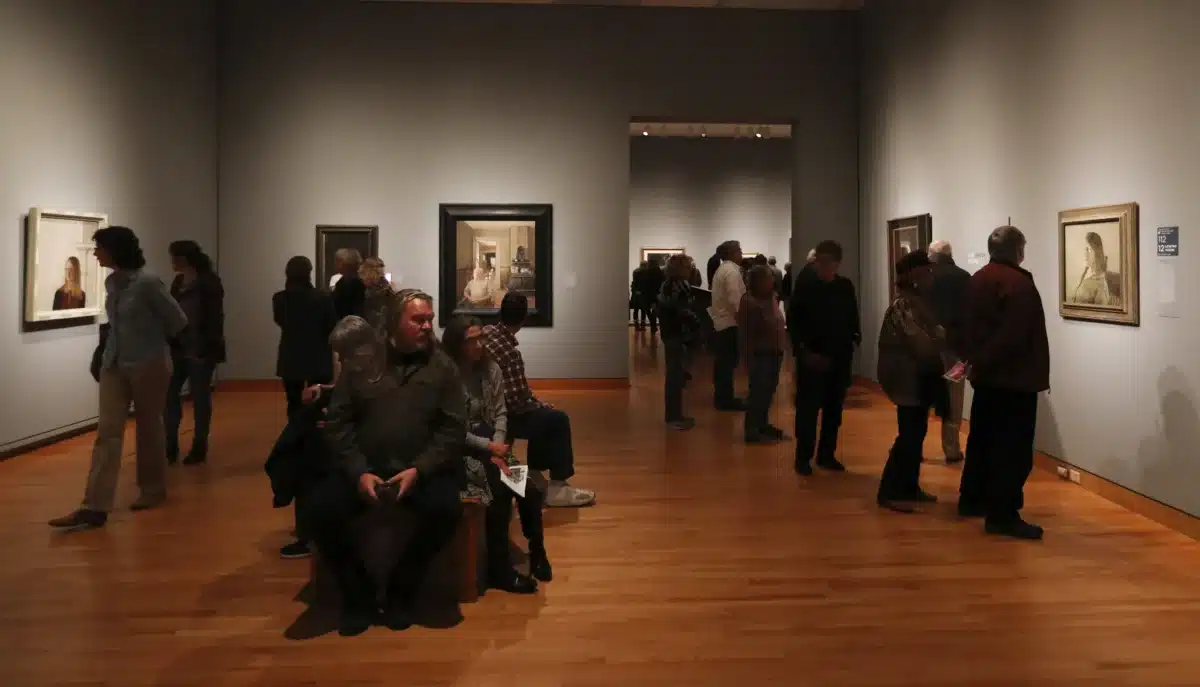
The Andrew Wyeth Exhibition 2026 in Osaka is a major retrospective of one of the most important American realist painters of the 20th century. Presented at ABENO HARUKAS Art Museum from October 3 to December 6, 2026, the exhibition brings approximately 100 works together from collections in Japan and overseas, including 15 works being shown in Japan for the first time. It is described by the organizers as the first major retrospective of Wyeth in Japan since his death in 2009.
The exhibition focuses on Andrew Wyeth’s distinctive approach to realism and his lifelong fascination with familiar people, houses, landscapes and objects. Rather than following the major American avant-garde movements of the postwar period, Wyeth developed a deeply personal visual language based largely on two regions: his home area of Chadds Ford, Pennsylvania, and the Maine coast where his family spent summers.
The central theme of the exhibition is “Boundaries or Windows.” Windows, doors, passages, ice and other dividing elements appear repeatedly in Wyeth’s work and can be understood as visual boundaries between interior and exterior, light and darkness, the self and the outside world, and life and death. The Osaka presentation uses this theme to examine the psychological dimension behind his apparently realistic paintings.
Enjoy Your Event Stress-Free with Japan Travelo
Do you know? Planning events, festivals, concerts, and cultural experiences in Japan can be overwhelming. Japan Travelo brings everything together in one place, helping you manage your itinerary, transport, and accommodation with ease—so you can enjoy Japan without the stress of planning.
Visitors can expect paintings created in different media, including tempera on panel and watercolor on paper. The exhibition brings together works from major American museums and private collections, allowing visitors to see paintings that are rarely exhibited together in Japan.
Among the highlights are Self Portrait from the National Academy of Design, Clothesline from the Cummer Museum of Art & Gardens, Windmill from the Philadelphia Museum of Art and Christina Olson from the Myron Kunin Collection of American Art. Other important works include Winter Fields from the Whitney Museum of American Art, Cooling Shed from the Philadelphia Museum of Art and The Carry from the Philbrook Museum of Art. Several of these works are being shown in Japan for the first time.
The exhibition is particularly significant because Wyeth has maintained a strong following in Japan. Major exhibitions were previously held in 1974, 1995 and 2008–09, but the 2026 retrospective provides the first comprehensive Japanese presentation following the artist’s death.
Event dates
Andrew Wyeth Exhibition 2026 runs from October 3 through December 6, 2026 at ABENO HARUKAS Art Museum in Osaka. The exhibition is open for more than two months, giving visitors considerable flexibility when planning a visit.
The exhibition hours are:
- Tuesday–Friday: 10:00 AM–8:00 PM
- Monday, Saturday, Sunday and public holidays: 10:00 AM–6:00 PM
- Last admission: 30 minutes before closing
- Closed: October 5, 2026
There is also a partial display change during the exhibition. The first presentation period runs from October 3 through November 3, while the second period runs from November 4 through December 6. Some works therefore change between the two periods, making the exhibition suitable for repeat visitors who want to compare the displays.
The late closing time on Tuesdays through Fridays is useful for visitors combining the exhibition with shopping, dining or sightseeing around Tennoji and Abeno.
Visiting this event? Don’t miss out on these amazing activities and local experiences while you’re here.
Venue & exhibition site
The exhibition takes place at ABENO HARUKAS Art Museum, located on the 16th floor of the ABENO HARUKAS skyscraper.
Venue: ABENO HARUKAS Art Museum
Address: 1-1-43 Abenosuji, Abeno-ku, Osaka 545-6016, Japan
The museum occupies a prominent position within the ABENO HARUKAS complex, one of Osaka’s major commercial and sightseeing destinations. Its location directly above major railway and subway connections makes the exhibition particularly convenient for visitors arriving from other parts of Osaka or from Kyoto, Kobe and surrounding areas.
The exhibition is organized by ABENO HARUKAS Art Museum, The Sankei Shimbun and Kansai Television, with sponsorship from DNP and special cooperation from Marunuma Art Park and the Unimat Group. The Wyeth Foundation for American Art and Japan Airlines provide cooperation, while the Embassy of the United States provides official support.
Full exhibition programme
The exhibition presents around 100 works covering the development of Wyeth’s artistic world. Rather than arranging the paintings simply by date, the exhibition examines recurring ideas and visual boundaries that appear throughout his career.
The main programme includes:
- Wyeth’s early development as an artist
- Portraits and self-portraits
- Pennsylvania landscapes and people
- Maine landscapes and summer subjects
- Windows, doors and architectural boundaries
- Interiors and exterior views
- Watercolor and tempera works
- Human relationships with landscape
- Themes of memory and isolation
- The relationship between life and death
- Works being shown in Japan for the first time
The exhibition begins by introducing Wyeth as an artist who remained largely independent from the dominant postwar American art movements. His realism was not simply an attempt to reproduce what he saw. Instead, familiar landscapes and people became vehicles for expressing memory, emotion and his private response to the world around him.
The later sections concentrate increasingly on the idea of the boundary. Windows and doors can separate private spaces from the outside world, while also providing a connection between them. Other recurring elements, including frozen water and passages between rooms or buildings, suggest transitions and moments of uncertainty.
The programme therefore encourages visitors to look beyond Wyeth’s precise technique and consider the emotional and psychological meanings embedded within apparently ordinary scenes.
Featured artists & designers
The exhibition is dedicated primarily to Andrew Wyeth, who lived from 1917 to 2009 and became one of America’s best-known realist painters.
Wyeth was born in Chadds Ford, Pennsylvania, as the fifth child of the celebrated illustrator N.C. Wyeth. His father provided early artistic instruction, and Andrew Wyeth began exhibiting professionally at a young age. His first solo exhibition in 1937 was an early indication of his developing reputation.
Wyeth spent his life returning to a relatively small number of familiar environments. Pennsylvania remained closely associated with his family and childhood, while Maine became an important summer location. The landscapes and people he knew intimately became recurring subjects throughout his career.
Important works represented in the exhibition include:
- Self Portrait, 1945
- Christina Olson, 1947
- Clothesline, 1961
- Windmill, 1962
- Cooling Shed, 1953
- Winter Fields, 1942
- The Carry, 1982
- Flowers, 1991
- Lighthouse, 1983
The selection includes works from institutions including the National Academy of Design, Cummer Museum of Art & Gardens, Philadelphia Museum of Art, Whitney Museum of American Art and Philbrook Museum of Art.
Galleries & exhibitors
Andrew Wyeth Exhibition is a museum retrospective rather than a commercial art fair, so there are no independent commercial galleries operating booths inside the exhibition.
The exhibition instead brings together loans from museums, foundations and private collections in the United States and Japan.
Important lending institutions and collections represented include:
- National Academy of Design, New York
- Whitney Museum of American Art, New York
- Philadelphia Museum of Art
- Cummer Museum of Art & Gardens, Jacksonville
- Philbrook Museum of Art
- Myron Kunin Collection of American Art
- Other domestic and international collections
The Wyeth Foundation for American Art is also involved in the exhibition’s international cooperation and rights management. The foundation plays an important role in preserving and documenting Wyeth’s artistic legacy.
The exhibition’s international loans are particularly significant because 15 works are being shown in Japan for the first time. These loans expand the Japanese presentation beyond works that have previously circulated domestically and provide a broader view of Wyeth’s career.
Exhibition halls & sections
The exhibition is organized into five principal chapters that gradually introduce Wyeth’s artistic world before concentrating on the idea of boundaries and windows.
Chapter 1: Andrew Wyeth as a painter
The opening section introduces Wyeth’s position within American art. Visitors learn how he developed an independent style while many contemporary artists were pursuing abstraction and other avant-garde directions.
His paintings are presented as more than straightforward records of places. Familiar landscapes, people and objects became deeply personal subjects through which Wyeth expressed memory, emotion and his own relationship with the world.
Chapter 2: Pennsylvania
Pennsylvania was central to Wyeth’s life and artistic identity. The landscapes surrounding Chadds Ford and the people he knew there appear repeatedly throughout his career.
This section allows visitors to understand how closely Wyeth’s work was connected to his immediate surroundings and how repeated observation could produce different emotional meanings over time.
Chapter 3: Maine
Wyeth’s summers in Maine provided another important source of imagery. Houses, coastal landscapes, people and weather became recurring subjects.
The Maine paintings demonstrate the contrast between the artist’s two principal geographical environments while also showing similarities in the way he treated familiar places.
Chapter 4: People and places
Wyeth frequently portrayed people who were personally familiar to him. His portraits and figure paintings are therefore closely connected to his broader world of landscapes and houses.
Christina Olson is particularly important within this context. The Olson family and their Maine home became some of Wyeth’s most recognizable subjects.
Chapter 5: Boundaries or Windows
The final chapter brings the exhibition’s central theme into focus. Windows, doors, passages, frozen water and other dividing structures become visual metaphors for the spaces between interior and exterior, self and other, light and darkness, and life and death.
Talks, workshops & special events
The Osaka exhibition includes several educational and cultural programmes designed to deepen visitors’ understanding of Wyeth.
Commemorative lecture
On October 3, the exhibition presents a lecture titled “Talking About Wyeth’s Art – With ‘Boundaries’ as a Keyword.” The speaker is Shuji Takahashi, director of Toyota Municipal Museum of Art, which hosted the earlier 2026 presentation of the exhibition.
The lecture runs from 2:00 PM to 3:30 PM at the Harukas University Seminar Room on the 23rd floor. The programme has a capacity of 70 people and requires advance registration. Attendance itself is free, but exhibition admission is required. The event had reached capacity according to the latest museum update.
Egg tempera workshop
On November 3, participants can learn about the tempera technique that Wyeth frequently used. The workshop combines an explanation of his preferred materials with a practical session in which participants make tempera paint and create their own work.
The programme is led by Yui Konishi, curator at ABENO HARUKAS Art Museum. It is designed for high-school students and older participants, with a capacity of 16 people. The participation fee is approximately $13 USD, excluding the exhibition admission requirement. The workshop had already reached capacity when checked.
Terroir, painting and sake
On November 14, the museum presents a special programme connecting Wyeth’s relationship with Pennsylvania and Maine to the idea of terroir in Japanese sake production.
The two-hour programme includes a curator’s talk about Wyeth’s landscapes, a presentation by sake brewer Daisuke Natsume about the terroir of Yoshino, a discussion between the speakers and a tasting of six Japanese sake selections with regional snacks. The participation fee is approximately $32 USD, with exhibition admission also required.
Wyeth talk and lunch
On October 14, ABENO HARUKAS Art Museum and Osaka Marriott Miyako Hotel present a talk and lunch programme examining Wyeth’s artistic career, his relationship with Pennsylvania and Maine, and the ideas behind his paintings.
The talk runs from 11:30 AM to 12:30 PM, followed by lunch from 12:45 PM to 2:00 PM. The package includes exhibition admission and costs approximately $63 USD.
Ticket types
The exhibition offers standard admission, advance tickets, student tickets and a special advance pair ticket.
Approximate USD prices are:
- General advance/group admission: $13
- General same-day admission: $14
- High school/university advance/group admission: $10
- High school/university same-day admission: $11
- Elementary/junior high school advance/group admission: $2
- Elementary/junior high school same-day admission: $3
- Advance pair ticket for two adults: $23
Advance tickets are available through October 2, 2026. The pair ticket provides two general-admission tickets and can be used by one person on two separate visits if desired.
The exhibition also offers special packages combining admission with dining at Osaka Marriott Miyako Hotel.
The approximate prices are:
- Cake set plus exhibition admission: $28 advance / $29 same-day
- COOKA lunch buffet plus exhibition admission: $43 advance / $44 same-day
- ZK European-style lunch plus exhibition admission: $49
The USD figures are approximate conversions of the official prices using approximately ¥158.05 per US dollar. Actual card charges may vary according to exchange rates and ticketing fees.
VIP & collector access
There is no conventional VIP admission, private collector lounge or art-fair-style priority programme announced for the exhibition.
Instead, visitors looking for a more specialized experience can choose from the exhibition’s lecture, workshop and hospitality programmes.
The Osaka Marriott Miyako Hotel packages provide one of the more premium ways to combine the exhibition with food and a high-rise Osaka setting. Visitors can select from a cake-and-drink package, a lunch buffet or the ZK restaurant lunch experience, all paired with exhibition admission.
For art-focused visitors, the commemorative lecture and tempera workshop provide additional opportunities to learn about Wyeth’s artistic methods and the exhibition’s curatorial approach.
An audio guide is also available for approximately $4 USD. The exhibition audio guide is narrated by actor Michiko Kichise and is available either through a rental device or app-based format.
Event rules
Visitors should review the official museum and exhibition rules before attending.
Key requirements include:
- The exhibition is held at ABENO HARUKAS Art Museum on the 16th floor.
- The museum is closed on October 5.
- Last admission is 30 minutes before closing.
- Tickets are generally non-refundable and cannot be reissued after purchase.
- Commercial ticket resale is prohibited.
- Student visitors may be required to show student identification.
- Visitors must follow museum instructions concerning photography.
- Flash photography is not permitted.
- Tripods, monopods, selfie sticks and similar equipment are restricted inside the museum.
- Mobile phones should be used quietly.
- Food and drinks should not be brought into exhibition galleries.
- Visitors should not touch artworks or exhibition structures.
- Exhibition content and admission arrangements can change if required by the organizers.
- Some works are displayed only during one of the two exhibition periods.
- The museum may impose admission restrictions during particularly busy periods.
The exhibition also notes that visitors should check the latest official information before travelling because operating conditions, displays and event arrangements may change.
How to get there
ABENO HARUKAS Art Museum is located in Abeno, one of Osaka’s best-connected central districts.
The museum address is:
ABENO HARUKAS Art Museum
1-1-43 Abenosuji, Abeno-ku, Osaka 545-6016, Japan
The museum is located directly within the ABENO HARUKAS complex. Visitors should use the dedicated shuttle elevators from the basement level or second floor to reach the museum on the 16th floor.
The location is particularly convenient for visitors arriving from Kansai International Airport, Shin-Osaka, Osaka Station and other parts of the Kansai region because Tennoji and Osaka-Abenobashi are major transportation hubs.
Public transport & parking
Public transportation is strongly recommended because the museum has no dedicated parking facility.
Kintetsu Railway
Osaka-Abenobashi Station is directly connected to the ABENO HARUKAS complex. Visitors should use the West Exit.
JR
Tennoji Station provides direct access through the Central Exit.
Osaka Metro Midosuji Line
Tennoji Station provides access from the Midosuji Line, with the West Exit serving as one of the convenient routes.
Osaka Metro Tanimachi Line
Tennoji Station is also served by the Tanimachi Line, with access through the southwest or southeast ticket gates.
Hankai Uemachi Line
Tennoji-ekimae Station is immediately adjacent to the complex.
The official museum access information states that there is no museum parking and asks visitors to use public transportation.
Accommodation areas
Tennoji and Abeno
Staying around Tennoji is the most convenient option for visitors whose main purpose is the exhibition. Hotels, restaurants, shopping and transportation are all concentrated around the station complex.
Namba
Namba offers a large selection of hotels and provides easy access to Tennoji by Osaka Metro. It is also convenient for visitors wanting to explore Dotonbori and central Osaka.
Umeda and Osaka Station
Umeda is useful for travelers who want strong connections to Kyoto, Kobe and other Kansai destinations. The area has extensive accommodation and dining options.
Shin-Osaka
Visitors arriving by Shinkansen may prefer to stay near Shin-Osaka, particularly when Osaka is part of a larger Japan itinerary.
Abeno
The Abeno neighborhood places visitors close to ABENO HARUKAS, Tennoji Park and several shopping and cultural attractions.
A particularly relevant accommodation option is Osaka Marriott Miyako Hotel, which is directly associated with several exhibition dining packages. Its high-rise location also provides convenient access to the museum within the same broader complex.
Food & refreshments
The exhibition has several food-related collaborations that make it possible to combine an art visit with a meal.
Osaka Marriott Miyako Hotel
The hotel offers several exhibition admission packages.
LOUNGE PLUS provides a cake set with one drink and exhibition admission. COOKA offers a lunch buffet with exhibition admission, while ZK on the 57th floor offers its Zekkei Lunch with exhibition admission.
Wyeth-inspired Philadelphia food
a&W ART&WINE has created a Philadelphia-inspired Philly cheesesteak because Wyeth’s birthplace and artistic roots are strongly associated with Pennsylvania.
The restaurant is located near Utsubo Park and also offers a discount on selected drinks when visitors present their exhibition ticket stub.
Exhibition-themed hospitality
The October 14 talk-and-lunch event also creates a more formal dining experience based around the landscapes and food traditions connected with Pennsylvania and Maine. The menu includes dishes inspired by both regions, including lobster and mushroom preparations and an apple dessert connected with Wyeth’s imagery.
Accessibility
ABENO HARUKAS Art Museum is located within a modern high-rise complex with elevator access to the museum floor.
The museum can be reached using the dedicated shuttle elevators from the basement level and second floor, making the venue accessible from the surrounding railway and commercial complex.
Visitors holding an eligible disability certificate can purchase same-day admission at half the regular price, and one accompanying person can receive the same discount arrangement. The museum ticket counter handles these admissions.
Visitors who need assistance should allow additional time when arriving and speak with museum staff before entering the exhibition galleries. Because the exhibition can become busy, particularly on weekends and holidays, quieter weekday periods may provide a more comfortable environment for visitors requiring additional space.
The October 3 commemorative lecture also includes Japanese sign-language and text interpretation arrangements in its accessibility information, demonstrating that the wider exhibition programme includes accessible educational opportunities.
Must-see exhibitions
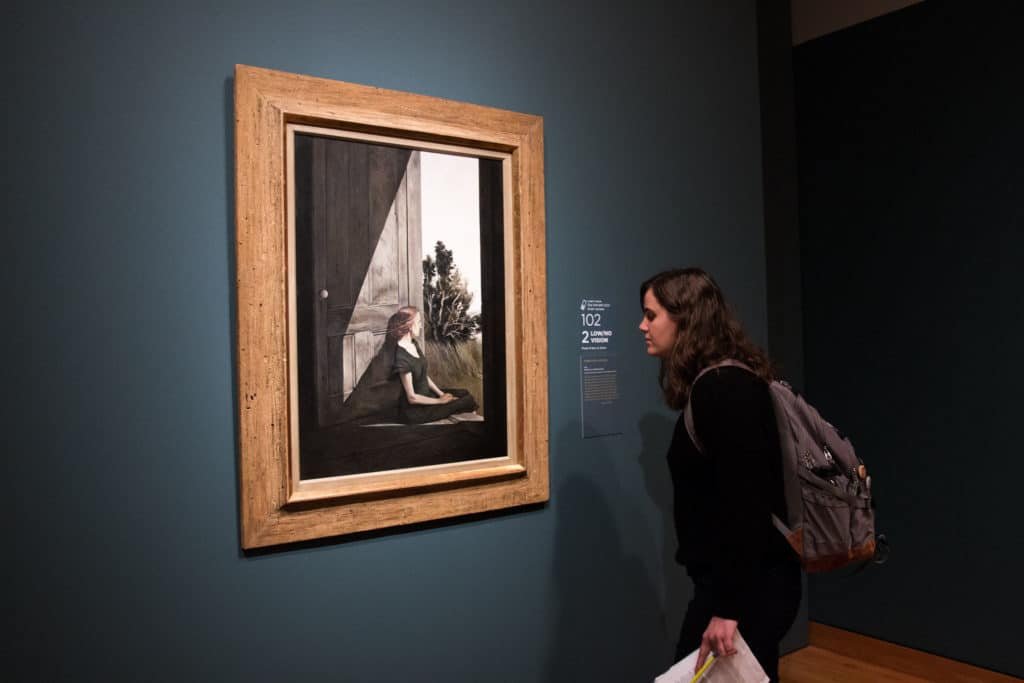
Christina Olson
Christina Olson is one of Wyeth’s most recognizable subjects and is closely connected with the artist’s relationship to Maine. The painting demonstrates his interest in familiar individuals and the emotional atmosphere surrounding the people and places he repeatedly observed.
Self Portrait
Created in 1945, Self Portrait provides an important introduction to Wyeth himself. The work is executed in tempera on panel and comes from the National Academy of Design in New York. It is particularly useful for understanding the highly controlled technique that became characteristic of his mature work.
Winter Fields
Winter Fields, painted in 1942, is one of the works highlighted as a Japanese first presentation. It comes from the Whitney Museum of American Art and demonstrates Wyeth’s ability to transform an ordinary rural environment into a highly atmospheric composition.
Cooling Shed
Cooling Shed, painted in 1953, comes from the Philadelphia Museum of Art and is another of the works specifically identified as being shown in Japan for the first time. It provides an opportunity to examine Wyeth’s treatment of architecture, landscape and open space.
The Carry
The Carry, painted in 1982, comes from the Philbrook Museum of Art. Its inclusion helps demonstrate the continued development of Wyeth’s visual language later in his career.
Clothesline
Clothesline, from 1961, is held by the Cummer Museum of Art & Gardens in Jacksonville. The work illustrates Wyeth’s ability to find visual interest in ordinary domestic objects and familiar surroundings.
Windmill
Windmill, painted in 1962, is another significant work in the exhibition. Its inclusion demonstrates Wyeth’s recurring fascination with rural structures and the relationship between built forms and the surrounding landscape.
Boundaries or Windows
The final thematic section should not be missed because it brings together many of the exhibition’s recurring ideas. Windows and doors are treated not merely as architectural features but as visual boundaries connecting different psychological and physical spaces.
Previous year’s highlights
There was no 2025 edition of this specific retrospective. The 2026 exhibition is a new nationwide retrospective that began its Japanese tour in Tokyo before moving to Toyota and then Osaka.
The exhibition opened at the Tokyo Metropolitan Art Museum from April 28 to July 5, 2026, as part of the museum’s centenary programme. It then moved to Toyota Municipal Museum of Art from July 18 to September 23 before reaching Osaka on October 3.
The Tokyo presentation was especially significant because it formed part of the Tokyo Metropolitan Art Museum’s 100th-anniversary programme. The retrospective’s overall concept remained focused on Wyeth’s independent position in American art and the recurring theme of boundaries.
The broader historical context is also important. Wyeth exhibitions were held in Japan in 1974, 1995 and 2008–09. The 1974 exhibition in Tokyo and Kyoto attracted approximately 330,000 visitors, helping establish his strong reputation among Japanese audiences. The 2026 retrospective therefore continues a long history of Japanese interest in Wyeth while presenting a new generation with works that have not previously been shown in the country.
The Osaka presentation is particularly notable because it includes 100 works and 15 Japanese first presentations. The partial display change between November 3 and November 4 also means that the Osaka edition is not completely static throughout its two-month run.
Official tickets
Official advance tickets for the Osaka exhibition are available through the exhibition’s authorized ticketing channels, including Ticket Pia, ePlus, Lawson Ticket, the museum’s online ticket service and other listed ticket providers. Advance sales run through October 2, 2026, while same-day ticket sales begin on October 3.
The Ticket Pia page supplied for the exhibition provides the official ticket information and sales route.
https://t.pia.jp/pia/event/event.do?eventBundleCd=b2665583
The official exhibition website contains the latest information on the Osaka schedule, works, events, ticket options and visitor arrangements.
https://www.wyeth2026.jp/
The official ABENO HARUKAS Art Museum page should also be checked before visiting for any changes to opening hours, exhibition arrangements or special-event availability.
https://www.aham.jp/exhibition/future/wyeth/
Video
Location
FAQ
What are the specific age guidelines and entry policies enforced by the museum for this special exhibition?
Children of all ages are welcome to attend, though younger visitors must be supervised by a responsible adult guardian at all times. Strollers may be subject to gallery restrictions during peak hours to ensure safe pedestrian flow.
How are timed-entry reservations managed for ticket holders visiting the Abeno Harukas Art Museum?
Visitors are required to select specific entry date and time windows when purchasing advance tickets to manage gallery density effectively. Guests arriving outside their designated window should consult on-site staff regarding available standby options.
Are photography and video recording permitted inside the exhibition galleries housing the original artworks?
Photography, video recording, and audio capturing are strictly prohibited within all special exhibition rooms to protect fragile pigments and copyright agreements. Visitors must keep mobile devices powered off or silenced throughout the gallery spaces.
Can visitors exit and re-enter the exhibition spaces once their admission ticket has been scanned?
Re-entry to the exhibition floor is strictly not permitted once a visitor has passed the gallery exit checkpoint. Guests are encouraged to complete restroom breaks and gift shop visits accordingly before entering.
What accessibility accommodations are available for visitors with mobility impairments at the venue?
The museum provides full wheelchair accessibility, elevators, and barrier-free pathways across all exhibition levels for optimal visitor comfort. Visitors requiring specialized physical assistance can coordinate directly with venue staff upon arrival.
What steps should attendees take if they misplace personal belongings during their museum visit?
Lost property items should be reported immediately to the nearest museum security officer or information desk assistant. Unclaimed items are securely logged at the main reception desk for designated retrieval processing.

Leave a Reply