
-
September 23, 2026
Event date:
-
September 23, 2026
Event end:
What to expect in 2026
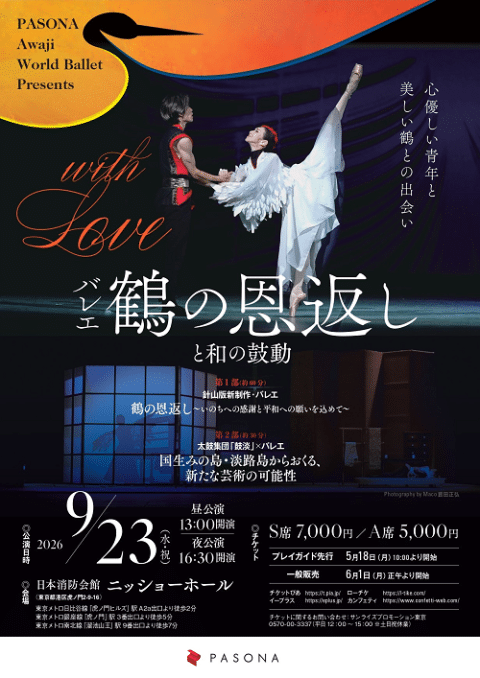
PASONA Awaji World Ballet brings its original production “with Love – Ballet The Crane’s Return of a Favor and Japanese Taiko” to Tokyo for a special one-day performance on September 23, 2026. The production combines classical ballet, Japanese storytelling and powerful taiko drumming, creating a stage work rooted in Japanese cultural traditions while using contemporary theatrical presentation.
The production is inspired by the Japanese folktale “The Crane’s Return of a Favor,” but it is not simply a traditional retelling. The ballet company has developed its own theatrical interpretation of the story, incorporating themes of gratitude, compassion, peace, human connection and the importance of passing kindness from one person to another. The story is communicated primarily through movement, music, staging and visual expression rather than relying heavily on spoken dialogue.
The Tokyo performance is particularly significant because it is described by the company as PASONA Awaji World Ballet’s first solo Tokyo performance. The company, which developed its artistic activities on Awaji Island in Hyogo Prefecture, is using the performance to introduce its cultural and regional revitalization work to a Tokyo audience.
Enjoy Your Event Stress-Free with Japan Travelo
Do you know? Planning events, festivals, concerts, and cultural experiences in Japan can be overwhelming. Japan Travelo brings everything together in one place, helping you manage your itinerary, transport, and accommodation with ease—so you can enjoy Japan without the stress of planning.
The programme is divided into two major parts. The first is the original long-form ballet “The Crane’s Return of a Favor – Gratitude for Life and a Wish for Peace,” while the second brings PASONA Awaji World Ballet together with Taiko Group Kotan for a special performance combining dance and Japanese percussion. Each performance is planned to run for approximately 100 minutes including an intermission.
Because this is a single-day Tokyo engagement, audiences have two opportunities to attend: a daytime performance beginning at 1:00 PM and an evening performance beginning at 4:30 PM.
Event dates
Performance date
The Tokyo performance takes place on Wednesday, September 23, 2026, which is a public holiday in Japan. There are two scheduled performances at Nissho Hall in Toranomon, Tokyo.
Daytime performance
Doors open at 12:00 PM and the performance begins at 1:00 PM. The venue has announced a staged opening process, with ticket exchange beginning at 12:00 PM, lobby access from approximately 12:15 PM and audience seating from approximately 12:30 PM.
Evening performance
The evening performance begins at 4:30 PM, with the main doors scheduled to open at 3:30 PM. Ticket exchange starts at 3:30 PM, lobby access is scheduled from approximately 3:45 PM and seating from approximately 4:00 PM.
Duration
Each performance is scheduled for approximately 100 minutes, including an intermission of around 10 minutes.
Visiting this event? Don’t miss out on these amazing activities and local experiences while you’re here.
Venue & performance locations
Main venue
Nissho Hall is the sole Tokyo venue for PASONA Awaji World Ballet’s “with Love” performance. The hall is located inside the Japan Firefighters Hall at 2-9-16 Toranomon, Minato City, Tokyo 105-0001.
The Toranomon location places the performance in one of central Tokyo’s major business and cultural districts, close to Toranomon Hills, Kasumigaseki, Akasaka and Shinbashi.
Performance setting
Unlike a touring festival with multiple stages, this production is presented inside a traditional theatre environment. The audience remains in assigned seating while the ballet, stage production and taiko performance unfold on the main stage.
The theatre setting is particularly suitable for the production because the work depends on contrasts between delicate ballet movements and the physical impact of Japanese percussion. The production can therefore shift between quiet, intimate sequences and larger ensemble moments without the distractions associated with an outdoor event.
Full programme
Part One – The Crane’s Return of a Favor
The first half of the programme presents the original long-form Japanese ballet “The Crane’s Return of a Favor – Gratitude for Life and a Wish for Peace.” It takes the familiar Japanese folktale as its starting point but develops the material into an original stage work.
The production focuses on the emotional ideas behind the story rather than treating it simply as a children’s fairy tale. Gratitude, kindness, sacrifice, human relationships and the consequences of compassion are represented through choreography and music.
The company has also described the work as a story about wishing for a world without hatred and suffering. Its original staging incorporates imaginative elements such as a mysterious lake and a magical fabric connected with healing and peace.
Part Two – Ballet and Taiko Special Performance
The second part brings PASONA Awaji World Ballet together with Taiko Group Kotan. This section emphasizes the relationship between dance and Japanese percussion, creating a more rhythmically driven conclusion to the programme.
The combination allows the audience to experience two different artistic languages on the same stage: the controlled lines, balance and movement of ballet alongside the physical sound and rhythm of taiko.
Featured productions & performers
Emi Hariyama
Emi Hariyama serves as the artistic director of PASONA Awaji World Ballet and is responsible for the direction and choreography of the Tokyo production. She is also a performer in the work. Her background includes study at the Bolshoi Ballet School and professional activity with ballet companies in Russia, the United States and Germany, including Berlin State Ballet.
Hariyama developed “The Crane’s Return of a Favor” from a long-standing interest in combining Japanese traditional culture with ballet. The work represents an attempt to create a Japanese long-form ballet rather than simply adapting an established European classical ballet.
Taro Kurachi
Taro Kurachi is one of the featured ballet performers. His professional background includes study and training in Belgium, Germany and the United States, followed by experience with Philadelphia Ballet and the Belarusian State Academic Bolshoi Theatre of the Republic of Belarus.
PASONA Awaji World Ballet
The company provides the principal ballet ensemble for the production. Its dancers have performed this work and related programmes in Japan and internationally, including presentations connected with the Osaka-Kansai Expo and a performance at the Latvian National Opera.
Taiko Group Kotan
Taiko Group Kotan joins the ballet company for the special second part of the Tokyo programme. Their role is central to the production’s combination of Japanese percussion and contemporary ballet performance.
Shows & performances
The Tokyo programme consists of two distinct theatrical sections rather than a series of unrelated short performances.
Original ballet performance
The main ballet explores the story of the crane through choreography and theatrical imagery. The production uses the emotional themes of the folktale to examine gratitude, relationships and the desire for peace.
Japanese taiko collaboration
The second section changes the atmosphere by bringing the dancers and taiko performers together. The rhythmic power of the drums provides a strong contrast with the controlled movement of classical ballet.
Visual storytelling
The production has previously incorporated projection and visual effects into its staging. The company describes the original work as using spatial imagery and projection techniques to strengthen the relationship between the dancers and the fictional world of the story.
Performance schedule
September 23, 2026 – Daytime
12:00 PM – Ticket exchange begins
12:15 PM – Lobby opens
12:30 PM – Audience seating
1:00 PM – Performance begins
Approximately 100 minutes – Performance including intermission
September 23, 2026 – Evening
3:30 PM – Ticket exchange begins
3:45 PM – Lobby opens
4:00 PM – Audience seating
4:30 PM – Performance begins
Approximately 100 minutes – Performance including intermission
The organizer notes that lobby and seating times may be moved slightly earlier depending on the day’s venue preparations.
Ticket types
S Reserved Seat
The S-seat category is priced at approximately $44 USD based on the announced ¥7,000 ticket price and an approximate exchange rate of ¥158 to $1. The S category provides reserved theatre seating in the higher-priced seating section.
A Reserved Seat
The A-seat category is priced at approximately $32 USD, based on the announced ¥5,000 ticket price. Like the S category, it is a reserved seat rather than general admission.
Ticket format
All seats are reserved. Buyers should select their preferred performance and seating category during the booking process.
Ticket release & booking
General ticket sales opened on June 1, 2026, at noon. The official Ticket Pia listing provides the current ticket-selection and sales information for the September 23 performance.
Ticket availability can change as the performance approaches, and individual seating inventory may differ between the daytime and evening shows. Buyers should therefore check the live seating chart before completing their purchase.
The performance is also listed through major Japanese ticket platforms, including Ticket Pia and ePlus.
Tickets cannot be changed or cancelled after purchase except where the organizer provides a refund because the performance itself is cancelled. The organizer also advises customers requiring wheelchair-accessible seating to contact the event organizers in advance.
VIP & premium seating
There is no separately announced VIP package for the Tokyo performance.
The premium seating distinction is instead represented by the two reserved seating categories. The S section is the higher-priced seating category, while A seats provide another reserved seating option.
Because the performance is built around detailed choreography, ensemble formations and the interaction between dancers and taiko performers, audiences interested in seeing the choreography clearly may wish to consider the higher seating category when available.
No meet-and-greet, backstage tour, VIP lounge or premium hospitality package has been announced for the Tokyo performance.
Event rules
Age restriction
Children below school age are not permitted to enter the performance. Families should take this restriction into account before purchasing tickets.
Ticket changes
Tickets cannot be changed or cancelled after purchase under normal circumstances.
Refund policy
Refunds are not available for reasons other than cancellation of the performance.
Wheelchair seating
Customers who require wheelchair-accessible seating should contact the organizers before attending so that appropriate arrangements can be discussed.
Programme changes
The performance content and running order may be changed without prior notice where necessary. Ticket platforms also advise customers to confirm the latest event information before attending.
How to get there
Nissho Hall is located in Toranomon, Minato City, in central Tokyo. The venue is particularly convenient by subway, with several major stations within walking distance.
From Toranomon Hills Station
Take the Tokyo Metro Hibiya Line to Toranomon Hills Station and use Exit A2a. The venue is approximately a two-minute walk away.
From Toranomon Station
Toranomon Station on the Tokyo Metro Ginza Line is approximately five minutes from the hall using Exit 3.
From Tameike-Sanno Station
The Tokyo Metro Namboku Line and Ginza Line connections at Tameike-Sanno provide another route, with Exit 9 approximately seven minutes from the venue.
From Kasumigaseki Station
Kasumigaseki Station is approximately eight minutes away on foot from Exit A13.
From Shinbashi Station
JR Shinbashi Station is around 17 minutes away on foot from the Karasumori Exit.
Public transport & parking
Public transportation is the most practical way to reach the performance because Nissho Hall does not have its own parking facility. The venue officially states that there is no parking at the hall.
The closest subway option is Toranomon Hills Station, only about two minutes away. Toranomon Station, Tameike-Sanno Station and Kasumigaseki Station also provide convenient alternatives.
Visitors driving into central Tokyo should plan to use a commercial parking facility elsewhere in the Toranomon area and continue to the hall on foot. Because the performance takes place on a public holiday, allowing additional travel time is advisable.
Accommodation areas
Toranomon is a convenient base for visitors attending the performance because several hotels are located close to Nissho Hall. Hotel options range from luxury properties to more compact business-oriented accommodation.
Toranomon
Staying directly around Toranomon provides the shortest journey to the theatre. Hotels in this area are particularly convenient for visitors who want to walk to the performance.
Toranomon Hills
The Toranomon Hills district has several upscale hotels and extensive dining facilities. It is also extremely close to the venue and subway connections.
Akasaka
Akasaka offers a broad selection of hotels, restaurants and nightlife, while remaining within a short subway or walking journey of Nissho Hall.
Shinbashi
Shinbashi is useful for travelers who want strong JR connections and access to a large range of restaurants and business hotels.
Roppongi
Roppongi is another option for visitors who want to combine the ballet with Tokyo nightlife, restaurants and attractions after the performance.
Dining & refreshments
Nissho Hall is located in a central commercial district with many restaurants and cafés around Toranomon, Toranomon Hills, Shinbashi and Kasumigaseki.
For the daytime performance, visitors can have lunch before entering the theatre or plan a meal after the show. The evening performance also makes it convenient to combine the ballet with dinner in Toranomon or nearby Shinbashi.
Because the performance itself lasts approximately 100 minutes including an intermission, visitors should not depend on leaving the venue during the production. Arriving early also gives ticket holders time to complete entry procedures and settle into their reserved seats.
For international visitors, the surrounding business districts offer a wide selection of Japanese, international and casual dining options within walking distance of the venue.
Accessibility
The organizers specifically ask customers requiring wheelchair-accessible seating to contact them in advance. This is important because accessible seating arrangements may need to be coordinated before the performance.
The venue is centrally located near multiple subway stations, with Toranomon Hills Station only about two minutes away. Visitors with mobility requirements should consider the most convenient station route and allow sufficient time for transfers.
For accessibility-related questions, the official event information lists PASONA Awaji World Ballet at 050-3816-3651, with enquiries handled during the stated office hours.
Best performances to attend
Daytime performance
The 1:00 PM show is convenient for visitors who want to experience the ballet during the afternoon and still have the evening available for sightseeing, dining or other Tokyo activities. It also allows travelers to reach the venue well before the performance without having to navigate Tokyo late at night.
Evening performance
The 4:30 PM show offers a later alternative for visitors spending the day exploring central Tokyo. It can also work well for travelers who want to combine the performance with an evening meal around Toranomon or Shinbashi.
For first-time visitors
Either performance provides the complete programme, including the original ballet and the special collaboration with Taiko Group Kotan. Since the two shows are scheduled for the same day and the published programme does not indicate different productions, visitors can choose based primarily on their wider Tokyo itinerary.
Previous year’s highlights
There was no directly documented 2025 Tokyo edition of “with Love” matching the September 2026 production, so a conventional previous-year Tokyo edition should not be presented as if it existed.
The most relevant recent history comes from the development and performances of “The Crane’s Return of a Favor,” the central work used in the 2026 production. The ballet has been presented as one of PASONA Awaji World Ballet’s representative works and has appeared in major international and Japanese cultural programmes.
A significant recent presentation took place as part of the opening programme of Expo 2025 Osaka-Kansai, where PASONA Awaji World Ballet performed the full “The Crane’s Return of a Favor” work.
The work was also presented at the Latvian National Opera, where the first part consisted of “The Crane’s Return of a Favor” and the second part was a special gala incorporating Japanese traditional cultural elements.
In 2026, the company returned to the work with performances on Awaji Island in March and April. Those performances featured Emi Hariyama as choreographer, director and artistic creator, together with Taro Kurachi and an international ensemble of dancers.
These earlier presentations provide the background for the Tokyo performance, which adds the Japanese taiko collaboration and brings the production to Nissho Hall as the company’s first dedicated Tokyo performance.
Official tickets
Tickets for PASONA Awaji World Ballet “with Love – Ballet The Crane’s Return of a Favor and Japanese Taiko” are available through the official Ticket Pia event page.
https://t.pia.jp/pia/event/event.do?eventBundleCd=b2667407
The official PASONA Awaji World Ballet performance page also provides the latest programme, venue, schedule, ticket and organizer information.
Location
FAQ
What is the primary narrative inspiration behind the performance?
The production adapts the beloved traditional Japanese folktale Tsuru no Ongaeshi, exploring themes of gratitude and sacrifice. It follows a rescued crane that transforms into a maiden to weave magical cloth from her feathers. This classic legend is reimagined through contemporary ballet and taiko percussion to resonate with modern audiences.
How do ballet and taiko drumming merge on stage?
Classical ballet dancers provide graceful visual storytelling that contrasts with the thunderous, earthy rhythms of live taiko drums. The percussion acts as a dynamic narrative force rather than simple background music, dictating emotional intensity and tempo. This collaboration creates a striking dialogue between Western dance traditions and Japanese acoustic arts.
Who are the key creative forces leading the production?
The show is directed, choreographed, and performed by the internationally acclaimed ballerina Aimi Hariyama. She is joined by principal dancer Taro Kurachi, the Pasona Awaji World Ballet ensemble, and taiko group Kotan. Together, these artists bring exceptional technical skill and deep cultural reverence to the Tokyo stage.
What can audiences expect from the two-part event structure?
Part One presents the original full-length narrative ballet adaptation of The Crane's Return with theatrical staging. Part Two features a special collaborative performance highlighting the synergy between the ballet company and taiko drummers. This structured progression offers a comprehensive and emotionally rewarding artistic journey for every attendee.
Why is Awaji Island significant to the performing arts company?
Awaji Island serves as the creative incubator and home base for the Pasona Awaji World Ballet ensemble. The company uses its platform to foster regional cultural revitalization while developing innovative cross-cultural dance works. Bringing this production to Tokyo allows the island's unique artistic vision to reach a broader national audience.
What venue rules apply regarding ticket purchases and attendance?
All ticket sales are final, with changes and refunds unavailable except in the case of official event cancellations. Children under school age are not permitted inside the auditorium to ensure an undisturbed viewing atmosphere. Patrons requiring accessible seating should contact the organizers in advance to arrange proper accommodations.

Leave a Reply