
-
November 7, 2026
Event date:
-
November 8, 2026
Event end:
What to expect in 2026
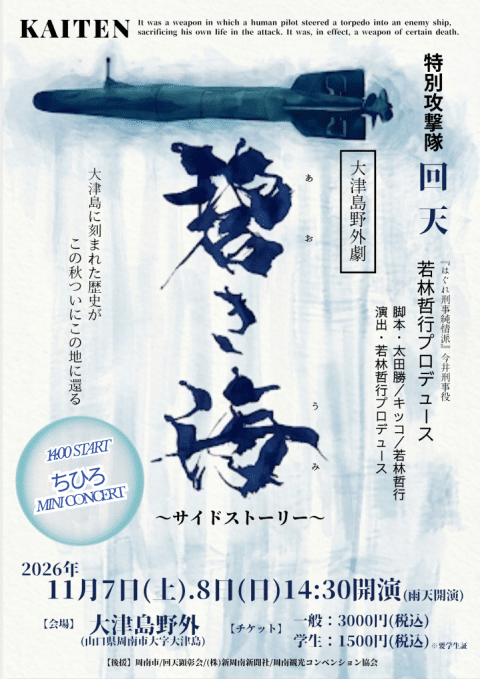
“The Azure Sea ~Side Story~” is an outdoor theatrical production presented on Otsushima Island in Shunan City, Yamaguchi Prefecture, on November 7 and 8, 2026. The production depicts the history of the Kaiten Special Attack Units and is being staged in the same island setting where Kaiten training took place during the final period of World War II. It is described as the first outdoor theatre production to be performed on Otsushima Island.
The production is being produced by actor Tetsuyuki Wakabayashi, who is known for his long-running role as Detective Imai in the television drama “Hagure Keiji Junjoha.” Wakabayashi is also part of the cast. The project brings a large ensemble of performers to the island and creates a temporary outdoor theatre in a location strongly connected to the history represented in the play.
The play focuses on the young men who served in the Kaiten units and the circumstances surrounding their lives during wartime. Kaiten were human-guided torpedoes developed by the Imperial Japanese Navy during the final stage of the Pacific War. Otsushima became one of the principal training locations, and surviving military remains and the Kaiten Memorial Museum preserve this history today.
Enjoy Your Event Stress-Free with Japan Travelo
Do you know? Planning events, festivals, concerts, and cultural experiences in Japan can be overwhelming. Japan Travelo brings everything together in one place, helping you manage your itinerary, transport, and accommodation with ease—so you can enjoy Japan without the stress of planning.
The setting is an important part of the production rather than simply a backdrop. The performance takes place on Otsushima, where visitors can also encounter the memorial museum, former training-base remains and other historical traces connected with the Kaiten programme. The production therefore places a theatrical interpretation of wartime history directly within the landscape associated with it.
The event is also connected with the annual remembrance activities on the island. A memorial ceremony for Kaiten personnel and crew members of submarines lost while carrying Kaiten is scheduled around the same period, making the November performances part of a wider period of remembrance on Otsushima.
Festival dates
The 2026 production takes place over two days:
- November 7, 2026, Saturday
- November 8, 2026, Sunday
The outdoor play is scheduled to begin at 14:30 on both days. The published event information gives an expected finish of approximately 15:30.
The November 8 programme also includes a mini concert by singer-songwriter Chihiro beginning at 14:00, followed by the outdoor play at 14:30. The performance is therefore more than a conventional theatre presentation, combining live music with the main dramatic production.
The organisers advise that the production will proceed in light rain. In the event of heavy rain or severe weather, the performance may be moved indoors. A typhoon or other natural disaster may result in cancellation or postponement.
Because Otsushima is an island reached by scheduled boat services, visitors should allow sufficient time for the ferry journey and island transfer before the performance. Boat services can also be affected by weather conditions such as strong winds and fog.
Visiting this event? Don’t miss out on these amazing activities and local experiences while you’re here.
Venues & festival locations
Otsushima Outdoor Park
The production is held at Otsushima Outdoor Park, generally listed as “Otsushima Outdoor” or “Otsushima Outdoor Park,” on Otsushima in Shunan City, Yamaguchi Prefecture. The venue is located in the Mabashima area of Otsushima.
This is an unusual theatre setting because the production is being staged outdoors on the island rather than inside a conventional theatre. The performance location is connected to the historical landscape of the former Kaiten training area.
Mabashima
Mabashima is the part of Otsushima associated with the former Kaiten training facilities. The island retains significant wartime remains, including the former training base, tunnels and other military structures.
Kaiten Memorial Museum
The Kaiten Memorial Museum is another important location for visitors interested in understanding the historical setting before or after the play. The museum contains personal effects and documents connected with the Kaiten personnel, together with a full-size model of a Kaiten. It is approximately 10 minutes on foot from Mabashima Port.
Former Kaiten training base
The former training base is located on the southwestern side of Mabashima. Parts of the original military infrastructure remain, including a tunnel through the cliffs, a concrete bridge and other facilities associated with the training operation.
Full programme
Outdoor theatre performance
The main programme is the stage production “The Azure Sea ~Side Story~,” beginning at 14:30 on November 7 and November 8. The play focuses on the Kaiten personnel and the wartime circumstances surrounding the human-guided torpedo programme.
Mini concert
The November 8 programme includes a mini concert by Chihiro at 14:00. The concert takes place before the 14:30 start of the outdoor theatre performance.
Historical setting
The programme is deliberately presented in Otsushima rather than relocated to a city theatre. The organisers describe the performance as a return of the story to the place where the historical events represented by the play occurred.
Remembrance context
The performances coincide with the period of the Kaiten remembrance ceremony held near the Kaiten Memorial Museum. Visitors therefore have an opportunity to experience the play alongside the island’s wider historical and memorial context.
Featured films & premieres
Although this is not a film festival and there are no film screenings or premieres, the requested section can be understood in terms of the production’s theatrical premiere and its connection to the earlier “The Azure Sea” stage work.
“The Azure Sea ~Side Story~” is the first outdoor presentation of the work on Otsushima Island. The island performance represents a new setting for the production and brings the story to the location associated with the Kaiten training programme.
The wider “The Azure Sea” production was previously performed at Shunan City Cultural Hall in August 2025 as part of the city’s postwar-80-years programme. The 2026 Otsushima production develops that theatrical project into a site-specific outdoor presentation.
The 2026 production is therefore significant as a new outdoor chapter of the theatrical work rather than as a film premiere. Its central feature is the relationship between live theatre and the historical landscape of Otsushima.
Directors, actors & guests
Tetsuyuki Wakabayashi
Tetsuyuki Wakabayashi produces the Otsushima performance and appears as one of its principal actors. He is widely associated with his long-running role as Detective Imai in “Hagure Keiji Junjoha.” Wakabayashi has also worked extensively in theatre and film.
The Otsushima performance represents a personal project for Wakabayashi, who has described staging the play in the place connected to the historical story as a long-held ambition. The 2026 event is also taking place during his 60th year as an actor and his 80th year of life.
Taichi Saito
Taichi Saito is part of the announced ensemble cast for the Otsushima performances.
Daisuke Yoshioka
Daisuke Yoshioka is another member of the cast and has publicly supported the Otsushima project as one of the performers involved in bringing the production to the island.
Yu Shiraoka
Yu Shiraoka is included in the announced ensemble for the 2026 outdoor production.
Machi
Machi is part of the cast appearing in the Otsushima production.
Kazue Nakagawa
Kazue Nakagawa is among the performers announced for the two-day outdoor engagement.
Mapeo
Mapeo joins the ensemble cast for the Otsushima performance.
Ryota Ohno
Ryota Ohno is part of the 2026 cast.
Keisuke Yamagishi
Keisuke Yamagishi is included among the performers announced for the production.
Kai Oya
Kai Oya is part of the ensemble appearing in the outdoor play.
Mizuki Hase
Mizuki Hase is one of the performers in the announced cast.
Kaede Murase
Kaede Murase is included in the cast and has also promoted the project publicly.
Saya Ito
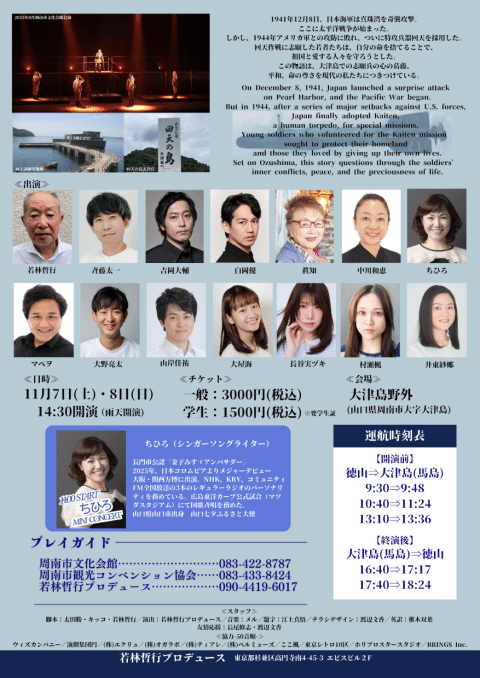
Saya Ito completes the announced cast list for the Otsushima production. The full cast is confirmed through the official Ticket Pia listing.
Screening schedule
There are no film screenings associated with this event. The programme is a live outdoor stage production.
November 7
The main outdoor theatre performance begins at 14:30. The event is scheduled to finish at approximately 15:30.
November 8
A mini concert by Chihiro begins at 14:00, followed by the outdoor play at 14:30. The theatre performance is scheduled to finish at approximately 15:30.
The organisers have stated that the performance will proceed in light rain. Heavy rain or severe weather may result in an indoor venue change, while a typhoon or other natural disaster could cause postponement or cancellation.
Ticket types & accreditation
The event uses two published admission categories:
- General admission: $19.12
- University students and younger: $9.56
The original ticket prices are ¥3,000 for general admission and ¥1,500 for university students and younger, with student identification required. The dollar figures above are approximate conversions.
The student category applies to university students and younger attendees, and eligible visitors must present a valid student ID.
There is no separate festival accreditation system comparable to a film festival. Admission is through event tickets, with general-sale tickets available through designated ticket outlets.
Industry & professional access
There is no separate industry market, film-industry accreditation programme or professional conference associated with the event.
The production is primarily a public theatre performance and historical-cultural event. Its significance for researchers, educators, historians and cultural visitors comes from the location and subject matter rather than from an organised industry programme.
Visitors interested in the historical background can also visit the Kaiten Memorial Museum and the former training-base remains on Otsushima. The museum displays personal belongings and historical materials connected with the Kaiten personnel, while the former training site preserves surviving military structures.
Red carpet & special events
There is no conventional red-carpet programme. The event is an outdoor theatre production rather than a film premiere or celebrity festival.
Chihiro mini concert
One of the additional programmes is a mini concert by singer-songwriter Chihiro on November 8 at 14:00. Her appearance precedes the 14:30 outdoor theatre performance.
Memorial activities
The November performances take place during a period when Otsushima also hosts remembrance activities connected with the Kaiten personnel and submarine crews. A memorial ceremony is scheduled on November 8 at the grounds in front of the Kaiten Memorial Museum.
Site-specific theatre
The decision to stage the play on Otsushima itself is the central special feature. Rather than presenting the work in a conventional urban theatre, the organisers are creating an outdoor performance space on the island associated with the historical events.
Festival rules
Student identification
Visitors purchasing the student ticket must be university students or younger and must bring valid student identification.
Weather
The production can proceed in light rain. If rain becomes heavy or weather conditions deteriorate, the performance may be moved to an indoor location.
Natural disasters
The performance may be cancelled or postponed if a typhoon or other natural disaster creates unsafe conditions. Visitors should check the latest organiser information before travelling to Otsushima.
Island travel
Because Otsushima can only be reached by boat from the mainland, visitors should allow sufficient time for the ferry journey. Boat operations can be suspended because of strong winds or dense fog.
Historical setting
Visitors should remember that the performance takes place in a location associated with wartime deaths and remembrance. The surrounding memorial facilities and historical remains should be treated respectfully.
How to get there
The main route to Otsushima is through Tokuyama Port in Shunan City.
From JR Tokuyama Station, visitors can walk from the station’s Minato Exit to Tokuyama Port in approximately five minutes. From the port, scheduled boats operate to Otsushima.
The island is approximately 10 kilometres southwest of Tokuyama and is reached by regular passenger and ferry services. Yamaguchi Prefecture states that two scheduled vessels operate between the mainland and Otsushima, with multiple daily round trips.
For the event, published access information gives example outward departures from Tokuyama Port at 09:30, 10:40 and 13:10, arriving at Otsushima at approximately 09:48, 11:24 and 13:36 respectively. Return services listed for the event include departures at 16:40 and 17:40. Visitors should confirm the current sailing timetable before travelling because schedules and weather conditions can affect service.
Public transport & parking
Train
JR Tokuyama Station is the principal rail arrival point for visitors travelling by train. The station’s Minato Exit is approximately five minutes on foot from Tokuyama Port.
Ferry
The island journey begins at Tokuyama Port. The normal ferry journey to Majima Port takes approximately 44 minutes, while passenger vessels can take approximately 18 to 34 minutes depending on the service.
Island transport
There is limited conventional transportation on Otsushima, and the city advises that movement around the island is principally on foot. Visitors should therefore wear comfortable footwear and allow time for walking between the port, historical sites and performance area.
Parking
Visitors travelling by car can reach Tokuyama Port via the Sanyo Expressway. The Tokuyama East Interchange is approximately 15 minutes from the port in normal conditions, while Tokuyama West Interchange is approximately 35 minutes away. A free parking area for ferry users is available, but if it is full, visitors should use nearby paid parking.
Cars are not the most practical way to explore the island itself. Visitors should plan around the boat schedule and leave their vehicle at or near Tokuyama Port where appropriate.
Accommodation areas
Tokuyama
Tokuyama is the most practical mainland base for visitors attending the performance. Staying near JR Tokuyama Station provides convenient access to Tokuyama Port and allows visitors to travel to Otsushima early in the day.
Shunan
Visitors staying elsewhere in Shunan City can travel to Tokuyama before taking the boat to Otsushima. Shunan provides access to restaurants, shopping and other city facilities.
Otsushima
Otsushima has limited accommodation and visitor facilities compared with mainland Shunan. The island’s nature-oriented facilities include Otsushima Umi no Sato, an exchange and training facility offering programmes connected with the island environment and peace education.
Because the event finishes in the afternoon and boat services are limited, visitors staying on the island or mainland should confirm accommodation and return-boat arrangements before attending.
Yamaguchi and Hiroshima travel bases
Visitors travelling from farther away can combine the production with a wider trip through Yamaguchi Prefecture or western Honshu. Tokuyama’s rail connections make it possible to use the city as a base for a short island visit.
Food & dining
Otsushima is a rural island rather than a major tourist destination, and facilities are limited. The island’s official information notes that there are no convenience stores or entertainment facilities, so visitors should not expect the same range of restaurants and shops found in mainland Shunan.
Visitors should consider eating before departing from Tokuyama or preparing suitable refreshments for the island journey, while following any venue or local restrictions regarding food and waste.
The island does have local facilities including Shimashokudo Hinata, which is listed among Otsushima’s visitor resources by Shunan City. Availability should be checked in advance because island businesses can have limited opening days and hours.
Visitors attending the November 8 performance should also allow time for the 14:00 Chihiro mini concert before the 14:30 play. A meal immediately before the performance may therefore be difficult to fit into the schedule.
Because return boats are limited, visitors should prioritise their transport timetable when planning meals after the performance.
Accessibility
The event takes place outdoors on an island with walking-based transportation, so visitors with mobility requirements should plan carefully.
The route from Majima Port to the Kaiten Memorial Museum is approximately 10 minutes on foot, while the museum and former training-base area also require walking. The city describes island travel as principally pedestrian.
The historical training-base area includes a tunnel through cliffs and a concrete bridge leading toward the former facility. These conditions may be challenging for visitors with limited mobility.
The outdoor nature of the performance also means that ground conditions can change according to weather. Visitors who need accessible seating, assistance or specific arrangements should contact the organiser before attending.
Weather-related changes can also affect accessibility because heavy rain may result in the performance being moved indoors.
Best screenings to attend
November 7 opening performance
The November 7 performance is the first presentation of the outdoor production on Otsushima. The 14:30 start allows visitors to arrive on the island earlier in the day and explore some of its historical surroundings before the performance.
November 8 performance
The November 8 programme offers the fullest event experience because it includes Chihiro’s mini concert at 14:00 followed by the outdoor play at 14:30.
November 8 historical programme
The second day also coincides with the memorial activities connected with the Kaiten personnel and submarine crews. Visitors interested in the historical context may therefore find this date particularly relevant, although they should plan carefully around the separate remembrance schedule.
Either outdoor performance
Both November 7 and November 8 offer the central opportunity to experience the play at its site-specific Otsushima setting. The two performances are scheduled for 14:30 and are subject to the same weather-related arrangements.
Previous year’s highlights
“The Azure Sea” was previously presented in August 2025 at Shunan City Cultural Hall as part of a postwar-80-years programme. The production focused on the lives and experiences of the young men associated with the Kaiten Special Attack Units.
The 2026 Otsushima presentation develops the project by moving the play from a conventional city theatre to the historical island where Kaiten training took place. The organisers describe this as the first outdoor theatre production on Otsushima.
The 2026 project is also closely associated with Tetsuyuki Wakabayashi’s long-standing desire to bring the production to Otsushima. His project describes the island performance as a return of the work to the place where the historical events represented by the play occurred.
The island itself remains an important historical site. Otsushima contains the only surviving Kaiten training-base remains of their kind in Japan, together with the Kaiten Memorial Museum and other military structures.
Official tickets & accreditation
General admission is $19.12, while university students and younger visitors pay $9.56 with valid student identification. These prices are based on the published ¥3,000 and ¥1,500 ticket categories and are shown here in USD as requested.
General ticket sales began July 25, 2026, at 10:00 and remain available through the listed sales period, subject to availability. Lawson Ticket lists sales through November 8, while Ticket Pia also lists the event for general sale.
Official Ticket Pia
https://t.pia.jp/pia/event/event.do?eventCd=2629831
Lawson Ticket
The event is also listed through Lawson Ticket under the official general-sale schedule.
Local ticket outlets
Tickets are also available through Shunan City Cultural Hall, the Shunan Tourism Convention Association and Tetsuyuki Wakabayashi Produce. The published event information provides the organiser’s telephone number as 090-4419-6017.
There is no separate film-festival accreditation system. Visitors attend through standard event admission, with the student category requiring proof of eligibility.
Location
FAQ
What is the primary historical focus of this outdoor production?
The play centers on the Kaiten human torpedo training units established by the Imperial Japanese Navy on Otsushima Island during World War II. It examines the psychological and emotional lives of young recruits facing inevitable sacrifice. The narrative honors their memory while exploring the heavy human cost of the conflict.
Who are the key creative forces and cast members involved?
The production is spearheaded by veteran actor and producer Tetsuyuki Wakabayashi, famed for his role in Hagure Keiji Junjoha. He leads a dedicated ensemble cast featuring talented performers such as Taichi Saito, Daisuke Yoshioka, and Yu Shiraoka. Together, the troupe brings raw emotional authenticity to the site-specific open-air staging.
What can audiences expect from the unique open-air island venue?
Performances are staged outdoors at Otsushima Outdoor Park on Otsushima Island in Yamaguchi Prefecture. Spectators are immersed in a site-specific environment where natural coastal elements like sea breezes and horizon views frame the drama. Visitors must take a ferry to the island, turning attendance into a reflective historical pilgrimage.
What weather policies apply to these outdoor coastal performances?
The production will proceed as scheduled in light rain, utilizing appropriate adjustments for the cast and audience. However, in the event of heavy rain, severe weather, typhoons, or natural disasters, performances may be moved indoors, postponed, or canceled. Patrons are advised to check official announcements regarding weather updates before traveling.
What entry rules apply regarding student tickets and age policies?
Student ticket holders must present a valid student ID at the gate to verify eligibility for discounted admission tiers. Children under school age and general attendees should review official booking guidelines regarding venue accessibility on the island. Advance ticket purchase is strongly recommended due to limited seating capacity.
How does the production balance historical tragedy with modern reflection?
The play avoids glorifying military conflict, choosing instead to focus on the vulnerability and human stories of the young recruits. Through poignant dialogue and sensitive direction, it encourages viewers to reflect on the value of peace. This approach transforms historical remembrance into an engaging, deeply moving contemporary theatrical experience.

Leave a Reply