
-
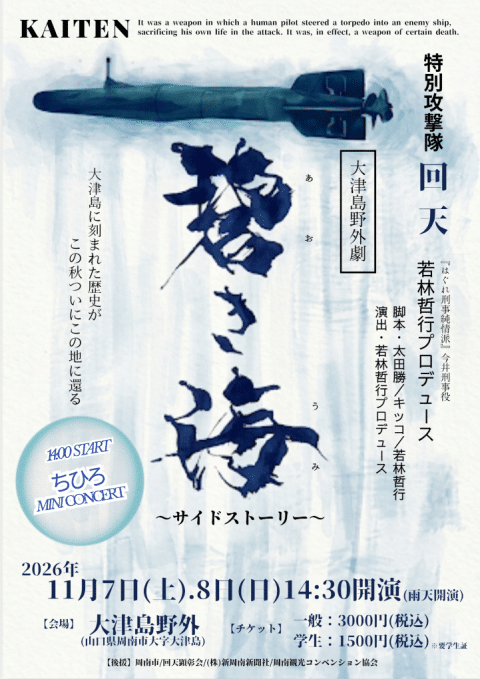
November 7, 2026
Event date:
-
November 8, 2026
Event end:
Historical Background & Kaiten Special Attack Units
The dark legacy of World War II casts a profound shadow over the coastal waters of Shunan, where the Imperial Japanese Navy established the notorious Kaiten human torpedo training base. These Kaiten special attack units represented one of the most desperate and tragic military developments of the late conflict, utilizing manned suicide torpedoes piloted by young volunteers. Young men stationed on remote island bases faced the agonizing psychological reality of impending martyrdom, torn between a sense of national duty and private youthful dreams. This theatrical production confronts that historical trauma head-on, unearthing the human stories buried beneath official military records and wartime propaganda.
The narrative meticulously reconstructs the oppressive atmosphere of the training camps, where camaraderie among soldiers flourished against the ticking clock of their deployment dates. Historical accounts detail how these young recruits grappled with isolation, fear, and the intense psychological conditioning designed to accept absolute sacrifice without hesitation. By focusing on the intimate human dimension of these soldiers, the play strips away abstract historical statistics to reveal vulnerable individuals confronting their final days. The setting itself becomes a character, holding the silent echoes of decisions that changed the course of countless families forever.
- Haunting historical exploration of the Imperial Japanese Navy’s Kaiten human torpedo training installations
- Psychological examination of young recruits facing inevitable martyrdom under extreme military indoctrination
- Intimate focus on soldier camaraderie, private fears, and the human cost of total wartime mobilization
- Striking contrast between official military propaganda and the raw emotional reality of daily camp life
- Ethical interrogation of systemic pressures driving young volunteers toward terminal suicide missions
- Respectful theatrical dedication honoring the memory of those who perished in Yamaguchi coastal waters
- Vital historical bridge connecting contemporary spectators with the painful wartime legacy of Shunan
- Powerful reminder of the fragile nature of peace and the permanent scars left by armed conflict
Event Schedule
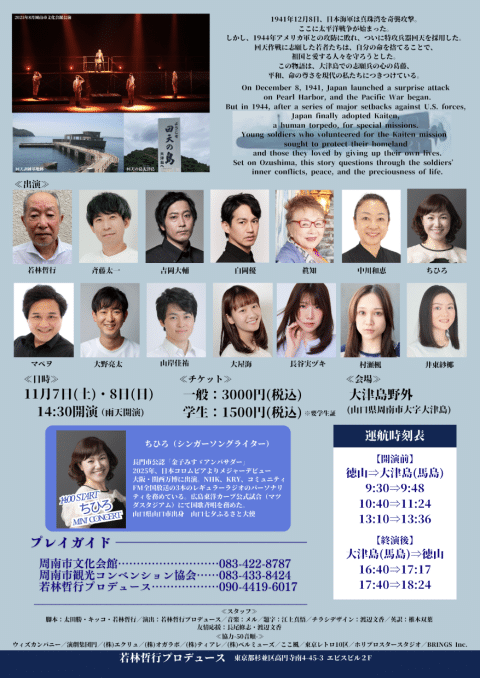
- Event Date: November 7, 2026 (Sat) and November 8, 2026 (Sun)
- Event Duration: Approximately 2 hours including a brief intermission break between theatrical acts
Visiting this event? Don’t miss out on these amazing activities and local experiences while you’re here.
Ticket Prices
- How Tickets Are Sold: Available via authorized Japanese ticket agencies, official online booking portals, and designated box office channels
- Admission Type: Reserved seating entry requiring a legally compliant digital pass or physical ticket for admission to the venue
- Ticket Pricing: Ranges from a minimum of $35.00 to a maximum of $75.00 depending on seat selection and student or adult tier availability
- Special Seating Options: Designated open-air reserved viewing blocks providing clear sightlines toward the coastal outdoor performance stage
- VIP Options: Premium admission packages featuring exclusive commemorative event pamphlets and priority venue entry privileges
Outdoor Theatre & “The Azure Sea” Story
The open-air theatrical format of “The Azure Sea ~Side Story~” offers a visceral, immersive storytelling experience set against the actual coastal backdrop where the history unfolded. Free from the enclosed boundaries of traditional indoor theaters, the production utilizes the natural elements of Otsushima to amplify its emotional and dramatic impact. The story weaves fictionalized accounts and historical records into a cohesive narrative that examines the daily lives and inner thoughts of the island’s wartime inhabitants. Every scene is shaped by the blowing sea breeze and the vast expanse of the horizon, grounding the drama in absolute realism.
Enjoy Your Event Stress-Free with Japan Travelo
Do you know? Planning events, festivals, concerts, and cultural experiences in Japan can be overwhelming. Japan Travelo brings everything together in one place, helping you manage your itinerary, transport, and accommodation with ease—so you can enjoy Japan without the stress of planning.
The plot focuses on the intricate interpersonal dynamics among soldiers, local townspeople, and visiting families navigating the harrowing final months of the war. As rumors of defeat and ultimate surrender swirl, characters must reconcile their immediate personal desires with the overwhelming demands of military duty and fate. The dialogue is sharp, poignant, and deeply resonant, capturing the quiet moments of connection forged under the constant threat of separation and death. These intimate vignettes humanize the historical figures, transforming distant historical dates into living, breathing human experiences.
- Immersive open-air theatrical format utilizing the actual coastal setting of Otsushima Island
- Natural elements like sea breezes and horizon views organically enhancing the dramatic presentation
- Seamless weaving of historical records and fictionalized narratives into a cohesive human story
- Exploration of interpersonal bonds among soldiers and locals navigating the final months of war
- Poignant dialogue capturing quiet moments of connection under the threat of separation and death
- Masterful utilization of the vast Seto Inland Sea landscape as a dynamic natural stage backdrop
- Powerful emotional arc guiding spectators from gentle reflection to profound historical catharsis
- Definitive proof of how site-specific outdoor drama can honor difficult history with unmatched grace
Getting to the Venue
- City and Country: Shunan, Yamaguchi Prefecture, Japan
- Venue Name: Otsushima Outdoor Park (Open-air island staging grounds)
- Google Maps Address: 2823 Otsushima, Shunan, Yamaguchi 745-0057, Japan
Otsushima Island & Its Wartime History
The secluded island of Otsushima holds a unique and solemn place in Japanese military history as the primary wartime training ground for the Kaiten special attack units. Surrounded by the azure waters of the Seto Inland Sea, the island’s natural beauty stands in stark, heartbreaking contrast to the dark training operations once housed there. Historic remnants of bunkers, barracks, and launch ramps still dot the landscape, whispering stories of the young men who trained and lived on its shores. Staging a play directly on this island transforms the theatrical experience into an immersive pilgrimage through history.
The geographical isolation of Otsushima amplified the psychological entrapment felt by the recruits, cutting them off from the mainland and civilian reality for months on end. Local island residents shared a complex, tense relationship with the military installation, bearing witness to the relentless drills and inevitable departures of the troops. This unique local perspective enriches the narrative, highlighting how the war enveloped entire regional communities rather than just distant battlefields. The island acts as a silent witness, holding the collective memory of a generation lost to the sea.
Bringing a theatrical production to Otsushima represents a groundbreaking moment for regional arts, marking the very first time an outdoor play is staged on the historic island. The open-air environment allows the natural coastal wind, waves, and sea spray to become organic elements of the dramatic presentation. Spectators traveling to the island embark on a journey that mirrors the physical pilgrimage required to confront this difficult chapter of national history. Every corner of the island seems to breathe with the spirits of the past, enhancing the authenticity of the performance.
The preservation of Otsushima’s wartime history ensures that future generations can learn firsthand about the devastating human toll exacted during the final months of the Pacific War. This outdoor production breathes new life into the silent ruins, transforming historical spaces into living stages for remembrance and reflection. Visitors leave the island with a profound appreciation for the local heritage and the resilience of a community marked by tragedy. It is a rare convergence of geography, history, and live performance that redefines site-specific theater.
- Solemn historical designation of Otsushima Island as the primary wartime Kaiten training base
- Striking juxtaposition between the serene Seto Inland Sea landscape and dark military operations
- Surviving wartime ruins, bunkers, and facilities serving as physical reminders of the past
- Psychological impact of island isolation on young recruits cut off from mainland civilian life
- Complex relationship between local island residents and the military personnel stationed nearby
- Groundbreaking achievement as the very first outdoor theatrical production staged directly on the island
- Organic integration of coastal winds, waves, and sea spray into the open-air dramatic presentation
- Powerful site-specific pilgrimage experience merging local heritage, history, and live performance
Tetsuyuki Wakabayashi’s Production & Performances
- Visionary artistic leadership helmed by acclaimed actor and producer Tetsuyuki Wakabayashi
- Wakabayashi bringing his extensive television and stage expertise, known for his work in Hagure Keiji Junjoha
- Stellar ensemble cast featuring talented performers including Taichi Saito, Daisuke Yoshioka, and Yu Shiraoka
- Powerful supporting contributions from Machi, Kazue Nakagawa, Mapeo, Ryota Ohno, and Keisuke Yamagishi
- Dynamic stage presence delivered by Kai Oya, Mizuki Hase, Kaede Murase, and Saya Ito
- Unwavering commitment from the entire cast to handle sensitive wartime material with utmost respect
- Exceptional physical and vocal stamina required to perform demanding dramatic roles in an open-air coastal setting
- Cohesive ensemble chemistry ensuring every character contributes depth to the historical narrative
Memory, War & Reflections on Peace
- Deep philosophical meditation on the collective memory of war and the responsibilities of surviving generations
- Examination of how historical trauma echoes through families and communities decades after a conflict ends
- Rejection of glorification in favor of stark, honest reflections on the sheer waste of human potential in war
- Encouragement of active audience self-reflection regarding the fragility of modern geopolitical stability
- Celebration of peace as an active, hard-fought human achievement requiring constant vigilance and care
- Exploration of art and theater as vital vehicles for historical reconciliation and public remembrance
- Poignant reminder of the individual faces behind grand political histories and wartime statistics
- Lasting cultural contribution reinforcing the urgent necessity of global peace and mutual understanding
Event Information
- Email: support@japanconcerttickets.com
- Phone Number: +81 834-22-8411
- Website: https://t.pia.jp/pia/event/event.do?eventCd=2629831
Location
FAQ
What is the primary historical focus of this outdoor production?
The play centers on the Kaiten human torpedo training units established by the Imperial Japanese Navy on Otsushima Island during World War II. It examines the psychological and emotional lives of young recruits facing inevitable sacrifice. The narrative honors their memory while exploring the heavy human cost of the conflict.
Who are the key creative forces and cast members involved?
The production is spearheaded by veteran actor and producer Tetsuyuki Wakabayashi, famed for his role in Hagure Keiji Junjoha. He leads a dedicated ensemble cast featuring talented performers such as Taichi Saito, Daisuke Yoshioka, and Yu Shiraoka. Together, the troupe brings raw emotional authenticity to the site-specific open-air staging.
What can audiences expect from the unique open-air island venue?
Performances are staged outdoors at Otsushima Outdoor Park on Otsushima Island in Yamaguchi Prefecture. Spectators are immersed in a site-specific environment where natural coastal elements like sea breezes and horizon views frame the drama. Visitors must take a ferry to the island, turning attendance into a reflective historical pilgrimage.
What weather policies apply to these outdoor coastal performances?
The production will proceed as scheduled in light rain, utilizing appropriate adjustments for the cast and audience. However, in the event of heavy rain, severe weather, typhoons, or natural disasters, performances may be moved indoors, postponed, or canceled. Patrons are advised to check official announcements regarding weather updates before traveling.
What entry rules apply regarding student tickets and age policies?
Student ticket holders must present a valid student ID at the gate to verify eligibility for discounted admission tiers. Children under school age and general attendees should review official booking guidelines regarding venue accessibility on the island. Advance ticket purchase is strongly recommended due to limited seating capacity.
How does the production balance historical tragedy with modern reflection?
The play avoids glorifying military conflict, choosing instead to focus on the vulnerability and human stories of the young recruits. Through poignant dialogue and sensitive direction, it encourages viewers to reflect on the value of peace. This approach transforms historical remembrance into an engaging, deeply moving contemporary theatrical experience.

Leave a Reply