
-
December 13, 2026
Event date:
-
January 17, 2027
Event end:
Elektra’s Story & Greek Tragedy
The timeless narrative of Elektra stands as one of classical antiquity’s most devastating explorations of familial destruction, vengeance, and moral retribution. Rooted deeply in the bloody mythology of the House of Atreus, the plot follows a princess consumed by grief after the assassination of her father. This production strips away extraneous melodrama to focus on the raw psychological core of a soul trapped by the demand for justice. Through meticulous theatrical framing, the ancient Greek framework is rendered startlingly immediate and relevant to modern audiences confronting systemic cycles of violence.
The tragedy centers heavily on the heavy inheritance of generational curses and the impossible choices forced upon descendants of corrupted power structures. Every scene pushes the characters deeper into a moral labyrinth where traditional concepts of right and wrong blur into indistinguishable shadows. As Elektra waits relentlessly for her brother’s return, her existence becomes defined entirely by a singular, consuming purpose. The play examines how this absolute fixation isolates her from normal human empathy, turning her into both a victim and an instrument of fate.
Translating this monumental Greek text into a contemporary Japanese stage context allows the universal themes of mourning and accountability to shine with renewed clarity. The narrative avoids simplifying the myth into a neat morality play, choosing instead to wallow in the messy, uncomfortable reality of human vengeance. Spectators are drawn into an oppressive atmosphere where every spoken word carries the weight of impending doom and inescapable destiny. It is a profound meditation on the cost of keeping past grievances alive in a world desperate for peace.
Enjoy Your Event Stress-Free with Japan Travelo
Do you know? Planning events, festivals, concerts, and cultural experiences in Japan can be overwhelming. Japan Travelo brings everything together in one place, helping you manage your itinerary, transport, and accommodation with ease—so you can enjoy Japan without the stress of planning.
The enduring power of Elektra lies in its unflinching look at human nature when stripped of comfort, safety, and familial love. By examining the psychological mechanics of revenge, the production challenges viewers to question whether true justice can ever be achieved through bloodshed. The storyline builds inexorably toward its chilling climax, leaving a lasting emotional impression on all who witness the downfall of the Atreus dynasty. This artistic interpretation honors the monumental scale of ancient Greek tragedy while injecting modern theatrical urgency into every line.
- Faithful dramatic adaptation of the ancient Greek tragedy focusing on the House of Atreus
- Exploration of generational curses, moral retribution, and the psychological weight of revenge
- Uncompromising portrayal of isolation, grief, and obsessive devotion to a singular purpose
- Examination of whether true justice can ever be born from cyclical acts of violence
- Seamless bridge connecting classical mythological themes with contemporary theatrical sensibilities
- Intense dramatic narrative pacing building steadily toward an inevitable, devastating climax
- Deep psychological excavation of characters caught in the inescapable machinery of fate
Event Schedule
- Event Date: December 13, 2026 (Sun) – January 17, 2027 (Sun)
- Event Duration: Approximately 2 hours and 30 minutes including an intermission break
Visiting this event? Don’t miss out on these amazing activities and local experiences while you’re here.
Agamemnon, Clytemnestra & Orestes
The spectral presence of King Agamemnon hangs over the entire production like a suffocating shroud, dictating every action and reaction of the surviving family members. His sacrifice of Iphigenia and subsequent murder upon returning from Troy form the original sin that poisons the generational well of the House of Atreus. Though he is dead, his memory functions as an active catalyst, worshipped by Elektra as a martyred saint and dismissed by his killers as a necessary casualty. The drama constantly interrogates how past patriarchal violence ripples forward to corrupt the lives of the innocent.
Queen Clytemnestra emerges not merely as a villainous stereotype, but as a complex, haunted woman paralyzed by the guilt of her own murderous actions. Her relationship with Elektra is a war zone of psychological attrition, characterized by mutual loathing, shared trauma, and desperate self-justification. Tormented by nightmares and paranoia, Clytemnestra attempts to maintain a fragile grip on stolen power while buckling under the weight of maternal dread. The production grants her character moments of raw humanity, complicating the moral binary of the ancient myth.
- The omnipresent legacy of Agamemnon casting a dark, foundational shadow over the entire plot
- Complex psychological portrait of Clytemnestra torn between royal ambition and paralyzing guilt
- Relentless psychological warfare defining the toxic maternal dynamic between queen and daughter
- Orestes’ harrowing return from exile to fulfill the inescapable blood debt of matricide
- Interrogation of how historical patriarchal violence corrupts subsequent generations of survivors
- Ambivalent sibling reunion exploring the emotional trauma of executing a preordained revenge
- Nuanced characterizations avoiding simple hero-villain binaries in favor of tragic gray areas
Ticket Prices
- How Tickets Are Sold: Available via Horipro Stage online ticketing, Pia ticket portals, and authorized playguides across Japan
- Admission Type: Reserved seating entry requiring a valid physical ticket or digital admission pass for hall entry
- Ticket Pricing: Ranges from a minimum of $45.00 to a maximum of $110.00 depending on seating tier and venue location
- Special Seating Options: Main floor S-zone seats and lower tier gallery views offering optimal acoustic and visual engagement
- VIP Options: Premium priority packages including exclusive cast pamphlets and expedited entry lanes at the theater doors
Poetry, Music & Theatrical Expression
The artistic identity of this production is defined by a striking synthesis of poetic lyricism and contemporary musical composition designed to heighten emotional resonance. Lyrics crafted by Ako Takahashi blend seamlessly with original musical scores by Brandon Lee, creating a dense auditory landscape that functions almost as a separate character. Rather than relying on standard theatrical dialogue, the production utilizes rhythmic spoken verse and haunting melodies to articulate unspoken psychological depths. This lyrical approach elevates the staging from a conventional play into a hypnotic, multi-sensory theatrical poem.
Music in the production acts as an emotional barometer, shifting fluidly from delicate, melancholic motifs to thunderous, discordant walls of sound during moments of crisis. The instrumental arrangements interact directly with the actors’ vocal cadences, establishing a hypnotic rhythm that draws the audience deep into the protagonist’s fevered mind. Every musical cue is meticulously timed to underscore the psychological tension, ensuring that sound design plays an active role in storytelling. This sophisticated integration of melody and verse challenges traditional boundaries between musical theater and straight drama.
The poetic delivery of the text requires extraordinary technical skill from the cast, who must balance rhythmic precision with raw, naturalistic emotional expression. Words are treated as musical notes, with pauses, crescendos, and dramatic silences carrying as much narrative weight as full orchestral swells. This stylized approach prevents the ancient tragedy from feeling dusty or archaic, transforming the script into a vibrant modern incantation. Audiences experience a rare synergy where language and auditory art merge into a unified, unforgettable aesthetic experience.
The deliberate choice to emphasize poetry and music over literal realism opens up abstract dimensions that standard dramatic staging often fails to reach. It allows the audience to feel the suffocating atmosphere of revenge and grief in their bones rather than simply observing it from a distance. The resulting performance resembles a dark, elegant ritual where every artistic element works in absolute harmony to serve the overarching tragedy. It stands as a masterclass in how modern directors can reinvent classical texts through innovative soundscapes and verse.
- Striking artistic fusion of poetic lyricism and contemporary musical composition
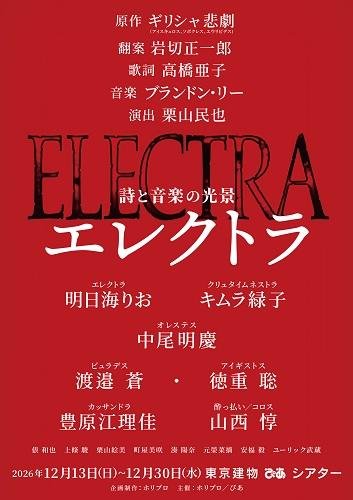
- Original musical scoring by Brandon Lee paired with evocative lyrics by Ako Takahashi
- Rhythmic spoken verse replacing standard dialogue to convey intense psychological states
- Dynamic musical arrangements functioning as an emotional barometer for the unfolding tragedy
- Meticulous timing aligning instrumental cues with actor vocal cadences and dramatic pauses
- Blurring of traditional boundaries between straight dramatic theater and lyrical performance art
- Immersive, multi-sensory sound design evoking the suffocating atmosphere of the Atreus myth
Event Information
- Email: support@horipro.jp
- Phone Number: +81 3-3490-4949
- Website: https://t.pia.jp/pia/event/event.do?eventBundleCd=b2669927
Cast Performances & Character Relationships
- Riveting central performance by former Takarazuka Revue star Rio Asumi in the demanding title role
- Exceptional ensemble support led by Midori Kimura, Akiyoshi Nakao, and So Watanabe
- Complex interpersonal dynamics exposing the fractures of trust and loyalty within a broken family
- Nuanced portrayals balancing classical theatrical grandeur with intimate psychological vulnerability
- Masterful ensemble synchronization highlighting shifting power balances and emotional betrayals
- Powerful onstage chemistry driving the tense confrontations between grieving siblings and reigning tyrants
- Critical acclaim praising the cast’s ability to navigate dense poetic verse with absolute clarity
Direction, Stage Design & Dramatic Atmosphere
- Visionary theatrical direction helmed by acclaimed Japanese director Tamiya Kuriyama
- Minimalist, highly stylized stage architecture maximizing the intimate acoustics of the theater
- Atmospheric lighting design carving out stark shadows and oppressive claustrophobic spaces
- Expert spatial choreography reflecting the emotional isolation and entrapment of the characters
- Seamless transitions between lyrical interludes and explosive dramatic confrontations
- Creation of an austere, ritualistic environment that strips away modern distractions
- Masterful pacing maintaining intense psychological suspense from opening scene to final blackout
Themes of Revenge, Grief & Human Emotion
- Unflinching exploration of how consuming grief transforms human empathy into bitter hatred
- Sociological critique of how cycles of revenge perpetuate generational trauma without resolution
- Examination of emotional isolation experienced by individuals trapped in obsessive missions
- Celebration of the resilience of the human spirit even within absolute moral darkness
- Interrogation of the fine line separating justice from cold-blooded murder and tyranny
- Universal theatrical meditation on mourning, forgiveness, and the heavy price of closure
- Deep psychological mapping of visceral human emotions under extreme catastrophic pressure
Getting to the Venue
- City and Country: Tokyo and Aichi, Japan
- Venue Name: Tokyo Tatemono Pia Theater and Niterra Nippon Tokushu Togyo Civic Hall Village Hall (Aichi Prefecture)
- Google Maps Address: 1 Chome-3-3 Higashishinbashi, Minato City, Tokyo 105-0021, Japan
Location
FAQ
What is the primary literary inspiration behind this stage production?
The play is directly inspired by the classical Greek tragedy Elektra, focusing on the mythological curse of the House of Atreus. It reinterprets the ancient revenge narrative through a modern theatrical lens emphasizing poetry and music. This adaptation bridges historical mythology with contemporary dramatic sensibilities for modern audiences.
How do poetry and music function within the staging?
Original music and rhythmic spoken verse replace traditional dialogue to convey the intense psychological states of the characters. Lyrics by Ako Takahashi and music by Brandon Lee create a dense, hypnotic auditory landscape throughout the performance. This lyrical approach elevates the production into a multi-sensory theatrical poem rather than a standard play.
Who are the key creative leads steering this project?
The production is helmed by renowned theatre director Tamiya Kuriyama, known for his precision and deep psychological staging. The musical score and lyrical framework are crafted by Brandon Lee and Ako Takahashi respectively. Together with an elite cast, these creators deliver an unforgettable artistic experience.
What can audiences expect from the venue environment?
Performances take place in mid-sized seated venues like the Tokyo Tatemono Pia Theater and Aichi's Village Hall. These spaces are chosen specifically for their excellent acoustics, which are essential for text- and music-driven works. Audiences are provided an intimate, focused environment that maximizes emotional engagement with the stage.
What are the specific entry rules regarding children and latecomers?
Children under school age are strictly prohibited from entering the auditorium to maintain an undisturbed viewing atmosphere. Late arrivals will not be admitted immediately and must wait until a designated break in the performance. Patrons are strongly encouraged to arrive early to clear security and find their assigned seats.
How does the production approach the theme of revenge?
Rather than glorifying bloodshed, the play examines the heavy psychological toll and destructive nature of cyclical vengeance. It portrays characters trapped by their own obsessions, questioning whether true justice can ever be achieved through violence. This nuanced perspective transforms an ancient myth into a profound meditation on modern human emotion.

Leave a Reply