

What to expect in 2026
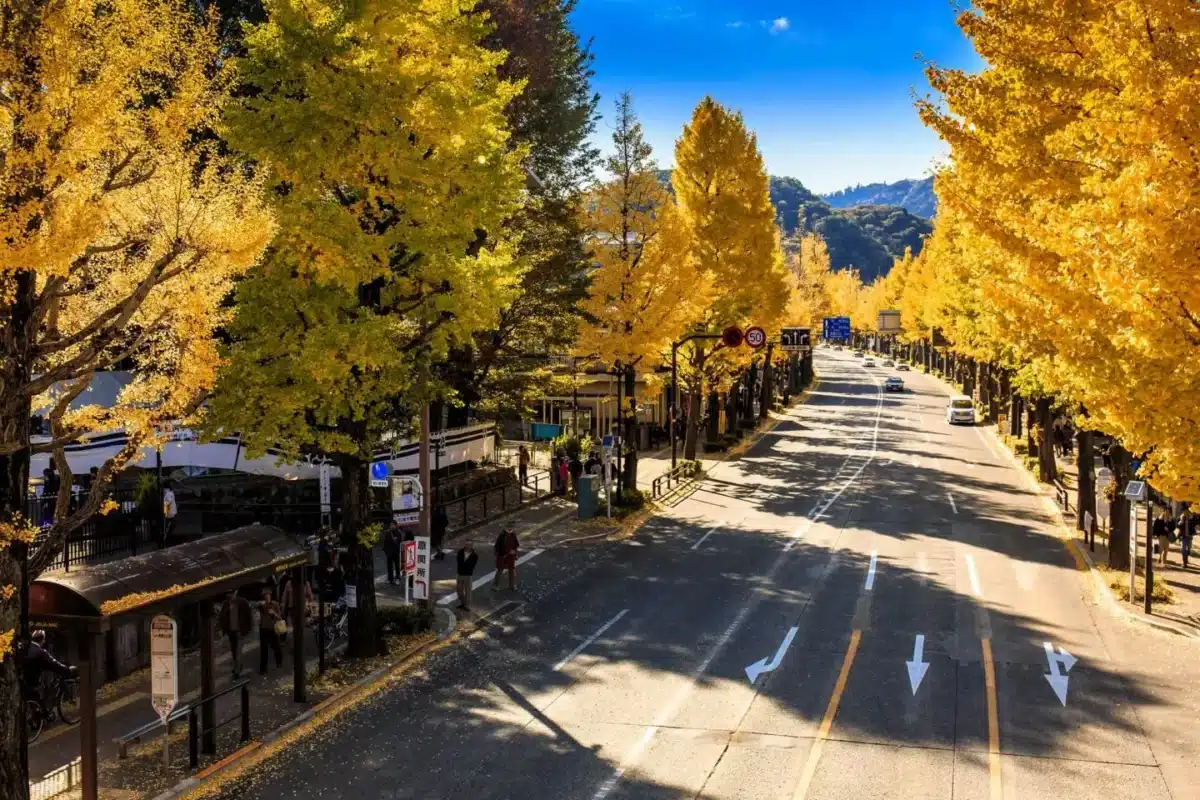
Hachioji Gingko Festival 2026 is a large community-led autumn celebration along the historic Koshu Kaido in Hachioji, western Tokyo. The festival is held during the season when the avenue’s famous ginkgo trees turn golden, creating one of the city’s most distinctive autumn landscapes. The official festival describes the event as a citizen-participation festival designed to connect residents, students, visitors and local communities through nature, culture, entertainment and neighborhood activities.
The 2026 edition is especially significant because it marks the 100-year anniversary of the ginkgo avenue along the Koshu Highway. The official theme celebrates the centenary of the avenue, while the festival slogan looks toward the next 100 years. The trees themselves were planted between the late 1920s and the early 1930s as commemorative trees connected with the development of the Musashino Imperial Mausoleum area.
Visitors can expect a combination of autumn sightseeing, local food, regional products, stage performances, community activities, traditional-style checkpoint orienteering and special festival attractions.
Enjoy Your Event Stress-Free with Japan Travelo
Do you know? Planning events, festivals, concerts, and cultural experiences in Japan can be overwhelming. Japan Travelo brings everything together in one place, helping you manage your itinerary, transport, and accommodation with ease—so you can enjoy Japan without the stress of planning.
The event is spread across a long section of Hachioji rather than being contained within a single festival ground. The main scenery stretches for almost 4 kilometers between the Oiwake area and the entrance to Takao Station, with approximately 770 ginkgo trees lining both sides of the Koshu Kaido.
The 2026 edition is the 47th Hachioji Gingko Festival and is being organized around the theme of the 100-year milestone of the Koshu Kaido ginkgo avenue. The official programme is being updated as individual activities are finalized, so visitors should check the organizers’ latest announcements before traveling.
Event dates
Hachioji Gingko Festival 2026 is scheduled for mid-November 2026, with the exact dates intentionally left as TBD here in accordance with the requested event listing format.
The festival is normally organized as a two-day autumn event, with daytime activities taking place across multiple venues along the Koshu Kaido. Japan Travel currently describes the 2026 edition simply as a mid-November event and notes that dates were awaiting confirmation on its listing.
The official festival website has subsequently announced the 2026 edition and is publishing programme details as they become available.
Visitors should allow several hours for the event because the festival extends across a substantial area. Those wanting to complete the checkpoint orienteering route will need additional time to walk between the participating locations.
The official programme indicates that the main festival activities generally operate during daytime hours, with the checkpoint orienteering taking place during the morning and afternoon.
Visiting this event? Don’t miss out on these amazing activities and local experiences while you’re here.
Venue & event locations
The principal setting is the Koshu Kaido, also known as National Route 20, in Hachioji, Tokyo.
The festival area extends approximately 4 kilometers from the Oiwakecho Intersection toward the Kobotoke Sekisho area near the Takao side of Hachioji. Around 770 ginkgo trees line the avenue, creating the distinctive golden corridor that gives the festival its name.
Important festival areas include:
- Koshu Kaido and its ginkgo-lined streets
- Oiwakecho Intersection
- Ryonan Park
- Ryonan Ginkgo Hall
- Ryonan Park Main Area
- Ryonan Park Annex Area
- Minami-Asakawa Bridge riverside
- Tama Imperial Mausoleum approach
- Kobotoke Sekisho ruins
- The various historical checkpoint locations
The official 2026 event information identifies Ryonan Park, the Ryonan Hall grounds and the riverside area around Minami-Asakawa Bridge as important festival locations for markets, tourism exhibitions and food vendors.
Because the festival is community-based, different areas have different purposes. Some function as performance stages, others as market areas, while the long avenue itself becomes the main sightseeing route through the golden ginkgo trees.
Full holiday programme
Hachioji Gingko Festival is primarily an autumn cultural and community festival rather than a conventional holiday event. Its programme combines seasonal sightseeing with local commerce, cultural activities and entertainment.
The 2026 programme includes several recurring elements:
- Sekisho Orienteering
- Furusato Bazaar
- National and neighboring-region tourism and product exhibitions
- Stage performances
- Community entertainment
- Parade activities
- Food stalls
- Local specialist shops and vendors
- Family activities
- Ginkgo-lined walking routes
The official programme describes the Furusato Bazaar as a food and shopping area where local specialist businesses, temporary stalls and other vendors provide opportunities to eat while walking around the festival grounds.
The tourism and product exhibition brings together Hachioji’s neighboring communities and other participating regions. The 2026 programme includes regional exchanges involving areas such as Sagamihara’s Midori Ward, with local products and tourism promotion included in the festival environment.
The event is therefore as much about community participation as autumn scenery. Visitors can move between the market areas, performance spaces and ginkgo-lined road while experiencing different aspects of Hachioji culture.
Main attractions & highlights
The golden ginkgo avenue is the central attraction. Approximately 770 trees stretch along nearly 4 kilometers of the Koshu Kaido, creating a continuous autumn landscape between western Hachioji and the Takao area.
The trees were planted in the early Showa period, and the 2026 festival specifically celebrates the 100-year milestone associated with the historic avenue. This gives the 2026 edition an additional heritage theme beyond the normal autumn festival programme.
Another major attraction is the Sekisho Orienteering experience. Visitors purchase a wooden tsuko tegata, inspired by historical travel permits, and use it to collect seals at 12 checkpoint locations. Participants who collect enough seals can take part in a lottery, while those completing the full route can qualify for a special completion prize.
Other major attractions include:
- Autumn photography along the ginkgo avenue
- Traditional-style checkpoint stations
- Local food and shopping stalls
- Regional tourism exhibitions
- Stage performances
- Marching and community performances
- Classic vehicle displays and parade activities
- Family-oriented activities
- Local crafts and products
Markets, decorations & themed areas
The festival’s market atmosphere is centered around the Furusato Bazaar and regional tourism and product exhibitions.
The Furusato Bazaar uses several festival areas, including the Ryonan Hall grounds, Ryonan Park and the riverside area near Minami-Asakawa Bridge. Vendors include local specialist shops, temporary food stalls and other participating businesses.
Visitors can expect seasonal foods, local products, regional specialties and shopping opportunities rather than a single centralized market.
The 2026 regional tourism exhibition also gives participating municipalities and neighboring areas opportunities to promote their destinations and local products. This adds a broader regional dimension to the festival.
The main visual decoration is provided naturally by the enormous ginkgo canopy. Golden leaves line the avenue and create a strong seasonal atmosphere throughout the festival area.
The centenary theme also gives the 2026 edition a special identity, connecting the current celebration with the history of the ginkgo avenue and its place in Hachioji’s landscape.
Events & entertainment schedule
The detailed 2026 event schedule is being released progressively by the organizers, but the festival structure includes several established activities.
The Sekisho Orienteering operates during daytime hours, with participants moving between 12 checkpoints from the Oiwake area toward Kobotoke. The official 2026 information confirms the checkpoint activity and the associated wooden travel pass system.
Stage entertainment is centered at the dedicated stage in Ryonan Park. The official event programme identifies the park as a location for live performances.
The Tama Imperial Mausoleum approach is also used as an event space. The 2026 programme includes vehicle displays, Japanese taiko, yosakoi, dance and other performances in this area.
Previous editions have also included marching-band performances and a classic-car parade, and these remain important parts of the festival’s established identity. The 2025 programme included both a marching-band parade and a classic-car parade.
Admission & ticket information
General admission to Hachioji Gingko Festival is free. Visitors do not need a general festival ticket to walk through the ginkgo avenue, visit the market areas or watch the publicly accessible performances. Japan Travel also lists the festival as free entry.
The main optional paid activity is the Sekisho Orienteering travel pass.
For the 2026 edition, the official festival website lists:
- Wooden Koshu Kaido travel pass: approximately $5
- 100-year commemorative travel-pass and goods set: approximately $10
The official Japanese prices are ¥700 for an individual travel pass and ¥1,500 for the limited commemorative set. The USD figures are approximate conversions for this listing.
The commemorative set is limited to 100 units according to the current official information.
Purchasing the pass is optional. Visitors who simply want to enjoy the ginkgo trees, food stalls, markets and performances can attend without participating in the checkpoint activity.
Special experiences & activities
The Sekisho Orienteering is one of the most distinctive experiences at Hachioji Gingko Festival.
The activity recreates the idea of passing through historical checkpoints. The 2026 route includes 12 checkpoint locations operated by local neighborhood associations and community organizations.
Participants can collect branded seals at each checkpoint using their wooden travel pass.
Collecting at least five seals allows participants to receive a verification mark at the designated magistrate station and enter the festival lottery. Completing all 12 checkpoints can qualify participants for a perfect-completion prize.
This turns the festival into a walking experience rather than simply a viewing event.
The route also provides opportunities to explore neighborhoods along the Koshu Kaido that visitors might otherwise pass through without stopping.
Other special experiences include sampling regional food, visiting local product stalls, watching performances and photographing the ginkgo-lined avenue.
Family & children’s activities
Hachioji Gingko Festival is designed as a community event suitable for families.
Children can participate in a dedicated checkpoint-style activity known as the Muchan and Gincyan Sekisho Tour stamp rally. The official 2026 programme identifies this as a paper-based activity for children.
Families can also enjoy:
- Ginkgo leaf viewing
- Walking between checkpoint areas
- Food stalls
- Local product stalls
- Stage performances
- Community entertainment
- Vehicle displays
- Tourism exhibitions
- Children’s stamp activities
The combination of walking, collecting stamps and visiting different parts of the festival makes the event suitable for families who prefer interactive sightseeing rather than remaining at one stage.
A baby rest area is also planned for the festival. The official FAQ states that baby tents, baby flat areas and rest spaces are scheduled to be provided.
Event rules
Visitors should follow instructions from festival staff, volunteers and local authorities, particularly because the festival takes place across public roads and residential neighborhoods.
Important considerations include:
- Follow temporary traffic restrictions.
- Use designated pedestrian areas.
- Follow instructions around parade routes.
- Keep roads and emergency access routes clear.
- Do not obstruct performers or parade participants.
- Keep children close in crowded areas.
- Dispose of food and other waste appropriately.
- Follow vendor instructions when purchasing food.
- Use designated bicycle parking areas.
- Respect residential neighborhoods along the route.
- Follow official safety instructions during vehicle parades.
The official festival FAQ warns that road closures are implemented during the event and that National Route 20 can become congested.
Visitors should also remember that the festival is organized across a large community area rather than an enclosed theme park, so normal consideration for residents and road users is particularly important.
How to get there
Hachioji is located in western Tokyo and is well connected by rail.
The festival can be approached from several stations on the JR Chuo Line, with Nishi-Hachioji Station and Takao Station particularly useful for reaching different parts of the event area. GO TOKYO identifies both stations as access points for the festival.
Nishi-Hachioji Station is convenient for the eastern and central sections of the festival.
Takao Station is useful for visitors approaching from the western end of the ginkgo avenue.
The event stretches across a long section of the Koshu Kaido, so visitors should choose their arrival station based on the activities they want to see.
For the checkpoint orienteering, starting near the Oiwake side and gradually moving toward the Kobotoke side provides a natural way to experience the route.
Public transport & parking
Public transport is strongly recommended.
The official festival FAQ states that there is no general festival parking available and specifically recommends using public transportation.
Visitors arriving by train can use:
- JR Chuo Line
- Nishi-Hachioji Station
- Takao Station
- Keio Takao Line services through Takao Station
GO TOKYO lists Nishi-Hachioji Station on the JR Chuo Line and Takao Station on both the JR Chuo Line and Keio Takao Line as useful access points.
Bicycle parking is planned near the main festival area. The official FAQ asks visitors arriving by bicycle or motorcycle to use the designated parking areas rather than leaving vehicles in the festival route.
Because road restrictions and congestion are expected, driving directly into the festival area is not recommended.
Accommodation areas
Visitors staying overnight can choose from several areas around western Tokyo.
Hachioji Station is a practical base for travelers wanting access to restaurants, shops, hotels and rail connections.
Nishi-Hachioji is useful for visitors who want to be closer to the eastern portion of the festival.
Takao is another option, particularly for travelers combining the festival with Mount Takao sightseeing.
Recommended areas include:
- Hachioji Station
- Nishi-Hachioji
- Takao
- Around Keio Hachioji
- Western Tokyo areas with direct rail access
Staying in central Tokyo is also possible because Hachioji is connected to the capital by the JR Chuo Line, although visitors should allow additional travel time on festival days.
For a full autumn itinerary, Takao is particularly convenient for combining the festival with hiking, temples and seasonal mountain scenery.
Food, drinks & seasonal specialties
Food is an important part of the festival atmosphere, especially around the Furusato Bazaar and temporary vendor areas.
The official event description states that local specialist shops, food stalls and temporary vendors participate in the bazaar, creating opportunities to eat while walking around the festival grounds.
Visitors can expect a mixture of local foods, regional products and festival-style snacks rather than a single fixed menu.
The regional tourism and product exhibition also introduces specialties from Hachioji and participating neighboring areas.
Popular things to look for include:
- Local Japanese street foods
- Warm seasonal snacks
- Regional packaged foods
- Traditional sweets
- Local agricultural products
- Drinks and refreshments
- Hachioji-area specialties
- Products from neighboring municipalities
Autumn is particularly suitable for enjoying warm foods while walking beneath the golden ginkgo trees.
Because vendor participation can change from one edition to another, the final 2026 vendor list should be checked through the official festival programme.
Accessibility
The festival covers a large outdoor area with public roads, sidewalks, parks and community venues, so accessibility conditions vary between locations.
Visitors with mobility concerns should plan their route in advance and avoid attempting to cover the entire approximately 4-kilometer festival corridor if long-distance walking is difficult.
The official festival FAQ confirms that rest facilities are planned, including baby rest areas.
Visitors should also expect crowds around popular viewing areas and market zones.
The long linear layout can be useful because visitors can choose a smaller section of the event rather than navigating one crowded central venue.
For those using wheelchairs or mobility aids, checking the latest venue map and temporary traffic arrangements before visiting is advisable.
Best days & times to visit
The best time to visit depends on whether your priority is autumn scenery, shopping, family activities or the main entertainment.
For the strongest ginkgo experience, visit during daylight hours when the golden foliage is clearly visible. Morning visits can provide a more relaxed walking atmosphere and are useful for visitors planning to complete the Sekisho Orienteering route.
Midday is useful for combining sightseeing with food stalls, markets and stage entertainment.
Visitors interested in the classic-car parade or major public performances should check the final 2026 programme carefully because individual activities are scheduled separately from the general festival opening.
The checkpoint orienteering operates during the daytime, making earlier arrival useful for participants who want to visit all 12 checkpoints.
For photographers, the ginkgo avenue is the central attraction. Walking between different sections allows visitors to find quieter stretches and different perspectives of the tree canopy.
Previous year’s highlights
The previous edition featured the same core elements that have made Hachioji Gingko Festival a long-running community attraction.
Hachioji City described the previous festival programme as including Sekisho Orienteering, the Koshu Kaido parade and the Furusato Bazaar.
The previous edition also featured a classic-car parade and marching-band performances. The classic-car programme included approximately 100 vehicles, with the parade traveling along the festival area as part of its traffic-safety and disaster-prevention theme.
The classic-car event was connected to one of the festival’s traditional pillars: the Furusato Bazaar, Sekisho Orienteering and classic-car parade.
The previous festival also continued the 12-checkpoint orienteering activity, where participants used a wooden travel pass and collected checkpoint marks along the route. GO TOKYO describes the activity as a tour around 12 checkpoints using the traditional-style tsuko tegata.
These established activities provide a useful guide to what visitors can expect from the 2026 edition, although the organizers are still updating individual programme details.
Official event information
The official Hachioji Gingko Festival website is the primary source for the 2026 programme, venue information, checkpoint orienteering details, traffic arrangements and updates.
The festival is organized by the Hachioji Gingko Festival Executive Committee, with Hachioji City and numerous local community organizations supporting the event.
The official festival website also confirms that programme information is being updated as arrangements are finalized.
For the latest information, visitors should check:
https://en.japantravel.com/tokyo/hachioji-gingko-festival/31991
The official contact information lists the Hachioji Gingko Festival Executive Committee at Ryonan Ginkgo Hall, with telephone support available for event enquiries.
Video
Location
FAQ
What are the general dates when the Hachioji Gingko Festival takes place every year?
The festival is held annually during mid-November when the urban ginkgo trees reach their peak brilliant yellow coloration. Because exact weekend dates shift slightly each year based on foliage conditions, checking official announcements ahead of time is recommended. The celebration typically spans a vibrant two-day weekend schedule running from morning until late afternoon.
How can travelers reach the festival location conveniently using public transportation?
Visitors can take the JR Chuo Line directly from central Tokyo and exit at either Nishi-Hachioji Station or Takao Station. Both stations sit within easy walking distance of the main Koshu Kaido festival route and primary event zones. Utilizing regional rail networks makes getting to the western suburbs smooth and efficient for day-trippers.
Is it necessary to purchase admission tickets to enter the festival grounds?
No admission tickets or entry fees are required, as the entire festival takes place openly along public streets and community parks. Visitors can walk freely beneath the golden canopy, enjoy stage shows, and browse bazaar stalls completely free of charge. Optional purchases apply only to specific items like food, crafts, or optional checkpoint orienteering travel passes.
What is the purpose of the traditional Tsuko Tegata wooden transit passes?
The wooden passes serve as interactive orienteering tools that let participants collect stamps at historical checkpoints between Oiwake and Kobotoke. This playful activity mimics ancient Edo period travel permits used along the historic Koshu Kaido highway. Completed wooden passes also double as wonderful keepsakes to remember your journey through the golden tree corridor.
What kind of food and shopping options can visitors expect to find on-site?
The festival features an expansive open-air bazaar filled with numerous food stalls offering regional street snacks, grilled specialties, and warm drinks. Shoppers can also browse vendor tents selling handmade crafts, local agricultural produce, pottery, and unique Tokyo souvenirs. These community-run booths provide a fantastic taste of local flavors and support regional tree conservation efforts.

Leave a Reply