
-
September 23, 2026
Event date:
-
September 23, 2026
Event end:
What to expect in 2026
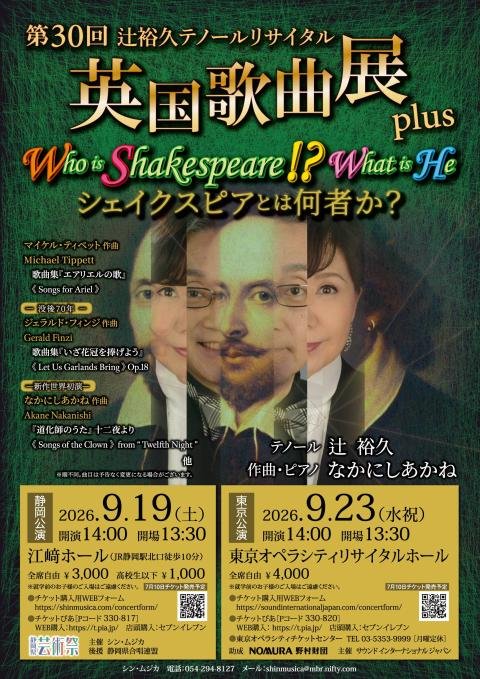
Hirohisa Tsuji Tenor Recital 2026 will take place on Wednesday, September 23, 2026, at Tokyo Opera City Recital Hall in Nishi-Shinjuku, Tokyo. The performance is part of the 30th British Art Song Festival Plus, a long-running recital series centered on British song repertoire and the work of tenor Hirohisa Tsuji and composer-pianist Akane Nakanishi. The Tokyo performance begins at 2:00 PM.
The 30th edition is presented around Shakespeare, with the theme “Who is Shakespeare!? What is He.” The programme brings together settings of Shakespeare texts by Joseph Haydn, Michael Tippett, Gerald Finzi and Akane Nakanishi. A major feature of the event is the world premiere of Nakanishi’s new work “Songs of the Clown” from Shakespeare’s Twelfth Night.
The programme also includes Nakanishi’s “Shakespeare’s Fairies – A Midsummer Night’s Dream,” creating a strong literary connection between the works. The concert combines established British art song with contemporary Japanese composition, while keeping the performance format intimate through tenor and piano.
Enjoy Your Event Stress-Free with Japan Travelo
Do you know? Planning events, festivals, concerts, and cultural experiences in Japan can be overwhelming. Japan Travelo brings everything together in one place, helping you manage your itinerary, transport, and accommodation with ease—so you can enjoy Japan without the stress of planning.
The 30th anniversary edition continues Tsuji and Nakanishi’s long-running collaboration. Tsuji has a particular connection with English-language vocal repertoire, while Nakanishi performs as pianist and presents her own compositions. Tsuji’s official profile notes his extensive activity in opera, oratorio, early music and contemporary music, as well as his work on world premieres.
Event dates
Hirohisa Tsuji Tenor Recital 2026 takes place on one day only.
Date: Wednesday, September 23, 2026
Performance time: 2:00 PM
Venue: Tokyo Opera City Recital Hall
The September 23 performance is the Tokyo presentation of the 30th British Art Song Festival Plus. The organisers have also scheduled a Shizuoka performance earlier in September, but the Tokyo event is the performance at Tokyo Opera City Recital Hall.
The organisers state that the programme order is not fixed and that the programme may be changed without prior notice. Visitors should therefore check the latest information before attending.
Visiting this event? Don’t miss out on these amazing activities and local experiences while you’re here.
Venue & festival site
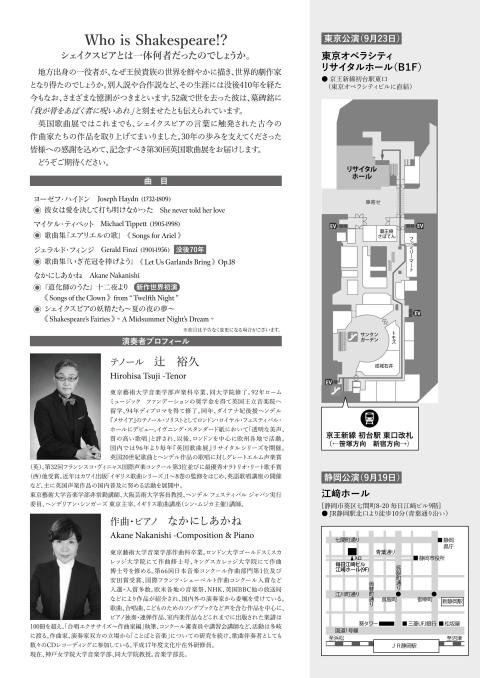
The recital will be held at Tokyo Opera City Recital Hall, part of the Tokyo Opera City complex in Nishi-Shinjuku, Shinjuku-ku, Tokyo. The address of the complex is 3-20-2 Nishi-Shinjuku, Shinjuku-ku, Tokyo 163-1403, Japan.
The Recital Hall is located on the B1 floor of Tokyo Opera City Tower. Unlike the larger Tokyo Opera City Concert Hall: Takemitsu Memorial, the Recital Hall is specifically designed for smaller-scale musical performances such as solo recitals and chamber concerts.
The hall uses a shoebox-style acoustic design and has approximately 265 seats. Its relatively intimate capacity makes it particularly suitable for vocal recitals, allowing the relationship between singer and pianist to remain central to the listening experience.
Tokyo Opera City itself is a major cultural complex containing concert facilities, an art gallery, restaurants, cafés and other commercial spaces. Its direct connection with Hatsudai Station makes the venue convenient for visitors travelling from Shinjuku and other parts of Tokyo.
Full lineup
The announced performers are:
- Hirohisa Tsuji – tenor
- Akane Nakanishi – piano and composition
Tsuji is the featured tenor and performs the vocal programme. Nakanishi accompanies him on piano and is also responsible for several compositions included in the programme.
The concert does not currently list an orchestra, choir or additional guest instrumentalist. The intimate tenor-and-piano format allows the programme to focus closely on English-language song and Shakespeare-inspired repertoire.
The programme also introduces a new work by Nakanishi, giving the audience the opportunity to hear a world premiere alongside established works from the British art-song tradition.
Headliners & featured artists
Hirohisa Tsuji
Hirohisa Tsuji is the featured tenor of the recital and has built a career around opera, oratorio, early music, contemporary music and song recital repertoire. His official biography states that he studied at Tokyo University of the Arts and later completed postgraduate studies at the Royal Academy of Music in London.
Tsuji has performed extensively in Britain and Japan and made his London Royal Festival Hall debut as a soloist in Messiah in 1994. His work also includes numerous recitals devoted to British songs, making the British Art Song Festival Plus a major part of his ongoing artistic activity.
His experience with contemporary repertoire is also relevant to this concert. His biography notes that he has participated in several world and Japanese premieres, including the world premiere of Harrison Birtwistle’s “The Sadness of Komachi,” written for tenor and prepared piano.
Akane Nakanishi
Akane Nakanishi serves as both pianist and composer for the Tokyo recital. Her compositions form an important part of the programme, including “Songs of the Clown” from Twelfth Night and “Shakespeare’s Fairies – A Midsummer Night’s Dream.”
Her long-running artistic collaboration with Tsuji includes recordings and concert programmes devoted to English-language songs. Their work together has also included Nakanishi accompanying Tsuji on recordings of British repertoire.
Stages & performance areas
This is a recital rather than a multi-stage festival, so there are no separate stages or simultaneous performance areas.
Main recital stage
The entire programme will be presented in Tokyo Opera City Recital Hall. Tsuji will perform as tenor with Nakanishi accompanying him at the piano.
Piano performance area
The piano forms an essential part of the performance setup because Nakanishi is both the accompanying pianist and composer of several works in the programme.
Vocal performance area
The intimate design of the Recital Hall is suited to solo voice and piano. With approximately 265 seats, the venue provides a more compact setting than the larger concert hall within Tokyo Opera City.
Stage-by-stage schedule
Because the event has one recital stage, there is no conventional festival stage schedule.
Opening programme
The recital begins at 2:00 PM with the announced programme of Shakespeare-related and British art-song repertoire. The exact running order has not been fixed by the organisers.
Classical Shakespeare settings
Joseph Haydn’s “She never told her love” introduces one of the programme’s historical Shakespeare settings. The work is followed by music from later British and contemporary composers.
Tippett and Finzi
Michael Tippett’s “Songs for Ariel” and Gerald Finzi’s “Let Us Garlands Bring,” Op. 18, provide substantial British art-song repertoire based around Shakespearean texts. The Finzi selection is also presented in connection with the composer’s 70th death anniversary.
Akane Nakanishi works
Nakanishi’s “Songs of the Clown” from Twelfth Night and “Shakespeare’s Fairies – A Midsummer Night’s Dream” bring the programme into contemporary Japanese composition. “Songs of the Clown” is identified as a new work receiving its world premiere.
Set times
The confirmed public schedule gives a 2:00 PM start for the Tokyo performance. The exact duration and individual work timings have not been published by the organisers.
The 2025 Tokyo edition of the British Art Song Festival Plus ran from 7:00 PM to approximately 9:00 PM, but that timing should not be treated as the confirmed schedule for the 2026 performance.
Visitors should arrive early enough to complete entry procedures and locate their seats before the recital begins.
The organisers specifically state that the order of the programme is not fixed and that the programme may be changed without notice.
Ticket types
The 2026 Tokyo performance is advertised as an all-unreserved-seat event with admission priced at ¥4,000. Converted to US dollars, this is approximately $25 USD using a rounded exchange rate of ¥160 per US dollar.
General admission
The published general admission price is approximately $25 USD, with all seats unreserved. This means visitors do not select a numbered seat when purchasing and should follow the venue’s admission instructions on the day.
The organiser’s listing does not currently identify separate VIP, premium, balcony or numbered-seat categories.
The previous Tokyo editions provide a similar pricing pattern. The 2024 Tokyo performance was also listed as all-unreserved seating at ¥4,000, equivalent to approximately $25 USD using the same conversion basis.
VIP & premium options
No dedicated VIP package or premium seating category is advertised for the 2026 Tokyo recital.
The event is presented as an all-unreserved-seat performance, with the published general admission price applying across the seating area.
There is also no announced meet-and-greet, backstage package, hospitality programme or special premium ticket for the event.
Because the Recital Hall has approximately 265 seats, arriving early may be useful for visitors who want greater choice over where they sit within the unreserved seating arrangement.
Event rules
Children of preschool age are not permitted to enter the performance. This restriction is specifically included in the event information.
Programme changes: The organisers state that the programme order is not specified and that the programme may be changed without prior notice.
Seating: The 2026 Tokyo performance is advertised as all-unreserved seating, so visitors should follow staff instructions when entering and selecting available seats.
Concert etiquette: Mobile phones should be silenced before the performance, and visitors should avoid conversations and other disruptive activity while music is being performed.
Recording: Visitors should follow the venue and organiser’s instructions concerning photography, video and audio recording.
Tokyo Opera City also notes that purchased tickets generally cannot be changed or cancelled after reservation and purchase.
How to get there
Tokyo Opera City Recital Hall is directly connected with Hatsudai Station on the Keio New Line.
From Hatsudai Station
Exit through the East Exit of Hatsudai Station. Tokyo Opera City is directly connected to the station, and the official venue information states that the hall can be reached within approximately five minutes on foot.
From Shinjuku
Visitors arriving at Shinjuku Station can transfer to the Keio New Line. Hatsudai is the first stop toward Sasazuka from the Keio New Line platform at Shinjuku, with a journey of approximately two minutes.
The Keio New Line platform should not be confused with the regular Keio Line platforms at Shinjuku.
Public transport & parking
Public transportation is particularly convenient for this event because Tokyo Opera City has a direct connection with Hatsudai Station.
Train: Hatsudai Station on the Keio New Line is the closest station. The East Exit provides access to Tokyo Opera City within approximately five minutes.
Bus from Shibuya: Keio and Toei buses connect Shibuya with the Tokyo Opera City area. The journey is approximately 20 minutes depending on traffic.
Bus from Shinjuku: Bus services from Shinjuku West Exit provide another route, with services stopping around the Tokyo Opera City area.
Parking: Tokyo Opera City has a B2 underground parking facility with approximately 400 spaces. The standard rate is ¥300 per 30 minutes, equivalent to approximately $1.90 USD per 30 minutes using the same rounded exchange rate. The building’s published maximum daytime rate is approximately $13.75 USD.
Concert and recital visitors can receive a one-hour parking discount, equivalent to ¥600 or approximately $3.75 USD, subject to the venue’s stated conditions. The parking facility operates from 7:00 AM to 11:30 PM.
Accommodation areas
Visitors travelling to Tokyo for the recital can stay in several nearby districts.
Hatsudai
Hatsudai is the most convenient area for visitors prioritising proximity to the venue. Staying nearby makes it possible to reach Tokyo Opera City without requiring a long train journey.
Shinjuku
Shinjuku offers a large selection of hotels, restaurants and transport connections. It is particularly practical for international visitors who want easy access to Tokyo’s wider rail network.
Nishi-Shinjuku
Nishi-Shinjuku places visitors close to Tokyo Opera City and the major hotels around the Shinjuku business district. The area is also convenient for sightseeing around central-western Tokyo.
Shibuya
Shibuya provides a broader choice of shopping, restaurants and entertainment. Visitors can travel from Shibuya to Tokyo Opera City by bus or train connections, although travel times can vary according to traffic and transfer arrangements.
Food & drink
Tokyo Opera City contains a wide selection of restaurants, cafés and food outlets, allowing visitors to eat before or after the recital without travelling far from the venue. The complex includes Japanese, Italian, Indian, Thai, noodle, café and bakery options.
Before the recital
Because the concert begins at 2:00 PM, visitors can have lunch in the Tokyo Opera City complex or surrounding Hatsudai area before entering the Recital Hall.
Cafés
Coffee shops and cafés within Tokyo Opera City provide options for a lighter meal, coffee or dessert before the performance.
Restaurants
The wider complex includes Japanese and international dining options, including noodles, Italian food, Indian cuisine and Thai cuisine.
Visitors should allow sufficient time for lunch because the event is an afternoon recital and the seating process begins before the 2:00 PM performance.
Accessibility
Tokyo Opera City provides accessibility services for visitors with mobility and other access requirements.
Wheelchair access: Existing seats in the Recital Hall can be removed to create wheelchair spaces. Visitors should speak to hall staff on arrival, while advance communication with the organiser is recommended.
Accessible toilets: The Recital Hall has a barrier-free toilet.
Wheelchair rental: Wheelchairs are available within the hall, although numbers are limited. Visitors who require one are advised to contact the hall in advance.
Elevator: Tokyo Opera City provides elevator access for visitors who need it, including wheelchair users, people with mobility difficulties and older visitors.
Assistance dogs: Guide dogs, assistance dogs and hearing dogs are permitted. The venue asks visitors to notify the event organiser in advance.
Best days to attend
There is only one Tokyo performance, so there are no alternative days to compare.
Wednesday, September 23, 2026
This is the only Tokyo date for the 30th British Art Song Festival Plus. The concert begins at 2:00 PM and presents the complete announced programme of Shakespeare-related works.
The date falls on a Japanese public holiday, making it possible for visitors to attend without taking a normal weekday off work. The afternoon timing also leaves time for exploring Shinjuku, Shibuya or central Tokyo after the performance.
The organisers have also scheduled a Shizuoka presentation on September 19, but that is a separate performance and not an alternative Tokyo date.
Previous year’s highlights
The previous edition was the 29th British Art Song Festival Plus, with the Tokyo performance held on September 19, 2025, at Tokyo Opera City Recital Hall. That concert was presented as “Singing, Guitar and Piano and Song” and featured Hirohisa Tsuji, Akane Nakanishi and guest guitarist Norio Sato.
The 2025 programme included William Walton’s “Three Songs” and “Anon in Love,” together with Nakanishi’s “Annabel Lee,” “My Star” and “The Bells.” The combination of piano and guest guitar gave the previous edition a broader instrumental palette than the 2026 programme.
The 2024 Tokyo edition, the 28th British Art Song Festival Plus, focused on Victorian ballads and songs alongside a 150th-anniversary celebration of Gustav Holst. The programme included “Home, Sweet Home,” “Annabel Lee,” “The Lost Chord” and selections from Holst’s “12 Songs by Humbert Wolfe.”
Both recent editions were presented at Tokyo Opera City Recital Hall, demonstrating the continuing relationship between the festival series, Tsuji and Nakanishi, and the venue.
The 2026 edition moves the focus specifically toward Shakespeare and introduces a new Nakanishi work as a world premiere.
Official tickets
The official organiser, Sound International Japan, lists the 2026 Tokyo performance at $25 USD approximately for all-unreserved seating, based on the published ¥4,000 admission price and a rounded JPY/USD conversion.
Official ticket purchase options listed by the organiser include:
- Ticket Pia
- Tokyo Opera City Ticket Center
- Shin Musica
The organiser lists Ticket Pia with P-code 330-820 and also provides a web purchase route. Tokyo Opera City Ticket Center is listed as another official sales channel, while Shin Musica is also identified for ticket enquiries and sales.
Visitors should use the organiser’s official information when checking remaining availability because the event is scheduled only once in Tokyo and seating is unreserved.
The official event information also confirms the September 23 date, 2:00 PM start, Tokyo Opera City Recital Hall venue, ¥4,000 admission, performer lineup and programme.
Location
FAQ
What is the primary musical focus of Hirohisa Tsuji's Tokyo recital program?
The recital centers heavily on exquisite art songs, British repertoire, and Shakespearean thematic settings. It bridges classical masterpieces with contemporary Japanese compositions and exciting world premiere works.
Are preschool-aged children permitted to attend events at Tokyo Opera City Recital Hall?
Children of preschool age are strictly prohibited from entering the auditorium during performances. This standard venue rule ensures an undisturbed, quiet listening environment for all patrons present.
How should international music lovers secure tickets for this Tokyo performance?
Overseas visitors can purchase tickets online through the official Tokyo Opera City ticketing portal or major Japanese agencies. Securing reservations well in advance is recommended due to the limited capacity of the recital hall.
What special collaborative role does Akane Nakanishi play during the concert?
Akane Nakanishi serves as both the featured composer and the collaborative pianist for the entire program. Her presence at the keyboard ensures an authentic execution of her own works and the world premiere.
Why is the Tokyo Opera City Recital Hall ideal for this style of performance?
The hall features world-class acoustic engineering specifically tailored for chamber music and vocal recitals. Its intimate design allows every nuanced dynamic and poetic text to reach listeners with pristine clarity.
What is the recommended arrival time for patrons attending the afternoon concert?
Concertgoers are strongly encouraged to arrive at least thirty minutes prior to the scheduled curtain time. Arriving early guarantees smooth entry, coat check services, and unhurried seating before doors close.

Leave a Reply