
-
February 7, 2027
Event date:
-
February 7, 2027
Event end:
What to expect
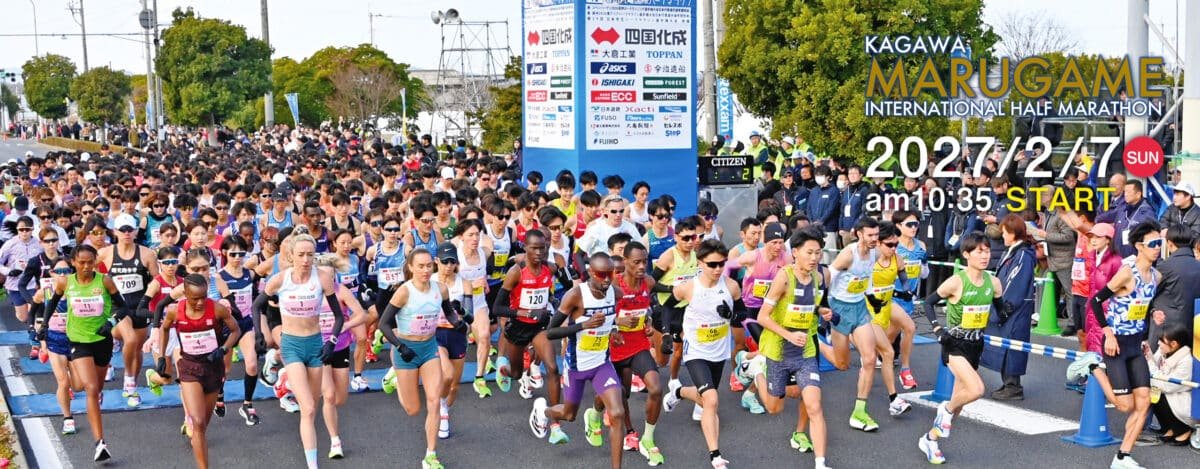
The Kagawa Marugame International Half Marathon is a cornerstone of Japan’s winter racing calendar and holds World Athletics Elite Label status, making it the first half marathon in Japan to earn this distinction. Held each year in the coastal city of Marugame in Kagawa Prefecture, the race is known globally as a super high speed course where world-leading times are produced. The current world-leading time of 60:00 was produced at Marugame, and recent editions have seen course records of 59:16 for men and 1:06:05 for women.
Expect a fast, flat, and fully certified experience. The AIMS-certified course is certified by both the Japan Association of Athletics Federations and World Athletics, beginning and ending at Pikara Stadium, which is officially Kagawa Prefectural Marugame Stadium. The route is largely linear, heading eastwards from the stadium before looping back to follow the same path towards the finish point inside the stadium. This out-and-back structure minimizes elevation change and allows for optimal pacing.
You can also expect deep competition. In addition to overseas invited players, a large number of top runners from business associations and university teams participate. The event routinely sees 200 men break 65 minutes, and features strong contingents of Japan-based African athletes alongside domestic stars. For general runners, a wave start system divides the start into three times to alleviate congestion. The atmosphere is supported by local residents who line streets near Marugame Castle and Seto Ohashi Bridge, plus live broadcast coverage and guest hospitality from legends of Japanese marathon running.
Enjoy Your Event Stress-Free with Japan Travelo
Do you know? Planning events, festivals, concerts, and cultural experiences in Japan can be overwhelming. Japan Travelo brings everything together in one place, helping you manage your itinerary, transport, and accommodation with ease—so you can enjoy Japan without the stress of planning.
Match/event dates
Event Dates: The next confirmed event is scheduled for February 7, 2027, as listed as the 78th edition and as Kagawa Marugame International Half Marathon 2027.
Expo and Bib Collection: Pre-event activities including bib pickup and race expo will be held on the day before the main race at Marugame Citizen’s Gymnasium and Pikara Stadium precinct.
Race Day: The main half marathon wave start is scheduled for 10:35 AM on February 7, 2027, with the 3km events starting separately. The event plan will go on rain or shine.
The official calendar entry notes the venue as Marugame Stadium, Marugame, with the date of February 7, 2027.
Visiting this event? Don’t miss out on these amazing activities and local experiences while you’re here.
Stadium & sports venue
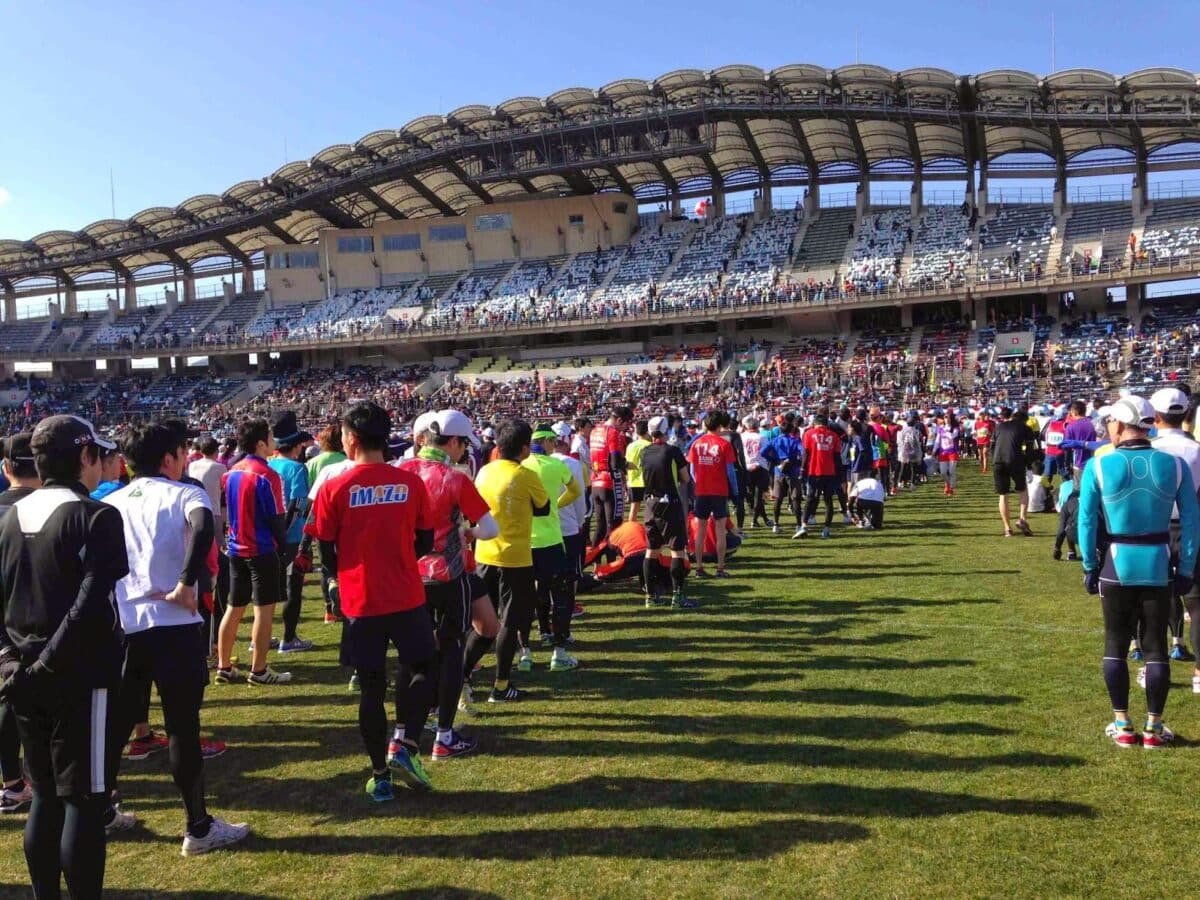
Primary Venue: Kagawa Prefectural Marugame Stadium, known as Pikara Stadium. Address listed as Marugame Citizen’s Gymnasium 924-1 Kanakura-cho, Marugame-shi, Kagawa Prefecture 763-0053. This stadium is the start and finishing point of the race.
Marugame Stadium is a full athletics stadium with a certified track that allows runners to finish on the track in front of grandstands. It offers changing facilities, warm-up areas, baggage storage, and medical support. The infield provides space for team tents and hospitality.
Secondary Venue: Marugame Citizen’s Gymnasium serves as the administrative center. The organizing committee operates from this location and handles inquiries via marugame-half@aroma.ocn.ne.jp.
Course Environment: The course itself goes through the streets of Sanuki, passing tourist attractions such as Marugame Castle, one of Japan’s twelve original castles, and offering views toward the Seto Ohashi Bridge. The course is attached to the stadium and is officially certified, eligible for national and world records.
Full fixture or event schedule
Pre-Race Schedule:
Morning Session: Organizing committee office opens at Marugame Citizen’s Gymnasium for elite accreditation, media check-in, and final course inspection.
Midday Session: General runner registration, bib collection, and participation prize distribution, which includes an original design T-shirt. Expo featuring running brands and local Kagawa products opens inside the gymnasium.
Afternoon Session: Course briefing in Japanese and English, technical meeting for invited athletes, and opening ceremony with guest speakers.
Race Day Schedule:
Early Morning: Venue opens for baggage drop, security screening, and warm-up on the outer fields of Pikara Stadium.
Late Morning Wave Start: Half marathon waves begin at 10:35 with three separate wave starts to manage the large field. This wave start system is a signature feature of Marugame to support personal best attempts.
Late Morning to Midday: 3km men’s and women’s races start separately around the stadium precinct. Elementary school Ekiden relay may be staged on the same day in some editions.
Midday to Early Afternoon: Elite finishers begin arriving inside Pikara Stadium, with live timing displayed on stadium screens. Final finishers close the course with a generous cut-off that supports personal record attempts.
Post-Race: Awards ceremony on the stadium podium, press conference with winners, and live broadcast on OHK Okayama Broadcasting and BS Fuji.
Teams, athletes & participants
The Kagawa Marugame International Half Marathon is renowned for assembling one of the deepest half marathon fields in the world.
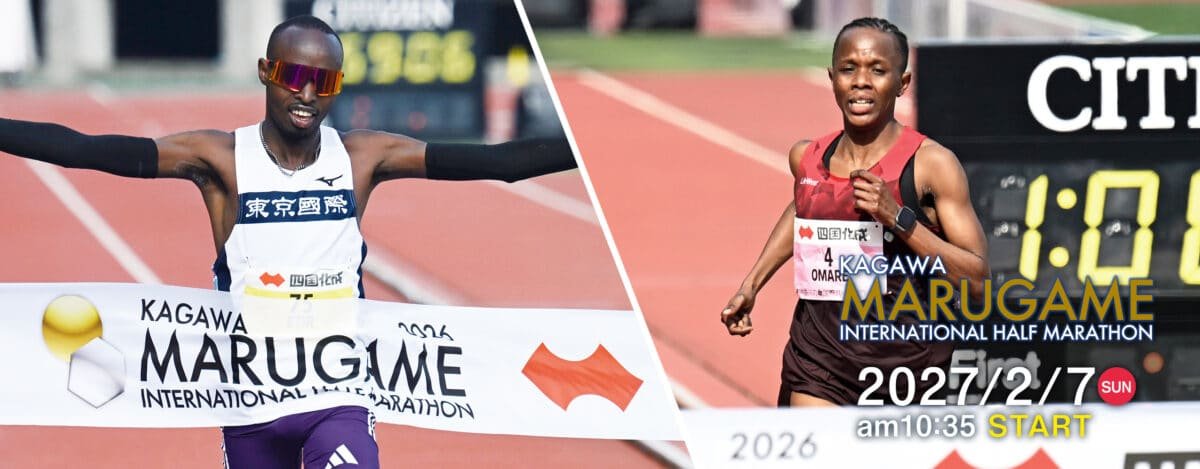
International Elite: Invited overseas athletes include World Athletics Label athletes from Kenya, Ethiopia, Great Britain, Australia, and Europe. Recent winners include Alexander Mutiso Munyao, the reigning London Marathon champion who broke the course record with 59:16 in 2025, and Dolphine Nyaboke Omare who broke the women’s course record with 1:06:05 for a second consecutive victory. Other notable past winners include Abdi Nageeye, Betsy Saina, and Callum Hawkins who ran 60:00 for a world-leading time at the 71st edition.
Japanese Elite and Corporate Teams: Top business association teams such as ND Software, Suzuki Hamamatsu AC, Logisteed, Sunbelx, and Teikyo University send large contingents. Recent highlights include Tomoki Ota becoming the first Japanese man to break one hour with 59:27 for third place, and Kotaro Shinohara breaking the Japanese collegiate record with 59:30.
General Field: Between 5,000 to 9,999 participants in recent editions, with 943 official participants in the elite divisions in 2020 but much larger general fields when including citizen runners. General runners are seeded into waves based on declared personal best to ensure smooth running.
Women’s Field Depth: The women’s race routinely features athletes under 1:07, with Isobel Batt-Doyle setting an Australian record of 1:07:17 in 2025, and Calli Hauger-Thacker running 1:06:58.
Tournament format & competition structure
Half Marathon Championship Format: The main race is an individual road race with chip timing and net and gun times recorded. The course is certified by JAAF and World Athletics and is eligible for national and world records. Rankings are by gun time for elite awards and net time for age-group awards.
Wave Start Structure: In order to alleviate course congestion, a wave start which divides the start into three times is adopted. Runners are assigned to Wave A, Wave B, or Wave C based on qualifying time. Each wave starts a few minutes apart but follows the same course.
3km Race Format: A separate short-distance race around Kagawa Prefecture Marugame Stadium. Men’s and women’s races start separately, run on a loop around Pikara Stadium, and are timed but not championship-ranked.
Ekiden Format: In some editions, an elementary school student Ekiden relay is included as a community event, run within the stadium precinct.
Awards Structure: Overall top ten men and women receive prize money and trophies. Age-group awards are given in five-year categories. Team awards are given for corporate and university teams based on combined times of top three finishers.
Match/event times
Stadium Opening: Pikara Stadium gates open early for warm-up and baggage check. The organizing committee recommends arrival at least ninety minutes before wave assignment.
Half Marathon Wave Start: The main half marathon is scheduled for 10:35 with Wave A, followed by Wave B and Wave C at intervals of several minutes. This late morning start allows for warmer temperatures compared to early morning races and is ideal for fast times.
3km Events: Start separately either the evening before or late morning on race day, depending on edition. These events are staged around Pikara Stadium and finish inside the stadium.
Cut-Off Time: The half marathon course remains open for three hours from the final wave start. Aid stations close progressively, and runners behind the cut-off vehicle are asked to move to the sidewalk.
Broadcast Window: Live broadcast coverage runs from 10:30 through to early afternoon on race day on regional and national networks.
Ticket types
All spectator access to Pikara Stadium stands and roadside viewing is free. Participation requires paid entry.
Half Marathon General Entry: Full price $37.00 USD. Based on previous entry fee of 5,500 yen. Includes original T-shirt, bib with timing chip, baggage service, insurance, finisher certificate, and access to post-race hospitality.
3km General Entry: Full price $30.00 USD. Based on previous entry fee of 4,500 yen. Includes T-shirt, bib, timing, and finisher gift. Open to general public and youth athletes.
Elementary School Ekiden Entry: Full price $14.00 USD. Based on previous entry fee of 2,000 yen per participant. Includes team bibs, participation prize, and certificate. Team entry required.
Pricing has been converted to USD from previous JPY editions listed on official materials. If pricing has not been announced for 2027, previous edition pricing will apply as above.
Ticket release phases
Phase One Early Application: The earliest entry window opens in late summer for invited athletes and corporate teams. Application period in 2019 was September 18 to November 22. Overseas invited athletes are contacted directly via marugame-half@aroma.ocn.ne.jp.
Phase Two General Lottery: General public entry for half marathon and 3km opens via RUNNET Japan at https://runnet.jp and via JTB Sports. Due to high demand as a World Athletics Elite Label race, general entries are selected by lottery when oversubscribed. Applicants receive results by email.
Phase Three Additional Sales: If capacity remains after lottery, first-come first-served sales are conducted until sold out. This phase often includes 3km and Ekiden categories.
Phase Four Final Instructions: Final race guide, bib numbers, and wave assignments are mailed and emailed to confirmed entrants approximately two weeks before race day. No race day entries or bib transfers are permitted.
VIP & hospitality options
Pikara Stadium Premium Seating: Full price $95.00 USD. Includes reserved seating in main grandstand, indoor lounge access, complimentary drinks, official program, and priority baggage service.
Elite Team Hospitality Tent: Full price $150.00 USD. For corporate team supporters and family of invited athletes. Includes access to heated tent area adjacent to finish line, live timing monitors, light meals featuring Sanuki udon, and meet area for athletes after doping control.
Guest Runner Experience: Full price $180.00 USD. Limited to guests associated with invited legends. Includes hospitality with guests such as Tetsuhiko Kin and Yuko Arimori, commemorative photo at Marugame Castle, and official event jacket.
Local Culture Package: Full price $120.00 USD. Includes guided tour of Marugame Castle, Marugame Uchiwa fan making workshop, and lunch featuring Kagawa’s famous Sanuki udon. Designed for international runners and family members.
All hospitality packages include priority entry to post-race party and English support.
Stadium & event rules
Eligibility: Half marathon is open to runners aged 18 and older with a qualifying time. 3km is open to general public including junior high school and older. Elementary Ekiden is limited to elementary school students.
Bib and Chip: Bib must be worn on front chest, visible and not folded. Timing chip must be returned after finish if reusable. Loss of chip incurs $20.00 USD replacement fee.
Course Rules: Run on left side, overtake on right. No headphones covering both ears in Wave A. No bicycles, strollers, pets, or personal hydration vehicles on course. Aid stations provide water, sports drink, and sponges at regular intervals.
Disqualification: Starting in wrong wave, receiving outside assistance, shortcutting course, or unsportsmanlike conduct will result in disqualification. The course is monitored by referees and cameras.
Weather Policy: Event will go on rain or shine. In case of severe weather warning, course may be shortened or canceled for safety. No refunds but deferral may be offered.
Media Consent: By entering, participants consent to use of photos, video, and results taken at Pikara Stadium and surrounding course for promotion and broadcast.
How to get there
Marugame City is located in Kagawa Prefecture on Shikoku Island, facing the Seto Inland Sea.
By Air: Takamatsu Airport is forty minutes by limousine bus to Marugame. Kansai International Airport is approximately two hours by train and bus via Okayama. From Tokyo, fly to Takamatsu with direct flights from Haneda.
By Train: JR Yosan Line serves Marugame Station. From Okayama, take Marine Liner rapid service across Seto Ohashi Bridge to Sakaide, then transfer to local train to Marugame. Travel time is about one hour from Okayama. From Tokyo, take Tokaido Shinkansen to Okayama then transfer.
From Station to Venue: Pikara Stadium is fifteen minutes by bus or taxi from JR Marugame Station. Free shuttle buses operate from Marugame Station and Marugame Castle area to Pikara Stadium on race morning.
Driving: Use Takamatsu Expressway to Marugame Interchange, then ten minutes to stadium. Private car parking is available at designated lots with shuttle service. Parking at stadium itself is prohibited for general runners.
Public transport & parking
Public Transport:
JR Shikoku: Frequent local trains connect Marugame with Takamatsu, Sakaide, and Kanonji. Special race day timetable adds extra services.
Community Bus: Marugame City community bus stops at Pikara Stadium, Marugame Castle, and City Hall. Day pass $4.00 USD.
Race Shuttles: Free shuttle buses run continuously from Marugame Station, Marugame Castle Otemon Plaza, and Botchan Shipyard parking to Pikara Stadium.
Parking:
Official Parking: Use Botchan Shipyard large parking lot and Marugame City Hall parking. Rate $5.00 USD per day with free shuttle to venue.
Restrictions: Roads around Pikara Stadium and the half marathon course are closed to traffic during race hours. Illegal parking will be towed. Follow police instructions.
Bicycle: Free bicycle parking available at stadium North Gate. Bicycle is an excellent way to move between viewing points along the linear out-and-back course.
Accommodation areas
Marugame City Center: Best for walkability to shuttles and castle sightseeing. Business hotels such as APA Hotel Marugame and Marugame Plaza Hotel offer rates around $65.00 USD per night. Includes easy access to Sanuki udon shops.
Pikara Stadium Vicinity: Hotels near Kanakura-cho are within ten minutes walk to start. Ideal for elite teams. Limited availability, early booking essential. Average $75.00 USD per night.
Takamatsu Area: Prefectural capital thirty minutes by train. Wider selection of hotels, international brands, and nightlife. Good base if combining race with tourism. Rates $80.00 USD to $130.00 USD per night.
Kotohira and Zentsuji Onsen Area: Traditional temple town and hot spring area twenty minutes by train. Ryokan with onsen baths ideal for pre-race relaxation and post-race recovery. Average $110.00 USD per night including breakfast.
Okayama Area: For travelers arriving via Shinkansen, Okayama offers many hotels and direct Marine Liner access to Marugame. Rates $70.00 USD per night.
Food & drink at the venue
Marugame is the home of Sanuki udon, and food is central to race weekend.
Stadium Concessions: Inside Pikara Stadium, vendors sell Sanuki udon, onigiri, yakitori, and sweets. Prices range $3.00 USD to $8.00 USD.
Aid Stations: Water and sports drink provided at frequent intervals along the linear course. Sponge stations and medical stations located at key points. At finish, bananas, sports drinks, and udon vouchers are provided.
Local Specialties: Marugame is famous for its fan-shaped Uchiwa production and Sanuki udon. Post-race, enjoy Honetsuki-dori grilled chicken, a local specialty. Vegetarian udon options available.
Drinks: Free tea and water in hospitality tents. Spectator area offers local Kagawa sake and craft beer for $5.00 USD. No alcohol in athlete competition area.
Sustainability: Runners are encouraged to bring personal reusable cups. Trash separation stations are provided at stadium.
Accessibility
The organizing committee aims to provide inclusive access.
Stadium Access: Pikara Stadium has barrier-free entrances, elevator access to grandstands, accessible restrooms, and priority viewing areas for wheelchair users.
Course Viewing: The linear out-and-back course along public roads is paved and flat, suitable for wheelchair spectators. Viewing at Marugame Castle and along Seto Ohashi Bridge approach has flat surfaces.
Athlete Support: Visually impaired runners may run with a guide runner at no extra cost. Guide must register separately. Wheelchair half marathon participation is limited due to course regulations but inquiries can be made via official email.
Communication: Japanese and English signage throughout venue. Information desk staffed with English-speaking volunteers. Hearing assistance available at main information desk.
Parking: Accessible parking spaces at Marugame Citizen’s Gymnasium and Botchan lot with accessible shuttle buses.
Best matches/events to attend
Men’s Elite Half Marathon: The headline event featuring sub-60 minute athletes. The linear course allows spectators to see leaders go out and return on same road. Best viewing inside Pikara Stadium for dramatic track finish, or at the turnaround point to see pace changes. The men’s race often features pacers taking field through 5km in 14:05 and 10km in 28:02.
Women’s Elite Half Marathon: Increasingly deep with course records broken recently. The women’s race started fast in 2025 with leaders on record pace from the start. Ideal for fans of competitive women’s distance running.
3km Community Race: Perfect for family members and youth athletes. Run around Pikara Stadium precinct, it offers a festival atmosphere and easy spectating.
Pre-Race Expo and Fan Meeting: Held at Marugame Citizen’s Gymnasium, featuring talks by guest runners and opportunities to purchase limited edition merchandise.
Post-Race Cultural Tour: Combine race with visit to Marugame Castle, one of twelve original castles, and Genichiro Japanese Uchiwa Museum. Both within shuttle distance.
Previous year’s highlights
The 77th edition delivered electrifying display of endurance and speed as top athletes from around the world delivered record-breaking performances on the fast and flat course.
Alexander Mutiso claimed the men’s title with a course record of 59:16, reclaiming the Elite Label title he had lost previously, just two months before defending his London Marathon title. He was followed by Emmanuel Maru with a personal best of 59:43, and Tomoki Ota who became the first Japanese man in history to go under one hour with 59:27 for third place. Kotaro Shinohara also broke the Japanese collegiate record with 59:30, making it one of the deepest Japanese half marathon results ever.
In the women’s race, Dolphine Nyaboke Omare started at a fast pace and broke her own course record with 1:06:05, achieving a second consecutive victory. She was followed by Great Britain’s Calli Hauger-Thacker in 1:06:58 and Australia’s Isobel Batt-Doyle who set a new Australian record of 1:07:17. The race conditions were described as best in history, with 15 hours of heavy rain that let up before start combined with cool mist and almost no wind.
Official tickets
All entries must be purchased through official channels to guarantee timing and insurance coverage.
Official Website: https://www.km-half.com/ – Japanese and English pages provide entry information, course maps, guest lists, and results. Contact via marugame-half@aroma.ocn.ne.jp or phone +81 877-24-6274.
Official Entry Platforms: RUNNET Japan at https://runnet.jp and JTB Sports entry system at https://jtbsports.jp. Both are listed as official booking sites.
Elite Entry: Invited and corporate team athletes enter via JAAF and organizing committee portal. Guest list is published at https://www.km-half.com/guest_list/.
Warning: Do not purchase bibs from resale sites or social media. Transferred bibs will be invalidated and removed from results. No race day registration is available. The tournament may be sold out early, as noted in past editions.
Video
Location
FAQ
Is Kagawa Marugame International Half Marathon suitable for first-time half marathon runners?
Yes, the course is known as a super high speed and flat course that is ideal for personal bests, with a linear out-and-back route that is easy to navigate. The wave start system divides the field into three starts to reduce congestion, so you can run at your own pace without crowding. Aid stations, medical support, and volunteer support are provided at regular intervals, and the finish inside Pikara Stadium offers a safe and inspiring conclusion with grandstand support for all runners regardless of finishing time.
How do I enter from overseas and is English support available?
International runners can enter via the English page at https://www.km-half.com/english/ and via JTB Sports which offers English support. The organizing committee responds to inquiries at marugame-half@aroma.ocn.ne.jp and can assist with entry procedures. On race weekend, the information desk at Marugame Citizen's Gymnasium is staffed with English-speaking volunteers, and course briefings include English summaries and pictograms. Results and certificates are available in English after the race.
What makes the Marugame course so fast?
The course is certified by both JAAF and World Athletics and is eligible for national and world records, with minimal elevation change and long straight sections. It begins and ends at Pikara Stadium, heading east before looping back on the same road, so runners benefit from shelter in the early kilometers and a slight tailwind often on return. The late morning start allows temperatures to rise slightly but remain cool, and pacers are provided for elite waves. These factors have produced performances such as 59:16 course records and multiple national records.
Can spectators watch easily and what is the best place to view?
Yes, spectating is free and easy due to the linear course design. You can see runners go out and return on the same road, effectively watching twice. The best places are inside Pikara Stadium for the start and dramatic track finish, near Marugame Castle for cultural backdrop, and at the turnaround point for close-up action. Free shuttle buses connect stadium, castle, and city center, and community buses run regularly. The stadium grandstand offers large screens with live timing.
What should I bring and what is prohibited on race day?
Bring your bib with timing chip, identification for verification, and weather-appropriate layers for cool coastal conditions. A disposable warm-up layer is useful before entering the start corral. Bring cash or IC card for food vendors selling Sanuki udon and local specialties. Do not bring pets, bicycles, strollers, glass bottles, or personal drones, as the area near the stadium and castle has flight restrictions. Headphones covering both ears are prohibited in Wave A for safety.

Leave a Reply