

-
October 8, 2026
Event date:
-
October 8, 2026
Event end:
What to expect in 2026
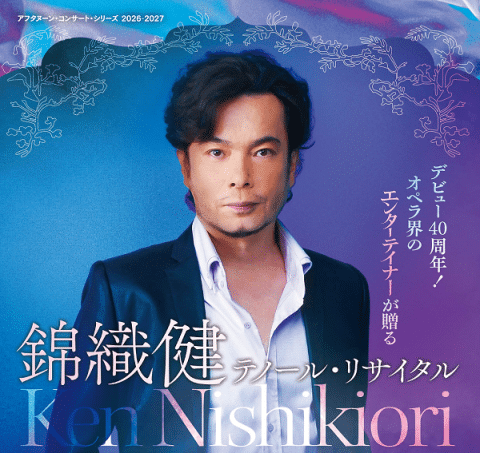
Ken Nishikori Tenor Recital 2026 celebrates 40 years since Ken Nishikiori made his professional debut as a singer. The special anniversary performance takes place on October 8, 2026, at Tokyo Opera City Concert Hall: Takemitsu Memorial in Tokyo as part of the Afternoon Concert Series 2026–2027.
The recital brings together Ken Nishikiori, one of Japan’s prominent tenors, and pianist Satoko Tada for an afternoon programme that moves across classical vocal music, Japanese songs, opera, anime music, crossover repertoire and popular music. The programme was described by Japan Arts as a unique form of musical variety, reflecting the breadth of Nishikiori’s career.
The programme has been updated from the originally announced selection. The final programme now begins with Handel’s music from Messiah and continues through Japanese songs by composers including Rentaro Taki, Kosaku Yamada, Toru Takemitsu and Ryoichi Hattori, operatic selections by Mozart, Rossini and Donizetti, music by Emmerich Kálmán and Domenico Modugno, the crossover favourite Time to Say Goodbye, and songs by Bixio and Queen.
Enjoy Your Event Stress-Free with Japan Travelo
Do you know? Planning events, festivals, concerts, and cultural experiences in Japan can be overwhelming. Japan Travelo brings everything together in one place, helping you manage your itinerary, transport, and accommodation with ease—so you can enjoy Japan without the stress of planning.
The concert is also a personal milestone for Nishikiori. In his message about the performance, he reflects on having continued his career as a singer for four decades and expresses gratitude toward the audiences, people and organisations that supported him throughout that journey. The recital therefore combines an anniversary celebration with a broad retrospective of the styles and repertoire that have shaped his performing career.
Event dates
Ken Nishikori Tenor Recital 2026 is a single-performance event.
- Date: Thursday, October 8, 2026
- Venue doors/opening: 12:50 PM
- Performance: 1:30 PM
- Scheduled ending: approximately 3:30 PM
- Duration: approximately 2 hours
- Series: Afternoon Concert Series 2026–2027
- Occasion: 40th Anniversary of Ken Nishikiori’s debut
Japan Arts lists the performance at 1:30 PM with doors opening at 12:50 PM and an expected end time of 3:30 PM.
Because there is only one Tokyo performance, visitors planning to attend should arrange their transport and seating in advance rather than relying on another date in the same city.
Visiting this event? Don’t miss out on these amazing activities and local experiences while you’re here.
Venue & festival site
The recital is held at Tokyo Opera City Concert Hall: Takemitsu Memorial, part of the Tokyo Opera City complex in Nishi-Shinjuku, Shinjuku-ku, Tokyo.
Venue: Tokyo Opera City Concert Hall: Takemitsu Memorial
Address: 3-20-2 Nishi-Shinjuku, Shinjuku-ku, Tokyo 163-1403, Japan
The concert hall is located on the third floor of Tokyo Opera City Tower and is specifically designed for classical music. The hall has a capacity of 1,632 seats and features a shoebox-style design intended to provide a rich acoustic environment.
The building is part of a larger cultural and commercial complex containing restaurants, shops and other arts facilities. Visitors arriving early can therefore combine the recital with lunch, coffee or time around the Tokyo Opera City complex before the performance.
The hall’s interior is particularly suited to vocal performance, with a large pipe organ forming a major visual feature of the concert hall. Its acoustic design is intended to support detailed musical expression, making the venue appropriate for a tenor-and-piano recital of this scale.
Full lineup
The 2026 recital features two performers.
Ken Nishikiori – Tenor
Ken Nishikiori is the featured vocalist and the central artist of the 40th-anniversary recital. He graduated from Kunitachi College of Music and completed the fifth class of the Agency for Cultural Affairs’ Opera Training Institute. He subsequently studied in Milan and Vienna and made his professional debut as Camille in The Merry Widow in 1986. His career has included opera performances, concerts, religious works and appearances outside traditional opera settings.
Satoko Tada – Piano
Satoko Tada accompanies Nishikiori on piano. A graduate of Tokyo University of the Arts, she has extensive experience supporting vocal performers and has worked with Nishikiori on more than 400 recital performances across Japan. Her role is particularly important in a programme that moves between opera, Japanese songs, anime music and popular repertoire.
Headliners & featured artists
Ken Nishikiori is the headline performer of the event, with the recital structured around his 40th anniversary as a professional singer. Rather than presenting a conventional opera production with a large cast, chorus and orchestra, the event places the tenor’s voice at the centre of an intimate concert format supported by piano.
The repertoire allows Nishikiori to demonstrate several sides of his performance style. The programme includes sacred and classical vocal music, Japanese art songs, opera arias, musical crossover pieces and internationally recognised popular songs. This broad selection reflects the variety of his career and is one of the defining features of the anniversary recital.
Satoko Tada is the only accompanying artist, providing the piano part throughout the recital. Her long professional collaboration with Nishikiori makes the performance a particularly established singer-pianist partnership rather than a one-off pairing.
Stages & performance areas
This is a seated recital rather than a multi-stage festival, so there are no separate festival stages or outdoor performance areas.
Main concert stage
The entire event takes place in the main auditorium of Tokyo Opera City Concert Hall. The hall contains 1,632 seats distributed across the first floor and upper balcony levels. The concert stage is designed for classical performance and provides the setting for Nishikiori’s tenor and Tada’s piano.
Audience seating
The seating arrangement includes the main first-floor area, second-floor balcony seating and third-floor balcony seating. The official seating information also identifies wheelchair spaces within the hall.
There is no separate VIP lounge, festival village or secondary stage associated with this recital.
Stage-by-stage schedule
Because Ken Nishikori Tenor Recital 2026 is a single-stage classical recital, the programme takes place entirely in the main concert hall.
12:50 PM – Doors open
Audience members can enter the venue from 12:50 PM. This gives visitors time to locate their seats, use the facilities and settle in before the performance.
1:30 PM – Recital begins
Ken Nishikiori and Satoko Tada begin the anniversary programme at 1:30 PM. The programme moves through several musical styles, starting with Handel and Japanese repertoire before progressing into opera, crossover works and popular music.
Approximately 3:30 PM – Scheduled conclusion
Japan Arts lists an expected end time of approximately 3:30 PM. Actual finishing time can vary slightly depending on performance flow and any programme adjustments.
Set times
There are no separate artist set times because this is a continuous recital rather than a festival.
- 12:50 PM: Doors open
- 1:30 PM: Ken Nishikiori and Satoko Tada begin
- Approximately 3:30 PM: Expected conclusion
The published programme is subject to possible changes, and Japan Arts specifically notes that individual pieces may be changed if necessary.
Ticket types
The official Japan Arts listing currently shows the Tokyo performance as a single reserved-seat ticket category.
General reserved seating: approximately $41.53
The current standard price is based on 6,500 Japanese yen converted at approximately 156.50 yen per US dollar, giving an indicative value of about $41.53. Exchange rates can change, so the final dollar equivalent may vary at the time of purchase.
Senior reserved seating: approximately $38.34
Japan Arts also lists a senior discount for visitors aged 65 or older on the day of the performance. The listed price converts to approximately $38.34 using the same reference exchange rate.
The official listing does not present separate SS, S, A, B, C, D and E prices for this concert; instead, the Tokyo performance is offered as general reserved seating.
VIP & premium options
There is no separately advertised VIP package for the Tokyo recital.
The closest premium-style option is simply choosing a preferred reserved seat within the concert hall. Because the hall has several seating levels and central and side sections, the exact experience depends on the seat selected during booking.
Japan Arts also promoted a limited three-concert Afternoon Concert Series package covering selected performances later in the series. The published package was approximately $95.85 for three concerts, with a senior version of approximately $89.46, based on the same reference exchange rate. This is a series package rather than a VIP upgrade specifically for the Nishikiori recital.
For this particular event, visitors primarily need to select the appropriate reserved seat rather than looking for backstage access, hospitality areas or VIP admission.
Event rules
Age restriction: Children who have not yet entered elementary school are not permitted to attend the performance.
Reserved seating: The event is presented as a reserved-seat concert, so visitors should sit in the seat specified on their ticket.
Ticket changes: Tokyo Opera City states that tickets generally cannot be changed or cancelled after reservation or purchase.
Programme changes: The published programme may be altered if circumstances require it. Japan Arts has specifically noted that individual pieces may change.
Resale: Commercial resale is prohibited. Ticket purchasers should use official sales channels rather than unauthorised resale services.
Arrival: As this is an afternoon recital, arriving before the scheduled 1:30 PM start is recommended, particularly for visitors unfamiliar with the Tokyo Opera City complex.
How to get there
Tokyo Opera City is conveniently connected to central Tokyo through Hatsudai Station.
The most straightforward route is the Keio New Line to Hatsudai Station. From Shinjuku, Hatsudai is the first station on the Keio New Line and the journey takes approximately two minutes. The Tokyo Opera City complex is connected directly to the station, making this the easiest option for most visitors.
Visitors should use Hatsudai Station’s East Exit and follow the underground connection toward Tokyo Opera City. The venue is located on the third floor of Tokyo Opera City Tower.
From Shinjuku: Take the Keio New Line from Shinjuku to Hatsudai.
From Shibuya: Bus services including Keio and Toei routes connect the Shibuya area with Tokyo Opera City and nearby stops.
By taxi: Tokyo Opera City is located at the intersection of Yamate-dori and Koshu Kaido Avenue, making it a straightforward destination for taxis.
Public transport & parking
Public transport is the simplest way to reach the recital because Tokyo Opera City is directly connected to Hatsudai Station.
Train: Keio New Line Hatsudai Station East Exit, with the venue reached within approximately five minutes on foot and connected to the station complex.
Bus: From Shibuya Station, visitors can use Keio or Toei bus services serving Tokyo Opera City or Tokyo Opera City South. From Shinjuku Station, bus services also operate toward the surrounding Hatsudai area.
Parking: Tokyo Opera City has a paid underground parking facility on B2. The facility operates from 7:00 AM to 11:30 PM, with standard parking charged at approximately $1.92 per 30 minutes based on the published rate and the September 2026 exchange rate.
Maximum daily rate: approximately $14.06 during the published operating period.
Concert Hall visitors can receive a parking discount equivalent to one hour of parking, approximately $3.83, subject to the venue’s conditions. The parking facility has a vehicle height limit of 2.1 metres.
Accommodation areas
Visitors travelling from outside Tokyo can stay in several convenient neighbourhoods around the venue.
Shinjuku: The most convenient major accommodation district for visitors who want extensive hotel choice, restaurants, shopping and direct rail access to Hatsudai.
Hatsudai: The closest area to the venue and a practical choice for visitors prioritising a short journey to the concert hall.
Yoyogi: A useful middle ground between Shinjuku and central Tokyo, with access to rail connections and a quieter atmosphere than the busiest parts of Shinjuku.
Shibuya: Suitable for visitors combining the recital with Tokyo sightseeing, shopping and nightlife. Bus connections also make the area practical for reaching Tokyo Opera City.
Nishi-Shinjuku: Particularly convenient for visitors who want to remain close to Tokyo Opera City while staying among the area’s major hotels and business facilities.
Food & drink
Tokyo Opera City is part of a large mixed-use complex with restaurants, cafés and shops, making it possible to plan a meal around the afternoon recital without travelling far from the venue.
For an early lunch, visitors can eat before entering the concert hall and then arrive in time for the 12:50 PM doors-open time. The complex also provides foyer buffet facilities associated with the concert hall.
Because the performance begins at 1:30 PM, visitors travelling directly from another part of Tokyo should allow enough time to reach the building, locate the concert hall on the third floor and complete any food or refreshment stop before taking their seats.
After the concert, the surrounding Nishi-Shinjuku and Shinjuku areas offer a much wider choice of Japanese, international and casual dining options.
Accessibility
Tokyo Opera City Concert Hall provides several accessibility facilities for visitors with mobility and other access requirements.
Wheelchair seating: The concert hall has eight wheelchair spaces on the first floor and two on the second floor. Visitors requiring wheelchair seating should communicate their needs to the event organiser when purchasing tickets.
Accessible toilets: The concert hall has accessible toilets on both the first and second floors.
Wheelchair rental: Wheelchairs can be borrowed for use inside the hall, subject to availability. Advance contact is recommended.
Assistance dogs: Guide dogs, assistance dogs and hearing dogs are permitted, with advance notification to the event organiser recommended.
Elevator: An elevator is available in the concert hall and priority is given to wheelchair users and visitors who need it because of mobility or age-related requirements.
Visitors who need specific seating or assistance should contact the organiser before attending so suitable arrangements can be confirmed.
Best days to attend
Because Ken Nishikori Tenor Recital 2026 is a single-performance event, there is only one opportunity to attend in Tokyo: Thursday, October 8, 2026.
Best and only performance: Thursday, October 8
The afternoon timing makes this performance particularly suitable for visitors who want to combine the recital with sightseeing in Shinjuku, Shibuya or central Tokyo later in the day.
The published schedule provides approximately 40 minutes between the venue opening at 12:50 PM and the 1:30 PM start. Visitors who want to explore Tokyo Opera City before the concert should arrive early enough to do so without rushing to their seats.
Previous year’s highlights
There was no directly comparable 2025 Tokyo Opera City edition identified in the official Japan Arts material for this anniversary recital. The 2026 performance is specifically presented as a 40th-anniversary event marking Nishikiori’s professional debut in 1986.
A useful recent reference is Nishikiori’s October 30, 2024 recital at Tokyo’s Tokyo Music Evening Yube. That programme included Mozart, Suppé, Rentaro Taki, Shoko Kinan, Masashi Sada, Chopin, Time to Say Goodbye, Ennio Morricone and Queen’s Bohemian Rhapsody, demonstrating the same broad movement between classical repertoire, Japanese songs and crossover music that characterises his 2026 anniversary programme.
The 2026 programme expands that variety considerably. The final selection includes Handel’s Messiah, Japanese songs, opera arias, anime music, Italian crossover repertoire and Queen, giving the anniversary recital a wider retrospective character.
Official tickets
Tickets are being sold through Japan Arts, Ticket Pia and other authorised ticketing channels. Japan Arts lists general sales from March 21, 2026, while the Japan Arts Pia online service lists the performance as available for purchase through October 8, subject to remaining availability.
Japan Arts: The official event page provides the latest performance information, programme, ticket information and purchasing options.
Ticket Pia: The supplied Ticket Pia event page can be used as an additional official ticketing route.
Tokyo Opera City Ticket Centre: The venue also lists its ticket centre as an authorised ticket source for performances at the complex.
Ticket availability can change as the performance approaches, so visitors should check the official ticketing page for the latest seat availability before travelling.
Location
FAQ
What makes Tokyo Opera City Concert Hall ideal for this anniversary tenor recital?
The hall features world-class acoustic engineering and a pyramid-shaped wood interior designed for pure sound distribution. This acoustic perfection allows every delicate art song and soaring high note to reach listeners without artificial enhancement.
Are children under school age permitted to attend Ken Nishikori's recital?
Children under school age are strictly prohibited from entering the concert hall to protect the performance atmosphere. This standard venue policy ensures that quiet art songs and spoken stage anecdotes remain free from disruptions.
How should international fans secure tickets for this Tokyo performance?
Overseas attendees can book tickets through major online Japanese ticketing services or specialized concierge platforms. Securing tickets well in advance is highly recommended given the artist's popularity and the significance of the 40th-anniversary milestone.
What special collaborative role does pianist Satoko Tada play in the concert?
Satoko Tada serves as an equal musical partner rather than a background accompanist throughout the evening. Her versatile touch and precise timing anchor the wide-ranging repertoire, spanning classical arias to modern crossover ballads.
Why is the recital program considered unusually eclectic for a classical tenor?
The playlist bridges centuries and genres by pairing traditional Japanese art songs and Italian opera with anime themes and rock. This adventurous selection highlights the singer's forty-year quest to break down stylistic barriers through song.
What is the recommended arrival time for patrons attending the event?
Concertgoers are strongly encouraged to arrive at least thirty minutes prior to the scheduled curtain time. Arriving early ensures smooth ticket checks, coat check services, and unhurried seating before late-entry restrictions are enforced.

Leave a Reply